Vaccination (AQA GCSE Biology): Revision Note

Exam code: 8461

Lára Marie McIvor

Written by: Lára Marie McIvor

Reviewed by: Dr Natalie Lawrence

Updated on

Loading video: 10.1.5 AQA GCSE Vaccination

Why vaccinate?

  • Vaccination will prevent illness in an individual by providing artificial immunity

  • Vaccination involves exposing an individual to the antigens of a pathogen in some form, triggering an immune response which results in the formation of memory cells which can make antibodies against it

  • If a vaccinated individual is infected with the pathogen, they can destroy it before they become infectious

  • Consequently, vaccines reduce the likelihood that an infected individual will spread the pathogen they have been vaccinated against to others

  • If a large number of the population are vaccinated, it is unlikely that an unvaccinated individual will become infected with the pathogen

  • This is the principle behind the idea of herd immunity

  • There are three main scenarios with vaccination:

    • There are no vaccinations and the disease spreads quickly

    • Some of the population are vaccinated and the disease spreads to fewer people

    • Most of the population are vaccinated and this prevents the spread

Diagram showing how vaccination levels affect disease spread, using coloured figures to compare no vaccination, partial vaccination, and widespread vaccination:

No one is vaccinated.
- Contagious disease spreads through the population.

Some of the population gets vaccinated.
- Contagious disease spreads through some of the population.

Most of the population gets vaccinated.
- Spread of contagious disease is contained.
Herd immunity protects the vulnerable that may not be able to have the vaccine

Use this image

Worldwide vaccination

  • The role of the WHO is to monitor global diseases: it tracks whether diseases are endemic, epidemic or pandemic

  • The importance of vaccines cannot be overstated:

    • The number of people with measles worldwide is increasing due to a drop in the vaccination rate globally

    • There was some controversy over the MMR vaccine in 1998 and the number of vaccinations dropped significantly after this

  • Vaccines have reduced drastically the cases of diseases worldwide

Vaccination statistics table

Disease

Pre-vaccination Cases Per Million, Per Year

Post-vaccination Cases Per Million, Per Year in 2006

Percentage Reduction (%)

Diphtheria

158 (1936-45)

0

100

Measles

3044 (1953-62)

0.2

99.99

Mumps

830 (1963-68)

22

97.4

Tetanus

4 (1947-49)

0.14

96.6

Smallpox

250 (1900-49)

0

100

Data source: ourworldindata.org/vaccination (opens in a new tab)

Advantages and disadvantages of vaccinations

Advantages:

  • Diseases that were once common are now fairly rare due to widespread vaccinations (for example polio, measles)

  • Epidemics can be prevented if a large number of the population are vaccinated

Disadvantages:

  • The vaccine doesn’t always give immunity

  • There can be side effects to the vaccine, for example swelling or a rash to more severe reactions such as seizures

How do vaccines work?

  • Vaccination involves introducing small quantities of dead or inactive forms of a pathogen into the body to stimulate the white blood cells to produce antibodies

  • If the same pathogen re-enters the body the white blood cells respond quickly to produce the correct antibodies, preventing infection

Diagram explaining vaccination: harmless pathogen injection, antigens trigger lymphocytes to make specific antibodies and memory cells for long-term immunity: 
1. Harmless pathogen injected
2. Antigens trigger an immune response. It can take days for a lymphocyte making complementary antibodies to be activated
3. Lymphocyte able to produce complementary antibodies multiplies, antibodies released
4. Memory cells (lasting years) are produced. If antigen is encountered again, antibodies are produced much faster
The process of long-term immunity by vaccination

Use this image

  • There are two types of immunity:

    • Active immunity that comes from the body creating antibodies to a disease either by exposure to the disease (natural) or by vaccination (artificial)

    • Passive immunity that comes from antibodies given from another organism, for example in breast milk

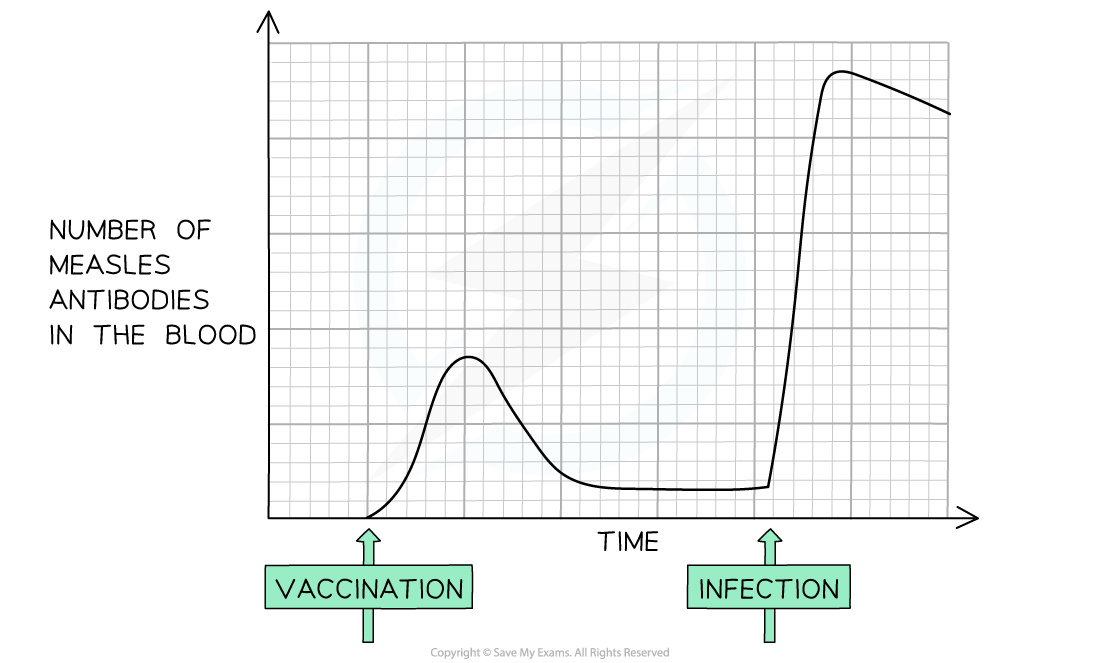
  • With the measles vaccine, for example, vaccination with a weakened form of the measles virus results in the production of antibodies and memory cells

  • When exposed to the virus naturally and infected, an individual can produce a higher concentration of antibodies much more quickly to destroy it

Graph of the effect of vaccination on antibody production

Graph showing measles antibody levels over time: small rise after vaccination, then low, followed by a rapid, higher increase after later infection.
The number of measles antibodies in the blood following vaccination and a subsequent infection

Use this image

Unlock more, it's free!

Join the 100,000+ Students that ❤️ Save My Exams

the (exam) results speak for themselves:

Build on this topic

Lára Marie McIvor

Author: Lára Marie McIvor

Expertise: Content Creator

Lára graduated from Oxford University in Biological Sciences and has now been a science tutor working in the UK for several years. Lára has a particular interest in the area of infectious disease and epidemiology, and enjoys creating original educational materials that develop confidence and facilitate learning.

Dr Natalie Lawrence

Reviewer: Dr Natalie Lawrence

Expertise: Content Writer

Natalie has a MCantab, Masters and PhD from the University of Cambridge and has tutored biosciences for 14 years. She has written two internationally-published nonfiction books, produced articles for academic journals and magazines, and spoken for TEDX and radio.