The Brain (AQA GCSE Biology): Revision Note
Exam code: 8461

The brain: Basics
The brain, alongside the spinal cord, is part of our central nervous system
The brain is made of billions of interconnected neurones and is responsible for controlling complex behaviours
Within the brain are different regions that carry out different functions
Structure of the brain
Scientists have discovered that different regions of the brain seem to be responsible for controlling different functions
These include the following regions:
The cerebral cortex:
is the outer layer of the brain, which is divided into two hemispheres
is highly folded
is responsible for higher-order processes such as intelligence, memory, consciousness and personality
The cerebellum:
is underneath the cerebral cortex
is responsible for balance, muscle coordination and movement
The medulla:
is the region which controls unconscious activities such as heart rate and breathing

Investigating the brain
Higher Tier Only
Studying the brain is very difficult; this is because:
the brain is very delicate, so can be damaged easily
the brain is highly complex; brain regions affect each other, so it is difficult to study parts of the brain in isolation
This limited understanding means that treating brain damage and disease is very difficult
Any potential treatment carries risks of further damage occurring
Accidental damage could lead to speech or motor issues, or changes to personality which are permanent
Mapping regions of the brain
Neuroscientists can map the regions of the brain to their functions by:
studying patients with brain damage
Patients with brain damage can be studied to determine the specific effects of damaging particular brain regions
The most famous example is Phineas Gage, a rail construction worker who survived an iron rod being driven through his head; this affected his peronality, indicating the brain region involved in determining behaviour
electrically stimulating different parts of the brain
Tiny electrodes can be pushed into different parts of the brain
Small jolts of electricity stimulate these regions and the effects can be observed
For example, if a region in the brain responsible for movement is stimulated, the movement caused can be observed
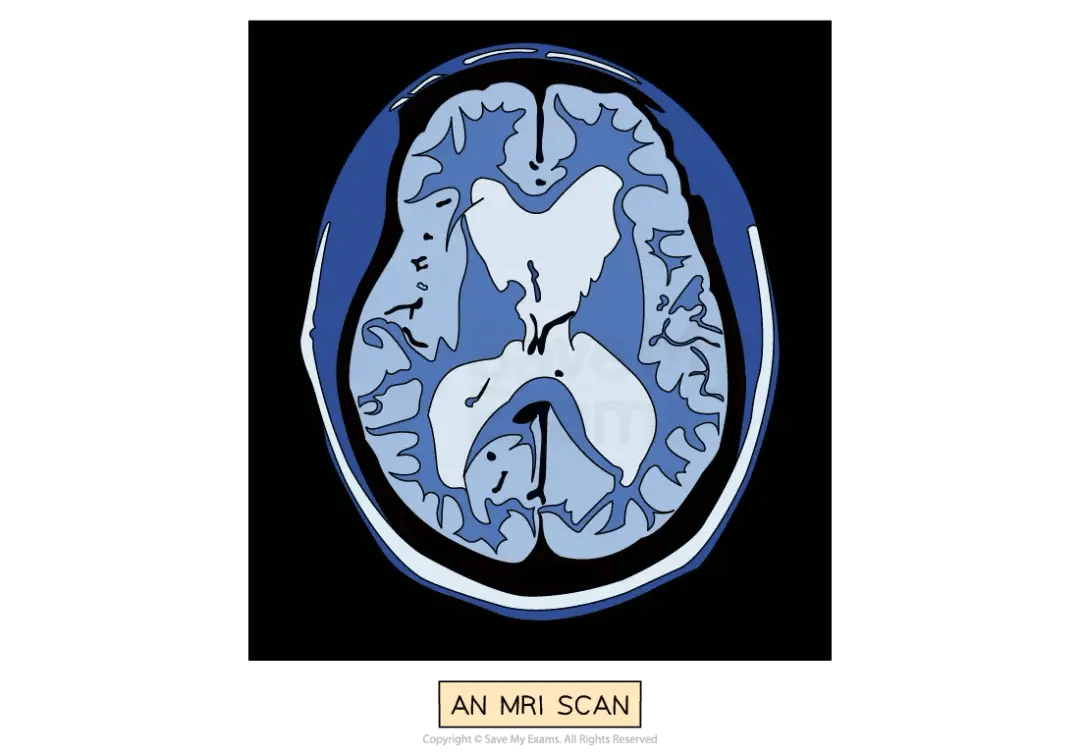
using MRI scanning techniques
MRI scanners produce detailed images of the brain
Traditional MRI scanners require patients to lie completely still
Functional MRIs can show which regions of the brain are active during different activities, e.g. listening to music or recalling a memory
Benefits and risks of brain investigations and procedures
Brain investigations
The benefits of brain investigations include:
scanning techniques are non-invasive, allowing the brain to be studied from outside the skull
fMRI scanners provide real-time information on brain regions and their function
scan images allow comparison of patient brains to those of healthy individuals; this aids in locating damage, tumours or disease
The risks of brain investigations include:
traditional MRI scanners require absolute stillness, which is not possible for everyone
the interior of MRI scanners can be claustrophobic and stressful
MRI machinery is very expensive to run
scanners only provide a diagnosis, and cannot provide treatment
Brain procedures
The benefits of brain procedures include:
physical procedures are the only way of treating some brain conditions, e.g. e.g. removing a tumour
electrical stimulation can be used to guide surgeons during a procedure
The risks of brain procedures include:
brain tissue is very difficult to access because of the skull
physical procedures risk causing damage to delicate brain tissue
physical procedures carry risk of infection or neurological side-effects

Unlock more, it's free!
Join the 100,000+ Students that ❤️ Save My Exams
the (exam) results speak for themselves:

Was this revision note helpful?
Build on this topic