Theory of Evolution (AQA GCSE Biology): Revision Note
Exam code: 8461

Darwin's theory of evolution by natural selection
Charles Darwin proposed the theory of evolution by natural selection; this was based on his:
observations on a round-the-world expedition
years of experimentation and discussion
developing knowledge of geology and fossils
The theory of natural selection states that:
individuals in a species show variation
We now know that this is caused by genetic differences
individuals with characteristics most suited to the environment have a higher chance of survival and more chances to reproduce
alleles that code for advantageous characteristics are passed to offspring at a higher rate than those that code for characteristics less suited to survival
over many generations these beneficial characteristics become more common in the population and it changes, or evolves
This idea of natural selection became known as survival of the fittest
Natural selection example: snails
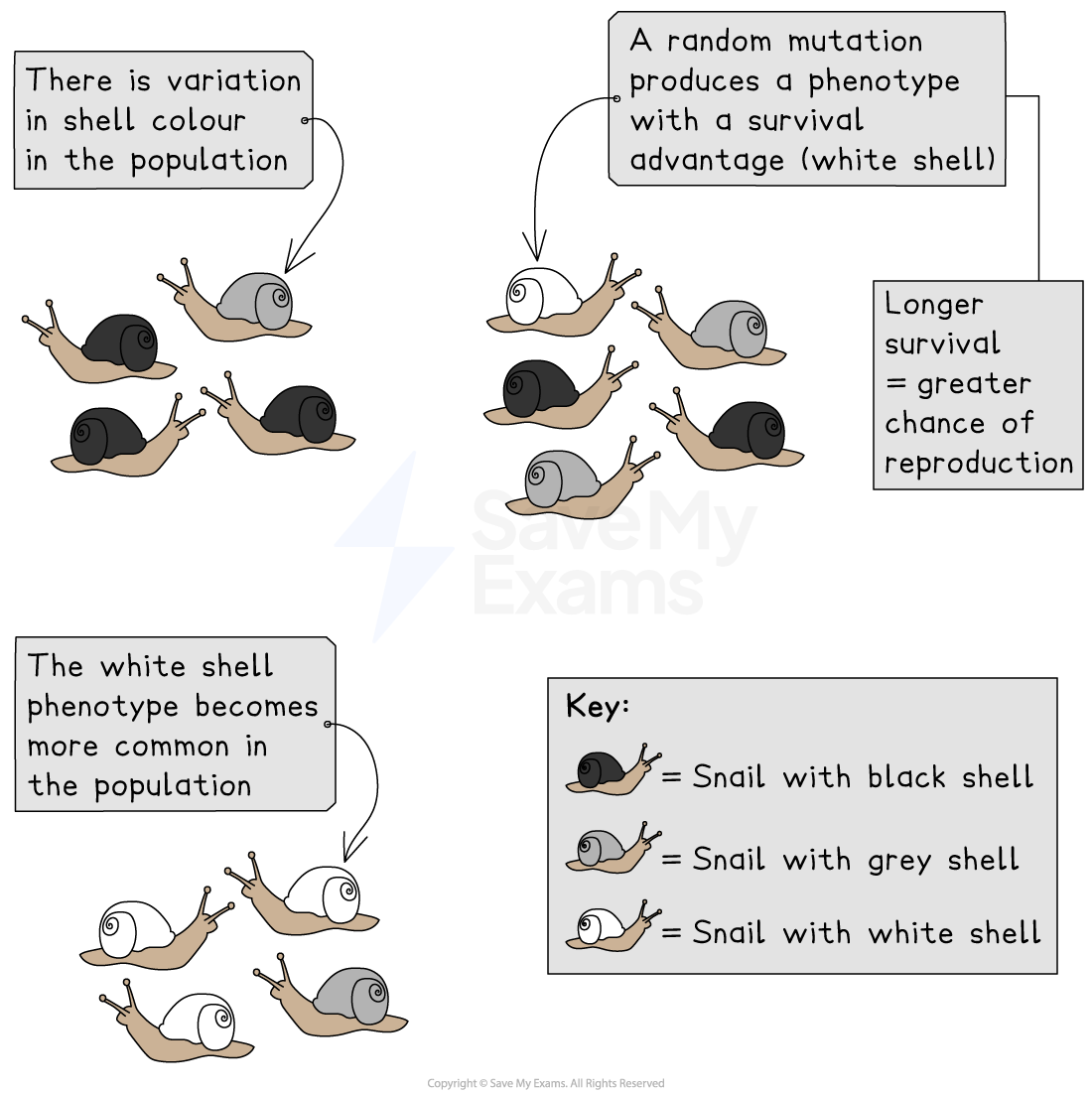
Within a population of snails there is variation in shell colour
Alleles in the population either code for grey or black colouring
Chance mutations result in a small number of snails having a white shell
The white shelled snails are more likely to survive because they are better camouflaged against pale rocks, and so they are less likely to be seen by predators and eaten
As they survive longer they are more likely to reproduce and so the allele for white shells is passed onto offspring more frequently than the alleles for black or grey shells
Over generations this is repeated until the majority of snails in the population have white shells
Natural selection example: peppered moth
Within a moth population, naturally occurring variation exists; some moths have alleles for dark colour, while some have alleles for light colour
Moths live on light-coloured tree bark, so natural selection favours light-coloured moths and there are more light individuals in the population
The light moths are camouflaged from predators
Over time, air pollution darkens the bark of trees and the dark-coloured moths are more likely to survive
The dark coloured moths are now more likely to reproduce and pass on their alleles for dark colour
The number of dark coloured moths in the population increases

Examiner Tips and Tricks
You could be asked to apply the process of natural selection to unfamiliar examples in an exam, so remember the following important principles:
Variation exists in a population due to mutation
Some individuals have advantageous alleles that increase their chance of survival
Surviving individuals are more likely to reproduce and pass on their alleles
Over time the advantageous alleles become more common in the population
Acceptance of evolution
Darwin published his ideas in his famous book, On the Origin of Species (1859)
The theory of evolution by natural selection was only gradually accepted because:
There was much controversy surrounding these revolutionary new ideas
The theory challenged the idea that God made all the animals and plants that live on Earth
There was insufficient evidence at the time the theory was published to convince many scientists
The mechanism of inheritance and variation was not known until 50 years after the theory was published
The theory of evolution by natural selection developed over time and from information gathered by many scientists
Lamarck's theory of evolution
Another theory of evolution, developed at the start of the 19th century (before Darwin announced his theory), was that of French scientist Jean-Baptiste Lamarck
Lamarck’s theory was based mainly on the idea that changes that occur in an organism during its lifetime can be inherited
His theory involved two main ideas:
a characteristic that is used frequently by an organism becomes better and stronger, whereas a characteristic that isn't used gradually disappears
the beneficial characteristics that are used frequently (and are improved as a result) are passed to offspring
For example, Lamarck suggested that:
Giraffes had a short-necked ancestor that would frequently stretch its neck to reach the high branches so it could feed on the leaves
This repeated stretching could very slowly elongate the giraffe's neck and that this would be passed to the giraffe’s offspring
Over time and many generations, the giraffe would evolve to have the very long neck it has today
It is now known that in the vast majority of cases this type of inheritance cannot occur and that Lamarck’s ideas were incorrect


Unlock more, it's free!
Join the 100,000+ Students that ❤️ Save My Exams
the (exam) results speak for themselves:

Was this revision note helpful?
Build on this topic