Fossils (AQA GCSE Biology): Revision Note
Exam code: 8461

How are fossils formed?
Fossils are the remains of organisms from millions of years ago, which are found in rocks
Fossils may be formed in several ways:
From parts of organisms that have not decayed because one or more of the conditions needed for decay are absent, e.g.:
In amber (fossilised tree resin) and tar pits a lack of oxygen and moisture means that decomposers cannot survive there to break down dead organisms
In glaciers and permafrost regions (areas that continuously remain frozen) it is too cold for decomposers to survive
Peat bogs are too acidic for decomposers to survive
When parts of the organism are replaced by minerals as they decay
The organism dies and is buried in sediment (e.g. sand, mud or silt) – not in rock. The soft parts decay, but hard parts such as teeth, shells and bones do not decay easily and are left behind
They are slowly replaced by minerals that form a rock-like substance in the same shape as the original body part
They can often be seen distinctly within the surrounding rock
As preserved traces of organisms, such as footprints, burrows and rootlet traces
An impression (e.g. from footprints) can be left in a soft material like clay
The impression becomes fixed as the clay hardens
Sometimes an organism may be buried in clay but decays after the clay has hardened, leaving a cast of the organism
Gaps in the fossil record
Many early forms of life were soft-bodied, which means that they have left few traces behind
Soft tissues often decay fully, leaving no trace in the fossil record
What traces there were have been mainly destroyed by geological activity
E.g. tectonic plate movements may have crushed fossils that had already formed
This is why scientists cannot be certain about how life began on Earth
Changing planet
Evidence for early life forms on Earth can be found in the fossil record
Fossils show how much or how little different species have changed as life developed on Earth
The development of species can be represented visually in an evolutionary tree diagram
Worked Example
The diagram below shows an evolutionary tree for several bear species.
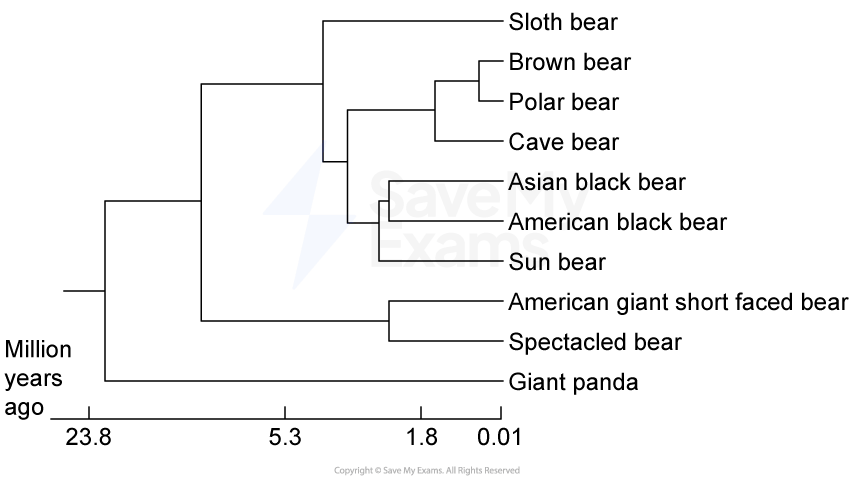
(a) Which two bear species diverged most recently?
(b) Which bear species shares the most recent common ancestor with the Asian black bear?
(c) Which bear is most distantly related to to the spectacled bear?
Answer (a)
A divergence of species occurs at a branch in the tree
The branches that split most recently are those that appear furthest to the right (see the time scale at the bottom of the diagram)
brown bear and polar bear
Answer (b)
Trace back from the Asian black bear to the first point where its branch joins another
The species on the other branch at that point shares the most recent common ancestor
American black bear
Answer (c)
The most distantly related bear can be seen by looking for the bear that is linked to the branch that diverged the longest time ago (i.e. the furthest to the left)
Don't be distracted by the bears that are nearest to, or furthest from, the spectacled bear in the diagram
Giant panda

Unlock more, it's free!
Join the 100,000+ Students that ❤️ Save My Exams
the (exam) results speak for themselves:

Was this revision note helpful?
Build on this topic