Enzymes & Metabolism (AQA GCSE Biology): Revision Note

Exam code: 8461

Enzymes & metabolism

  • Digestive enzymes work outside of cells; they digest large, insoluble food molecules into smaller, soluble molecules which can be absorbed into the bloodstream

  • Metabolism is the sum of all the reactions happening in a cell or organism, in which molecules are synthesised (made) or broken down

  • Enzymes are biological catalysts made from protein

    • Enzymes speed up chemical reactions in cells, allowing reactions to occur at much faster speeds than they would without enzymes at relatively low temperatures (such as human body temperature)

  • Substrates temporarily bind to the active site of an enzyme, which leads to a chemical reaction and the formation of a product(s) which are released

  • Enzymes remain unchanged at the end of a reaction, and they work very quickly

    • Some enzymes can process 100s or 1000s of substrates per second

Enzyme specificity diagram

Diagram showing a substrate molecule fitting the active site of enzyme 1 and not the active site of enzyme 2, illustrating complementary enzyme–substrate specificity
Enzymes are biological catalysts: enzyme-substrate collisions occur because all molecules are in random motion in a liquid

Use this image

Enzymes: How they work

  • Enzymes catalyse specific chemical reactions in living organisms – usually one enzyme catalyses one particular reaction:

Enzyme specificity of catalase to hydrogen peroxide diagram

Diagram showing how the enzyme catalase can bind to its substrate, hydrogen peroxide, as they are complementary in shape, whereas DNA polymerase is not.
The enzyme catalase can bind to its substrate hydrogen peroxide as they are complementary in shape, whereas DNA polymerase is not

Use this image

  • The specificity of an enzyme is a result of the complementary nature between the shape of the active site on the enzyme and its substrate(s)

  • Enzymes have specific three-dimensional shapes because they are formed from protein molecules

    • Proteins are formed from chains of amino acids held together by bonds

    • The order of amino acids determines the shape of an enzyme

    • If the order is altered, the resulting three-dimensional shape changes

The lock and key model

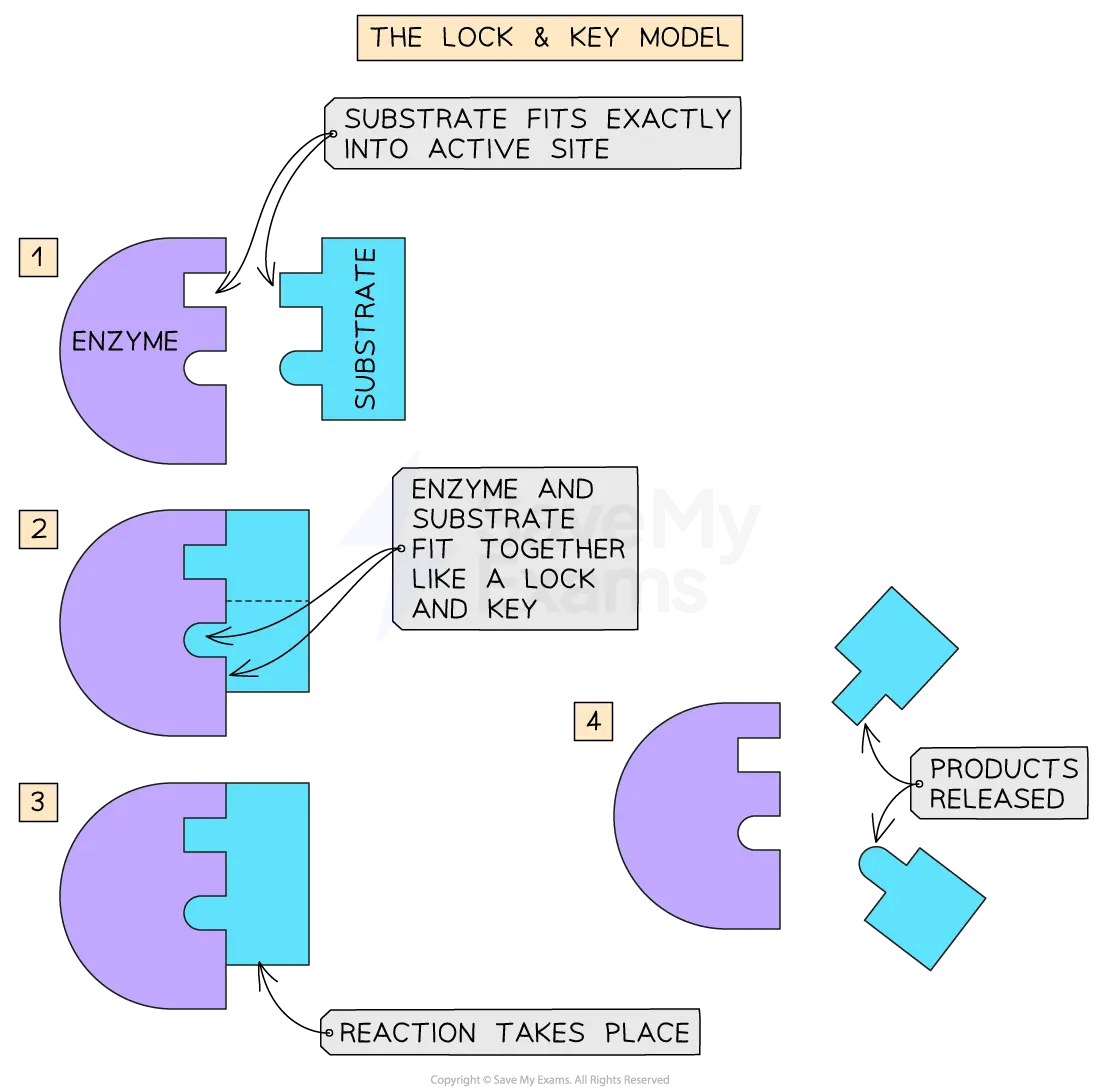
  • The ‘lock and key theory’ is one simplified model that is used to explain enzyme action

  • The enzyme is like a lock, with the substrate(s) the keys that can fit into the active site of the enzyme with the two being a perfect fit

Diagram showing the lock and key model in an enzyme controlled reaction: 
- A specific substrate fits enzyme 1 but not enzyme 2
- Enzyme 1 joins with the substrate molecule like a lock and key
- Substrate is turned into product forms products
-  Enzyme remains unchanged after reaction
The process of an enzyme controlled reaction in which the enzyme and specific substrate combine, allowing product formation and an unchanged enzyme after the reaction

Use this image

  1. Enzymes and substrates move about randomly in solution

  2. When an enzyme and its complementary substrate randomly collide – with the substrate fitting into the active site of the enzyme – an enzyme-substrate complex forms, and the reaction occurs

  3. A product (or products) forms from the substrate(s) which are then released from the active site. The enzyme is unchanged and will go on to catalyse further reactions
Effect of temperature and pH on enzyme activity

The effect of temperature

  • The specific shape of an enzyme is determined by the amino acids that make the enzyme

  • The three-dimensional shape of an enzyme is especially important around the active site area; this ensures that the enzyme’s substrate will fit into the active site enabling the reaction to proceed

  • Enzymes work fastest at their ‘optimum temperature’ – in the human body, the optimum temperature is around 37 °C

  • Heating to high temperatures (beyond the optimum) will start to break the bonds that hold the enzyme together – the enzyme will start to distort and lose its shape – this reduces the effectiveness of substrate binding to the active site reducing the activity of the enzyme

  • Eventually, the shape of the active site is lost completely and the enzyme is described as being ‘denatured’

    • Substrates cannot fit into denatured enzymes as the specific shape of their active site has been lost

Enzyme denaturation diagram

Diagram showing how increasing temperature breaks the bonds between the amino acids in an enzyme's unique structure, distorting its active site shape and preventing the substrate from fitting, causing denaturation
Denaturation is irreversible: once enzymes are denatured they cannot regain their original shape and activity will stop

Use this image

  • Increasing temperature from 0 °C to the optimum increases the activity of enzymes as the more energy the molecules have the faster they move and the number of collisions with the substrate molecules increases, leading to a faster rate of reaction

  • This means that low temperatures do not denature enzymes, but at lower temperatures with less kinetic energy both enzymes and their substrates collide at a lower rate

The effect of temperature on enzyme activity diagram


Graph showing rate of enzyme activity versus temperature.

At lower temperatures:
* there are fewer successful collisions
* enzymes + substrates have less kinetic energy
* therefore low enzyme activity and  less substrate turned into product

Increasing temperatures:
* More successful collisions
* Enzymes + substrates have more kinetic energy = more substrate turned into product

At temperatures above optimum:
* there are more collisions
* but active site being deformed by higher temperature
* = number of successful collisions decrease
* (Substrate + active site no longer complementary)
Higher temperature means more kinetic energy, which initially increases enzyme activity until enzymes begin to be denatured

Use this image

The effect of pH

  • The optimum pH for most enzymes is 7 but some that are produced in acidic conditions, such as the stomach, have a lower optimum pH (pH 2) and some that are produced in alkaline conditions, such as the duodenum, have a higher optimum pH (pH 8 or 9)

  • If the pH is too high or too low, the bonds that hold the amino acid chain together to make up the protein can be destroyed

  • This will change the shape of the active site, so the substrate can no longer fit into it, reducing the rate of activity

  • Moving too far away from the optimum pH will cause the enzyme to denature and activity will stop

Diagram showing how pH affects enzyme shape

Diagram showing that increasing pH far above optimum changes an enzyme’s active site from complementary to non‑complementary to its substrate
At pH far from optimum, then the shape of the enzyme is altered and it becomes less complementary to its substrate

Use this image

The effect of pH on enzyme activity diagram

Graph of enzyme activity against pH, showing a peak at optimum pH around 8–9 (depending on what enzyme and where it works in the body) and reduced activity at very low or very high pH due to denaturation and distortion of the active site
The effect of pH on the rate of activity of an enzyme from the duodenum

Use this image

Unlock more, it's free!

Join the 100,000+ Students that ❤️ Save My Exams

the (exam) results speak for themselves:

Build on this topic

Lára Marie McIvor

Author: Lára Marie McIvor

Expertise: Content Creator

Lára graduated from Oxford University in Biological Sciences and has now been a science tutor working in the UK for several years. Lára has a particular interest in the area of infectious disease and epidemiology, and enjoys creating original educational materials that develop confidence and facilitate learning.

Dr Natalie Lawrence

Reviewer: Dr Natalie Lawrence

Expertise: Content Writer

Natalie has a MCantab, Masters and PhD from the University of Cambridge and has tutored biosciences for 14 years. She has written two internationally-published nonfiction books, produced articles for academic journals and magazines, and spoken for TEDX and radio.