11 mark
The object at the centre of our Solar System is
A comet
The Earth
The Moon
The Sun
Was this exam question helpful?
Exam code: 4XSD1
The object at the centre of our Solar System is
A comet
The Earth
The Moon
The Sun
Was this exam question helpful?
The diagram shows four planets, P, Q, R and S, orbiting a star.

This combination of planets and a star is most like
A galaxy
The Milky Way
The Solar System
The Universe
Was this exam question helpful?
The diagram shows four planets, P, Q, R and S, orbiting a star.
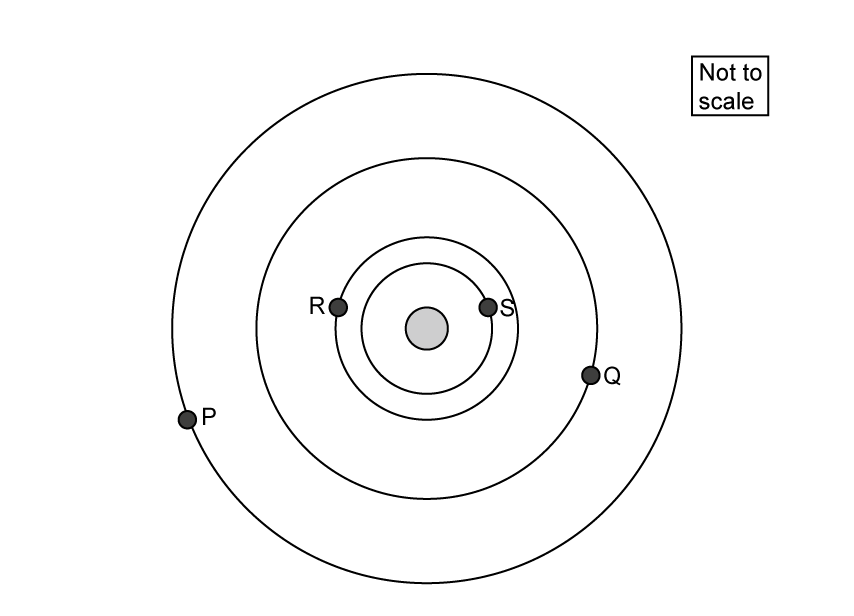
Planet Q has a moon.
On the diagram, draw the orbit of this moon.
On the diagram from part (a), draw the orbit of a comet.
Planets nearer to the star take less time to orbit the star.
Suggest why.
As the planets orbit the star, the distances between the planets change.
Planet P is 200 million km from the star and planet R is 50 million km from the star.
(i) Calculate the maximum distance between planet P and planet R.
[1]
maximum distance = ........................................... million km
(ii) Calculate the minimum distance between planet P and planet R.
[1]
maximum distance = ........................................... million km
Was this exam question helpful?
The Moon orbits the Earth.
State a difference between the orbit of a moon and the orbit of a planet.
The radius of the Moon’s orbit is 385 000 km.
It takes 27 days for the Moon to complete one orbit.
Calculate the orbital speed of the Moon.
Give a suitable unit.
orbital speed = ............................. unit .........................
Was this exam question helpful?
A comet passes close to the Earth. An astronomer observes the position of the comet and the Earth on the same day each week for several weeks.
The diagram shows her observations for weeks 1 to 11.

The observation showing the comet nearest to the Earth was made during
Week 7
Week 8
Week 9
Week 10
Was this exam question helpful?
Which list gives the astronomical objects in order of size, starting with the largest?
Galaxy - Solar System - planet - sun
Galaxy - Solar system - Sun - planet
Planet - galaxy - Solar System - Sun
Planet - Solar System - Sun - galaxy
Was this exam question helpful?
The diagram shows four planets, P, Q, R and S, orbiting a star.
Planet P makes one complete orbit.
During this time
Planet R makes more orbits than S
Planet R makes fewer orbits than Q
Planet S makes more orbits than P
Planet Q makes fewer orbits than P
Was this exam question helpful?
Planets and comets in our Solar System orbit the Sun.
Which force causes planets and comets to orbit the Sun?
The diagram [not to scale] shows the orbits of a planet and a comet around the Sun.
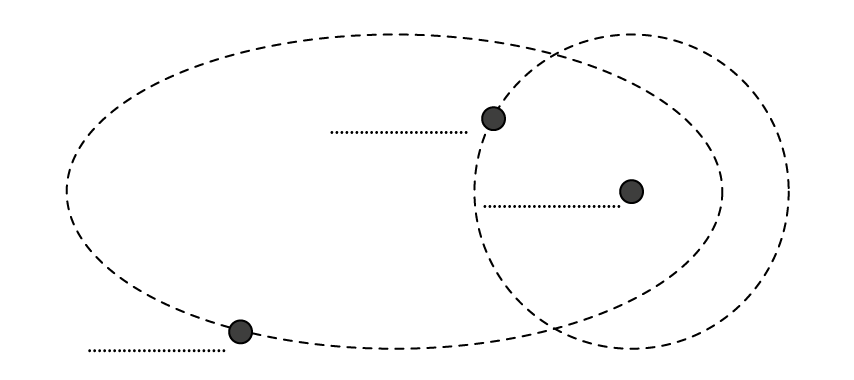
(i) On the diagram, label the planet, the comet and the Sun.
[1]
(ii) Explain why it is possible for a planet and a comet in our Solar System to collide.
[2]
Was this exam question helpful?
A comet passes close to the Earth. An astronomer observes the position of the comet and the Earth on the same day each week for several weeks.
The diagram shows her observations for weeks 1 to 11.
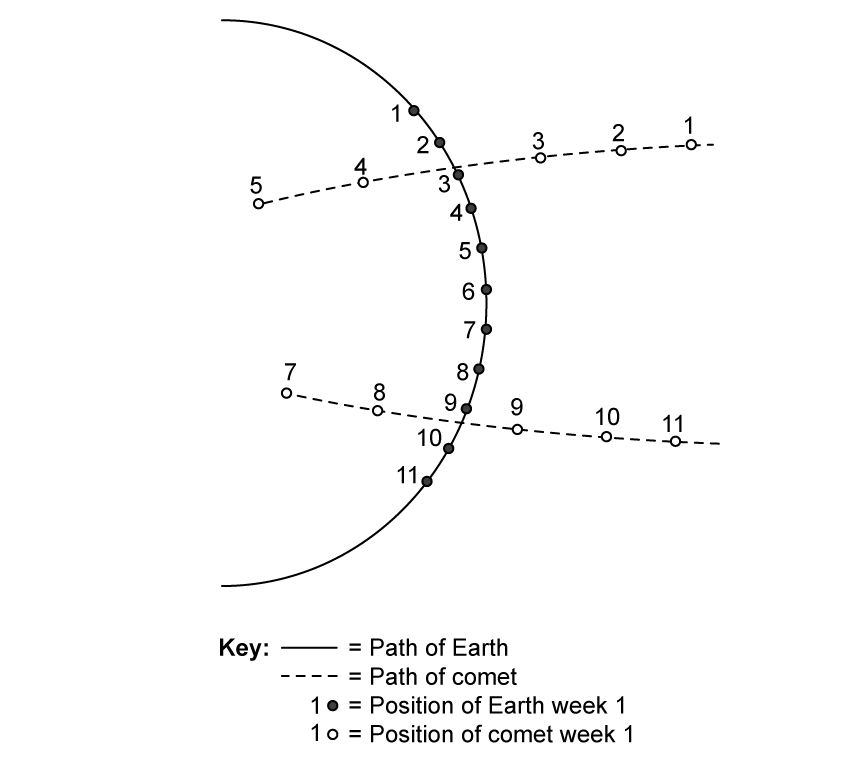
(i) Complete the path for the comet between week 5 and week 7.
[1]
(ii) Mark an X on the diagram to show the position of the Sun.
[1]
(iii) Suggest why the astronomer did not observe the comet during week 6.
[1]
(i) Explain how the diagram shows that the speed of the comet changes as it moves from position 1 to position 5.
[2]
(ii) Suggest why the speed of the comet changes.
[1]
The Earth orbits the Sun once in 365 days. The radius of the Earth’s orbit is 150 000 000 km.
Calculate the orbital speed of the Earth in kilometres per hour.
Was this exam question helpful?
These sentences are about astronomy.
The Earth is an astronomical object.
One astronomical object smaller than the Earth is ........................... .
Two astronomical objects larger than the Earth are ............................ and ............................ .
The Milky Way is the name given to our ............................ .
Complete the sentences by writing words in the blank spaces.
The diagram shows the path followed by a comet as it moves around the Sun.
A, B, C, D and E are points on the comet’s orbit.
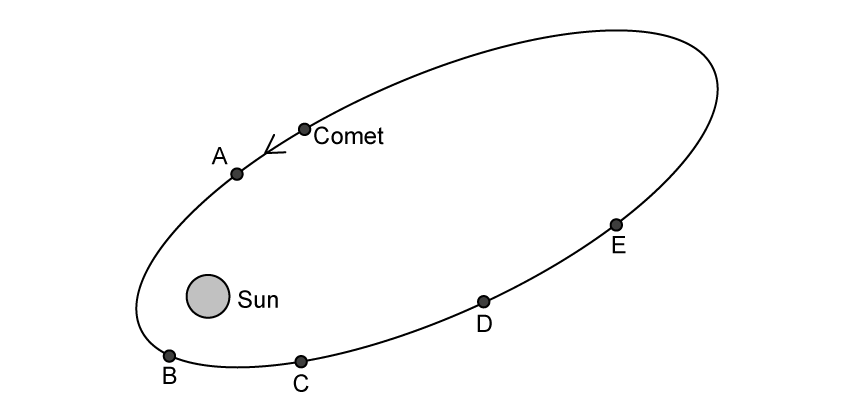
(i) State the name of the force that causes the comet to orbit the Sun.
[1]
(ii) At which of the points shown is the force on the comet greatest?
[1]
(iii) Draw an arrow at point D to show the direction of the force acting on the comet.
[1]
(iv) At which of the points shown does the comet have the greatest kinetic energy?
[1]
Was this exam question helpful?
The table shows some data about planets in our Solar System.

Use data from the table to answer these questions.
Which planet has about the same diameter as the Earth?
Jupiter has the largest gravitational field strength.
Suggest a reason for this.
(i) State the equation linking density, mass and volume.
[1]
(ii) Calculate the density of Neptune in kg/km3. You may assume that Neptune is a sphere and that its volume is given by
.
[3]
density = ............................................. kg /km3
Calculate the orbital speed of Earth in km / s.
orbital speed = .......................................... km / s
A student says:
'The smaller the planet, the shorter its period of orbit'
Use data from the table to evaluate this statement.
Was this exam question helpful?
The planet Mercury orbits the Sun.
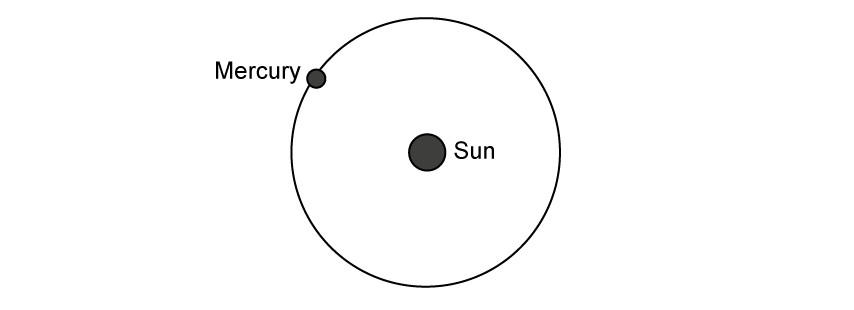
Mercury takes 88 days to orbit the Sun.
The average radius of the orbit is 58 million km.
Calculate the average orbital speed of Mercury. Give the unit.
Comets also orbit the Sun.
(i) Name the force that causes comets and planets to orbit the Sun.
[1]
(ii) Add to the diagram in part (a) to show the orbit of a typical comet.
[1]
The speed of a comet changes during its orbit.
(i) On the orbit you have drawn, label with the letter X the position where the comet travels at its fastest speed.
[1]
(ii) Explain why the comet travels fastest at point X.
[2]
Was this exam question helpful?
The Hubble Space Telescope is in orbit around the Earth. It detects visible light from distant objects.
Name the force that keeps the telescope in orbit around the Earth.
The Hubble Space Telescope moves in a circular orbit. Its distance above the Earth’s surface is 560 km.
The radius of the Earth is 6400 km and the Hubble Space Telescope completes one orbit in 96 minutes.
(i) Calculate the radius of the orbit of the Hubble Space Telescope.
[1]
Orbital radius = ........................ km
(ii) Calculate the Hubble Space Telescope's orbital speed in m/s.
[3]
Orbital speed = ........................ m/s
The Chandra Telescope also orbits the Earth, but does not move in a circular orbit.
Its distance from the Earth and its speed change as it orbits the Earth.
It travels fastest when it is closest to the Earth.
Use ideas about energy to explain why.
The Chandra Telescope detects X-rays from distant objects.
(i) State the name of the type of wave that includes X-rays and visible light.
[1]
(ii) Describe two differences between X-rays and visible light.
[2]
Was this exam question helpful?
The Astra satellite is in an orbit around the Earth. The satellite uses microwave signals for communication.
State one property of electromagnetic waves that makes microwaves suitable for communications with a satellite in space.
The Astra satellite takes 24 hours to orbit the Earth once. It travels at a speed of 3.1 km/s.
Calculate the orbital radius of the satellite and give the unit.
Orbital radius ........................ unit …........
Was this exam question helpful?
The Earth and Mars are planets in our Solar System.
(i) State two ways in which the orbits and Earth and Mars are similar
[2]
(ii) State one way in which the orbits of Earth and Mars are different
[1]
Deimos is a moon that orbits the planet Mars. The radius of its orbit is 23 500 km and its time period is 1.26 days.
Calculate the orbital speed of Deimos. Give your answer to 2 significant figures.
orbital speed = ................................ km / day
Enceladus is a moon that orbits the planet Saturn.
Enceladus has a similar orbital period to that of Deimos, but its orbital speed is about 10 times larger.
Explain how this is possible.
Was this exam question helpful?
Earth and Mars are planets in our Solar System.
The table shows some data for these planets.

Calculate the orbital speed of Mars in km / day.
speed = ...................................................... km / day
The distance between Earth and Mars varies between 100 million km and 400 million km.
Explain why this distance is not constant. You may draw a diagram to help your answer.
Visible light from Mars reaches the Earth.
The speed of light is 300 000 km / s.
Show that when the planets are 170 000 000 km apart, it takes about 600 s for light to travel this distance.
Scientists land a remote-controlled vehicle on Mars. The vehicle sends images back to Earth showing its surroundings on Mars. Sometimes these images show rocks ahead that could damage the vehicle.
A scientist on Earth sends radio signals that control this vehicle.
The speed of the vehicle is limited to 0.04 m/s.
Suggest why the speed is kept low.
Was this exam question helpful?
The table shows some data about planets in our Solar System.
Use data from the table to answer these questions.
Which planet has about the same diameter as the Earth?
Jupiter has the largest gravitational field strength.
Suggest a reason for this.
(i) State the equation linking density, mass and volume.
[1]
(ii) Calculate the density of Neptune in kg/km3. You may assume that Neptune is a sphere and that its volume is given by
[3]
density = ............................................. kg /km3
Calculate the orbital speed of Earth in km / s.
orbital speed = .......................................... km / s
A student says:
'The smaller the planet, the shorter its period of orbit'
Use data from the table to evaluate this statement.
Was this exam question helpful?