1.1 Solids, Liquids and Gases (Cambridge (CIE) O Level Chemistry): Flashcards
Exam code: 5070
1/240Still learning
Know0
- FrontKinetic Theory
In a solid, particles are held in an .......... arrangement and can only .......... about fixed positions.

Was this flashcard helpful?
Cards in this collection (24)
In a solid, particles are held in an .......... arrangement and can only .......... about fixed positions.
In a solid, particles are held in an ordered arrangement and can only vibrate about fixed positions.
True or False?
A liquid has a fixed volume and a fixed shape.
False.
A liquid has a fixed volume but does not have a fixed shape — it takes the shape of its container.
How do gas particles exert pressure on the walls of their container?
Gas particles exert pressure by colliding with the walls of their container. The force of these collisions creates pressure on the container walls.
True or False?
Liquids can be compressed into a smaller volume.
False.
Liquids cannot be compressed. Their particles are already close together with very little space between them.
Why do gases have a much lower density than solids or liquids?
Gases have a much lower density than solids or liquids because their particles are much further apart, with large spaces between them.
Particles in the .......... state have the highest kinetic energy and are completely free to move in all directions.
Particles in the gas state have the highest kinetic energy and are completely free to move in all directions.
Complete the table for the three states of matter:
State
Particle separation
Arrangement
Motion
Solid
Very close
Vibrate only
Liquid
Close
Random
Gas
Random
Move freely in all directions
State
Particle separation
Arrangement
Motion
Solid
Very close
Ordered
Vibrate only
Liquid
Close
Random
Flow / slide past each other
Gas
Far apart
Random
Move freely in all directions
Define kinetic theory.
Kinetic theory is the model that explains the properties of solids, liquids and gases in terms of the arrangement and motion of their particles, stating that all particles are in constant motion and that temperature is a measure of their average kinetic energy.
Evaporation occurs only at the .......... of a liquid and below its .......... point.
Evaporation occurs only at the surface of a liquid and below its boiling point. This distinguishes it from boiling.
True or False?
The temperature at which a pure substance freezes is the same as its melting point.
True.
The temperature at which a pure substance freezes is the same as its melting point. Freezing is the reverse of melting and always occurs at the same temperature.
What is the key difference between boiling and evaporation?
Boiling occurs at a specific temperature (the boiling point) throughout the liquid, forming bubbles. Evaporation occurs over a range of temperatures and only at the surface of the liquid.
What do the horizontal sections on a heating curve represent?
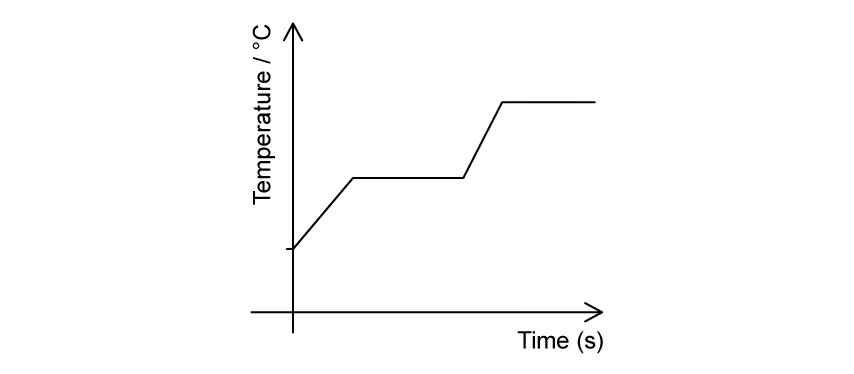
The horizontal sections represent changes of state. Temperature remains constant because the energy absorbed is used to overcome intermolecular forces, not to increase the kinetic energy of the particles.
Complete the table to describe particle behaviour when a solid melts:
Solid
Liquid
Separation
Closely packed
Arrangement
Random
Motion
Vibrate in fixed positions
Solid
Liquid
Separation
Closely packed
Close together
Arrangement
Ordered
Random
Motion
Vibrate in fixed positions
Move (slide) past each other
Define melting point.
Melting point is the specific temperature at which a solid changes into a liquid. It is the same as the temperature at which that substance freezes.
True or False?
Condensation is endothermic because gas particles lose energy as they cool.
False.
Condensation is exothermic. It is when gas particles lose energy as they cool, that energy is released to the surroundings as they form a liquid.
How does the average distance between particles change when a liquid freezes into a solid?
When a liquid freezes into a solid, the average distance between particles changes very little. The particles in both states are already close together.
Gas particles create .......... by hitting the inside walls of their container. More .......... collisions produce greater pressure.
Gas particles create pressure by hitting the inside walls of their container. More frequent collisions produce greater pressure.
True or False?
Increasing the temperature of a gas causes its volume to increase.
True.
Increasing the temperature of a gas causes its volume to increase as the particles gain kinetic energy, move faster, and spread further apart.
Why does the pressure of a gas decrease when its temperature is lowered?
When the temperature of a gas is lowered, its pressure decreases because particles lose kinetic energy and move more slowly, colliding with the container walls less frequently and with less force.
True or False?
Increasing the temperature of a gas in a sealed, rigid container causes its volume to increase.
False.
In a sealed, rigid container, the volume cannot change. Increasing the temperature causes the pressure to increase instead.
What effect does increasing the pressure on a gas have on its particles?
Increasing the pressure on a gas forces the particles closer together, reducing the distance between them and decreasing the volume of the gas.
True or False?
Gas particles move in random directions inside a container.
True.
Gas particles move in random directions inside a container.
When a gas is heated, particles gain .......... energy and move faster, causing the .......... between particles to increase.
When a gas is heated, particles gain kinetic energy and move faster, causing the distance between particles to increase.
What happens to the mass of a gas when it is heated?
The mass of a gas does not change when it is heated. Only its kinetic energy and volume increase.
Sign up to unlock flashcards
or