1.2 Diffusion (Cambridge (CIE) O Level Chemistry): Flashcards
Exam code: 5070
1/80Still learning
Know0
- FrontDiffusion
Define diffusion.

Was this flashcard helpful?
Cards in this collection (8)
Define diffusion.
Diffusion is the process by which different gases or liquids mix due to the random motion of their particles. Particles move from an area of high concentration to an area of low concentration until the concentration is even throughout.
Gaseous particles have more .......... energy than liquid particles at the same temperature, so they move .......... and diffuse more rapidly.
Gaseous particles have more kinetic energy than liquid particles at the same temperature, so they move faster and diffuse more rapidly.
True or False?
Diffusion is a spontaneous process and requires no energy input.
True.
Diffusion is a spontaneous process driven by the random motion of particles and requires no energy input.
Why does diffusion occur faster at higher temperatures?
At higher temperatures, particles have more kinetic energy and move faster, so they mix more rapidly.
At the same temperature, a gas with a .......... relative molecular mass diffuses faster, because its particles move at .......... average speeds.
At the same temperature, a gas with a lower relative molecular mass diffuses faster, because its particles move at higher average speeds.
True or False?
At the same temperature, all gases diffuse at the same rate.
False.
At the same temperature, different gases diffuse at different rates. Gases with a lower relative molecular mass diffuse faster.
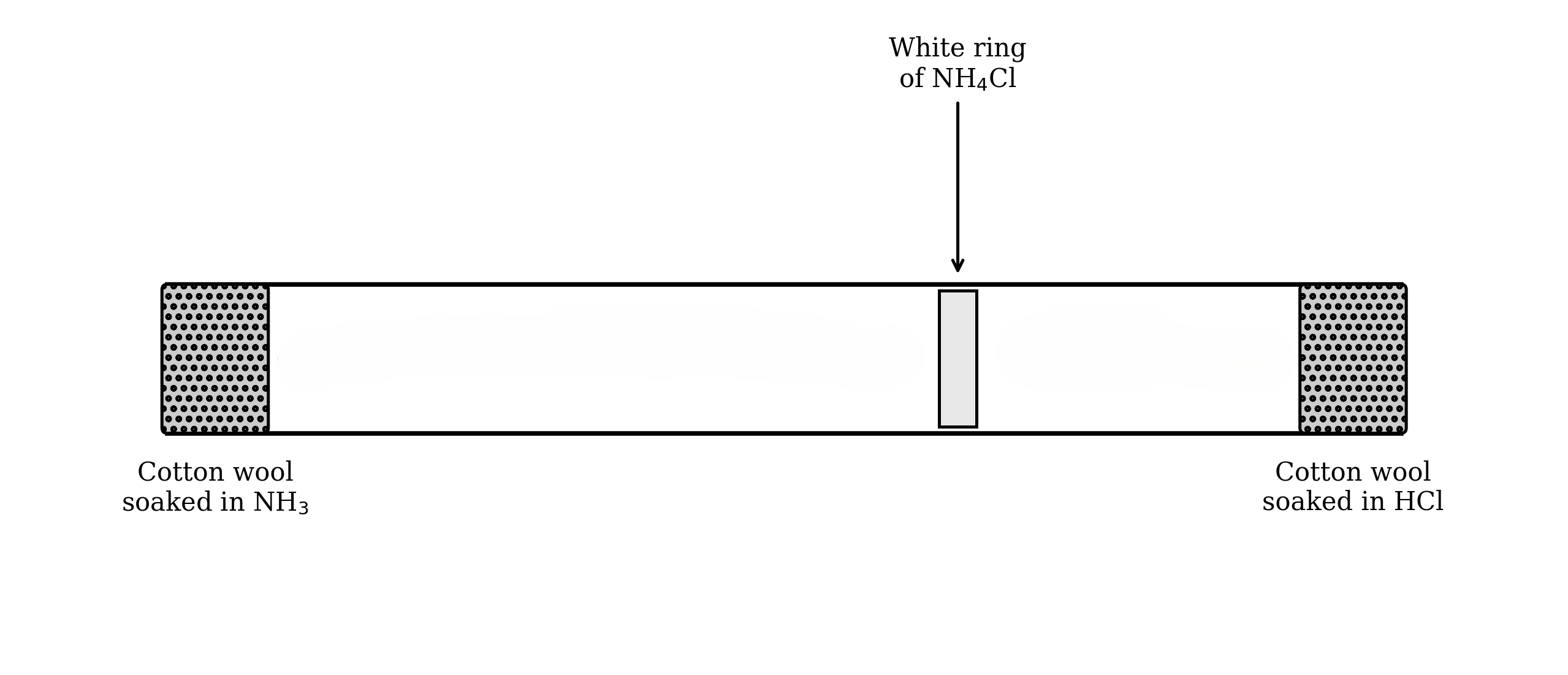
Why does the white ring of NH4Cl form closer to the HCl end of the tube?
Ammonia (Mr = 17) has a lower relative molecular mass than hydrogen chloride (Mr = 36.5), so it diffuses faster and travels further along the tube before the two gases meet.
True or False?
A gas with higher chemical reactivity will diffuse faster than a less reactive gas.
False.
The rate of diffusion depends on relative molecular mass, not chemical reactivity. At the same temperature, a gas with a lower relative molecular mass diffuses faster.
Sign up to unlock flashcards
or