Properties of Ellipses (Edexcel A Level Further Maths: Further Pure 1): Revision Note

Exam code: 9FM0

Mark Curtis

Written by: Mark Curtis

Updated on

Properties of ellipses

What is an ellipse?

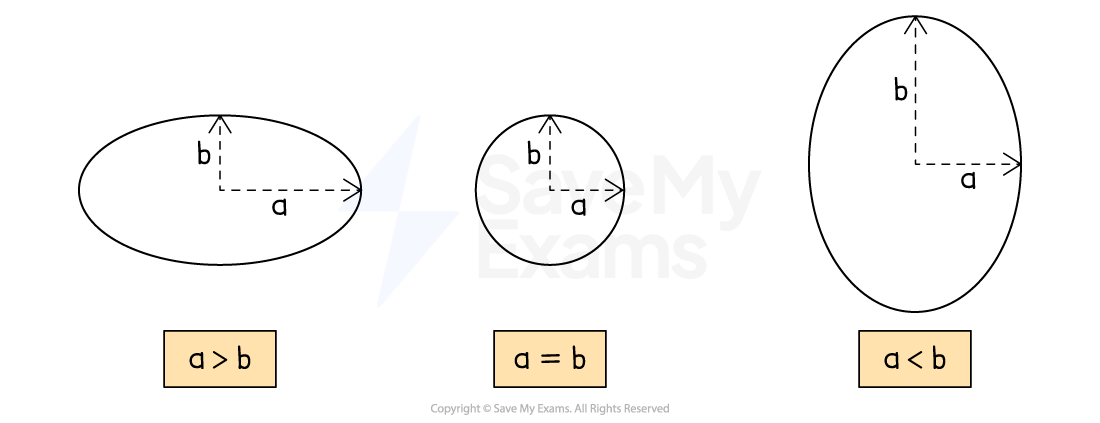
  • An ellipse is a stretched circle

    • a is its horizontal half length

    • b is its vertical half length

Three shapes: a horizontal ellipse with a greater width than height labelled 'a > b,' a circle labeled 'a = b,' and a vertical ellipse labelled 'a < b.'
  • If a>b

    • the major axis is axa

      • of length 2a

    • the minor axis is byb

      • of length 2b

    • 0xa is called a semi-major axis

      • of length a

    • 0yb is called a semi-minor axis

      • of length b

Diagram of an ellipse showing major axis as 2a, minor axis as 2b, semi-major axis as a, semi-minor axis as b, with a greater than b.
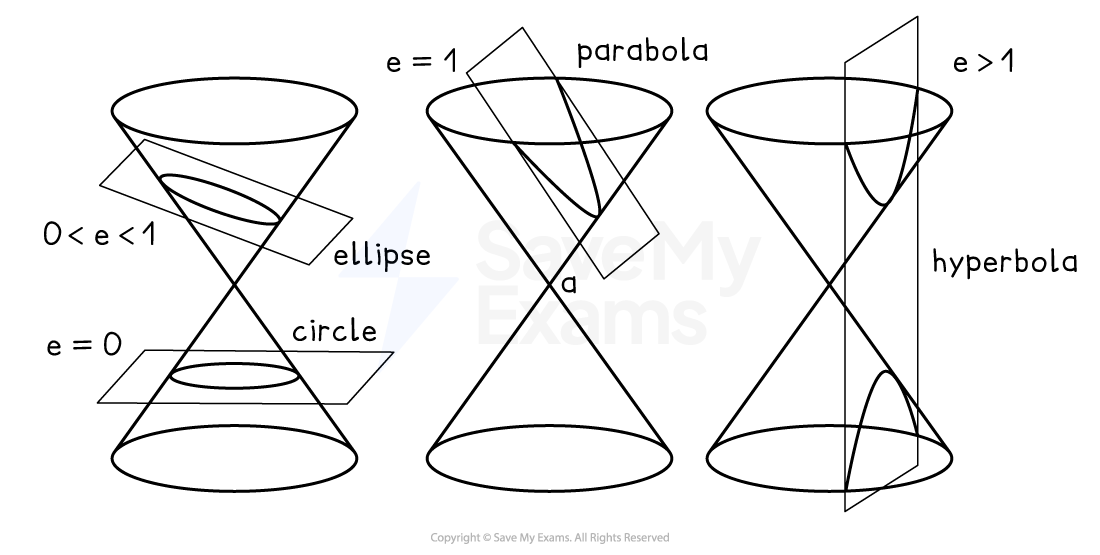
  • An ellipse is one of the conic curves

    • with eccentricity 0e<1

    • A circle is an ellipse with e=0

Diagram of conic sections showing circles, ellipses, parabolas, and hyperbolas formed by intersecting a plane with cones.
Examples of conic sections

What is the equation of an ellipse?

  • The Cartesian equation of an ellipse with its centre at the origin

    • is x2a2+y2b2=1

    • where

      • axa

      • byb

  • The parametric equations of an ellipse

    • are

      • x=acosθ

      • y=bsinθ

    • where 0θ<2π

  • Eliminating the parameter, θ, gives the Cartesian equation x2a2+y2b2=1

    • using that cos2θ+sin2θ1

Examiner Tips and Tricks

You are given the Cartesian and parametric equations of an ellipse in the formulae booklet.

What are the coordinates of a general point on an ellipse?

  • A general point P on the ellipse x2a2+y2b2=1 has coordinates given by its parametric equations, P(acosθ, bsinθ)

Diagram of an ellipse with equation x^2/a^2 + y^2/b^2 = 1; axes labelled from -a to a horizontally and -b to b vertically with a general point P with coordinates (a cost, b sin t).
  • e.g. P(3cosθ, 2sinθ) is a general point on the ellipse x29+y24=1

    • It satisfies the equation of the curve

    • It moves around the curve depending on the value of θ

  • This is different to, say, (3, 0)

    • which is a fixed point on the ellipse x29+y24=1

What is the eccentricity, focus and directrix of an ellipse?

  • The eccentricity of an ellipse, e, where 0e<1, is a measure of how stretched the ellipse is

    • e=0 gives a perfect circle

    • e1 gets flatter and flatter

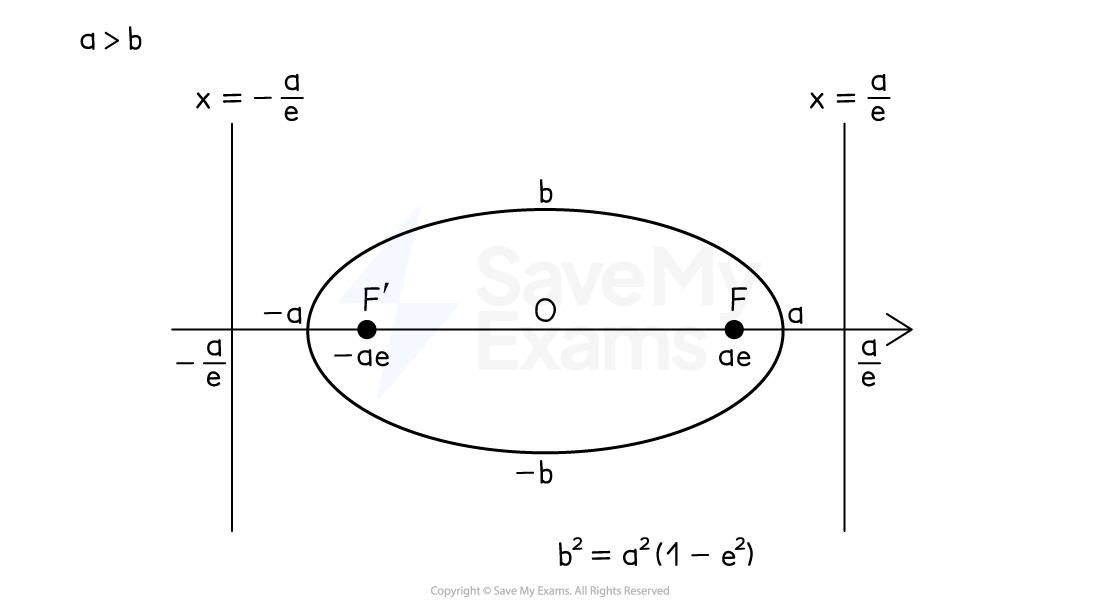
  • If a>b

    • the eccentricity is found be rearranging the following formula

      • b2=a2(1e2)

    • the foci, F and F', are two symmetric points inside the ellipse on the major axis

      • with coordinates (±ae, 0)

    • the directrices are the two vertical lines positioned symmetrically outside of the ellipse

      • with equations x=±ae

Diagram of an ellipse where a>b with foci F(ae, 0) and F'(-ae,0), centre O, semi-major axis a, semi-minor axis b, and eccentricity given by b^2=a^2(1-e^2). Two vertical lines (directrices) are at x=-a/e and x=a/e.
Example of an ellipse with its foci and directrices when a>b

Examiner Tips and Tricks

You are given the eccentricity formula, foci and directrices of an ellipse in the formulae booklet.

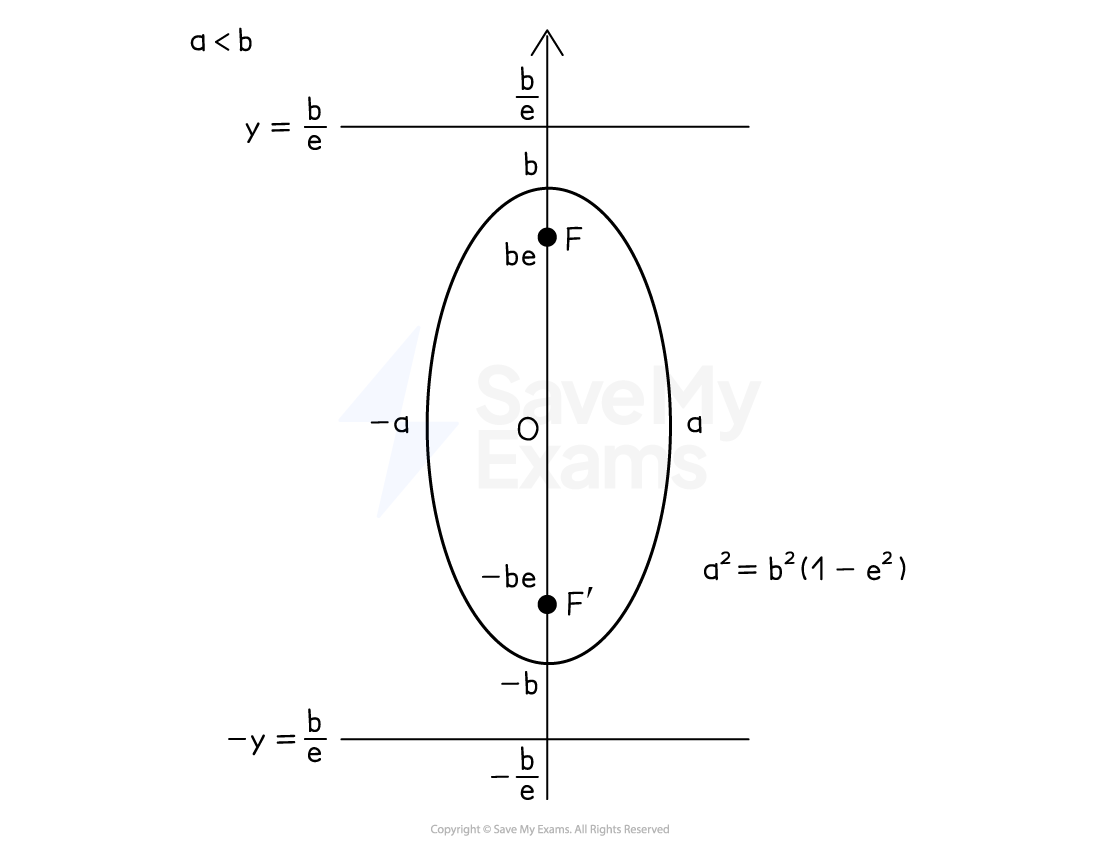
  • If a<b

    • the eccentricity is found be rearranging the following formula

      • a2=b2(1e2)

    • the foci, F and F', are the symmetric points on the major axis

      • with coordinates (0, ±be)

    • the directrices are the two symmetric horizontal lines

      • with equations y=±be

Diagram of an ellipse where a<b with foci F(0, be) and F'(0. -be), centre O, semi-major axis b, semi-minor axis a, and eccentricity given by a^2=b^2(1-e^2). Two horizontal lines (directrices) are at y=-b/e and y=b/e.
Example of an ellipse with its foci and directrices when a<b

Examiner Tips and Tricks

You are not given any formulae for the a<b case, but you can work them out by swapping 'horizontal to vertical' and ' a to b'.

Worked Example

An ellipse has the equation x225+y216=1.

(a) Calculate the coordinates of the foci.

(b) Calculate the equations of the directrices.

Answer:

(a)

Find a and b by comparing to the general equation x2a2+y2b2=1

a=5b=4

Check that a>b

5>4

Rearrange the relationship b2=a2(1e2) to find e

  • and check that 0e<1

42=52(1e2)1625=1e2e2=11625e2=925e=35

Calculate the foci using (±ae, 0)

(±5×35, 0)

The foci have coordinates (±3, 0)

(b)

Calculate the equations of the directrices using x=±ae

x=±5(35)

The directrices have equations x=±253

What is the focus-directrix property of an ellipse?

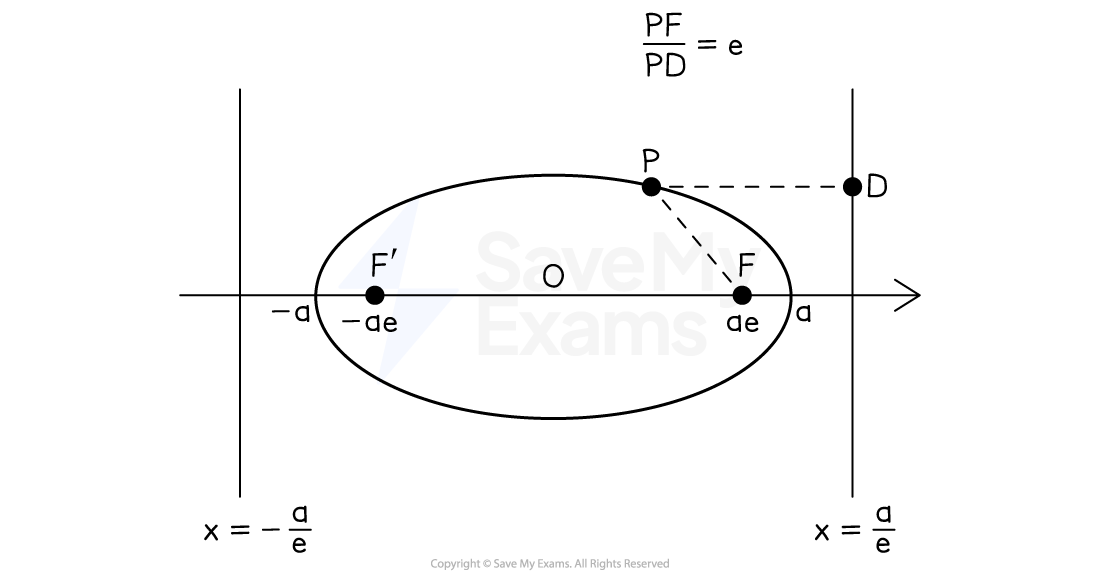
  • The focus-directrix property says that, if you take any point P on an ellipse, then

    • the distance from P to the focus, F

    • divided by the shortest distance from P to the directrix (at point D)

    • is always equal to e, the eccentricity

    • i.e. PFPD=e

      • sometimes rearranged to PF=ePD

The focus-directrix property showing a general point P, the length PF from P to the focus at (ae, 0) and the length PD which is a horizontal distance from P to the directrix x=a/e. The formula is PF/PD = e.
  • The focus-directrix property works from P to the other focus, F', and directrix, D'

    • PF'PD'=e

      • where e is the same eccentricity

Examiner Tips and Tricks

You are not given the focus-directrix property in the exam (you must learn it).

Worked Example

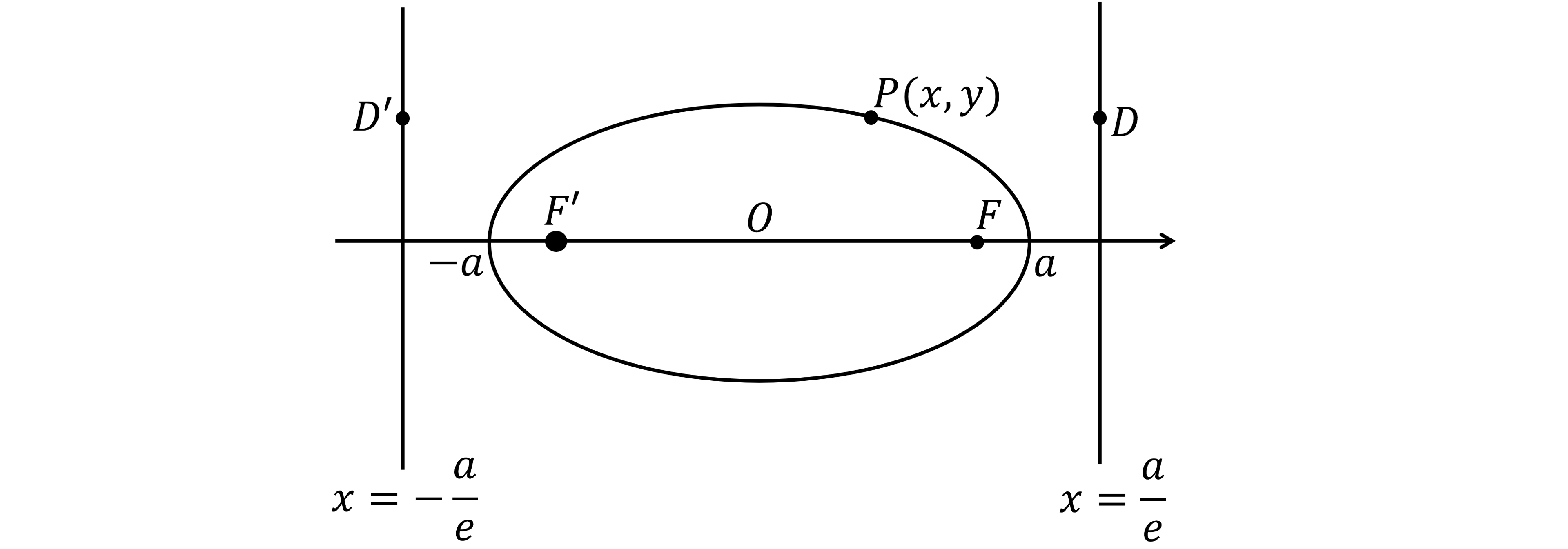
An ellipse with foci F and F' and directrices x=±ae is shown below.

The point P on the ellipse has coordinates (x, y) and the points D and D' are on the directrices, at the same height as P.

An ellipse between -a and a with the foci F and F' shown and vertical lines at x=-a/e and x=a/e. The point P lies on the ellipse in the first quadrant and has coordinates (x, y). The points D and D' are on the directrices at the same vertical height as P.

Using only the focus-directrix property,

(a) prove that PF'+PF=2a

(b) derive the Cartesian equation of an ellipse, x2a2+y2b2=1, where b2=a2(1e2)

Answer:

(a)

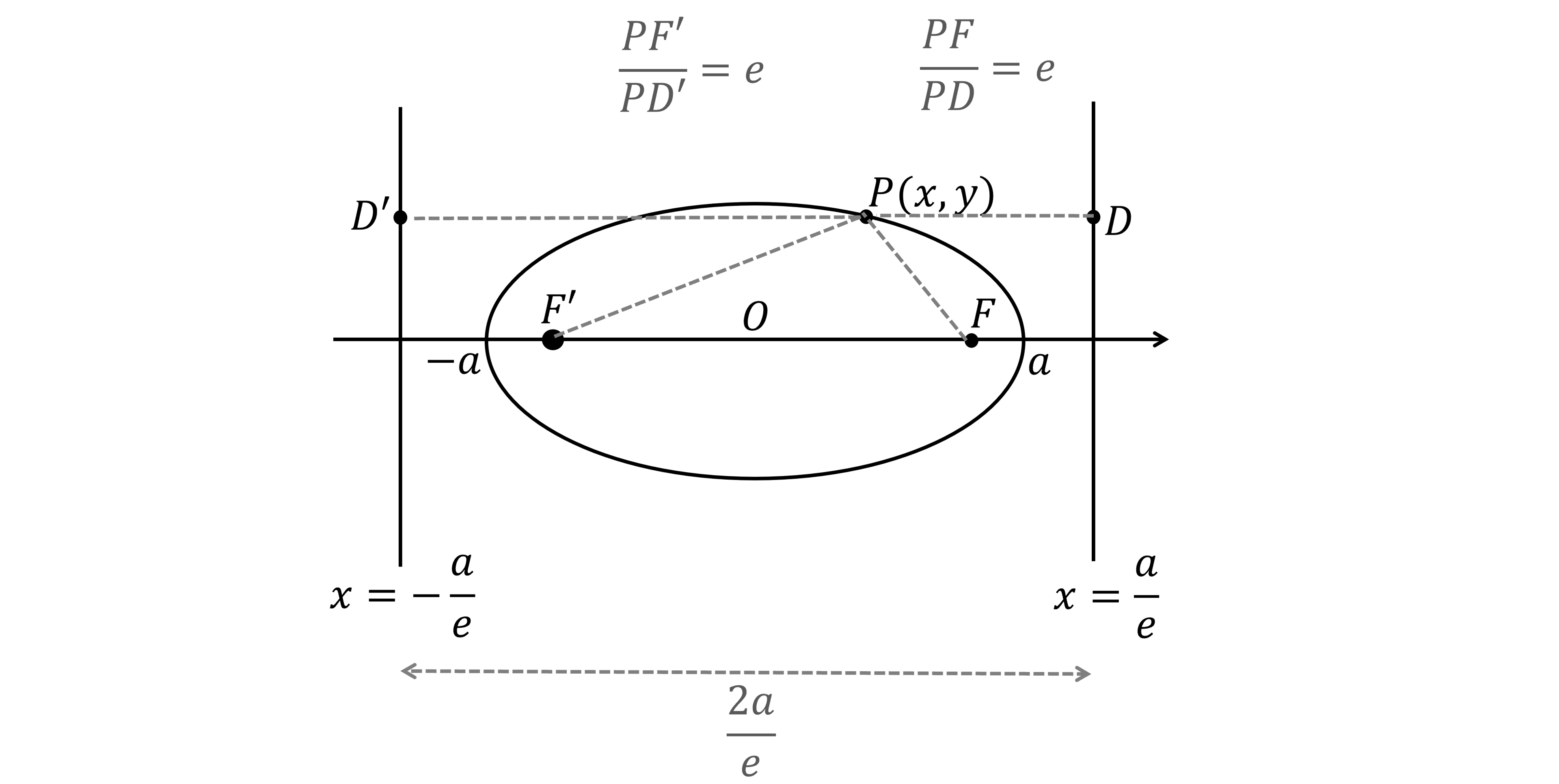
Use the focus-directrix property on P, F' and D' and again on P, F and D

PF'PD'=e  and  PFPD=e

An ellipse with foci F, F' and directrices x=a/e and x=-a/e. The point P(x,y) is on the ellipse and the points  D and D' are on the directrices at the same height. The lines PF, PF', PD and PD' are shown. Two formulas are shown: PF'/PD'=e and PF/PD=e. The total distance between the directrices is 2a/e.

Rearrange to make PF' and PF the subjects

PF'=ePD'  and  PF=ePD

Add together PF' and PF

PF'+PF=ePD'+ePD

Factorise out e

PF'+PF=e(PD'+PD)

Use that PD'+PD is the total distance between the two directrices x=±ae

PD'+PD=ae(ae)=2ae

Substitute this back into PF'+PF

PF'+PF=e(2ae)

Simplify

PF'+PF=2a

(b)

Use the focus-directrix property on P, F and D (draw on lines PF and PD)

PFPD=e

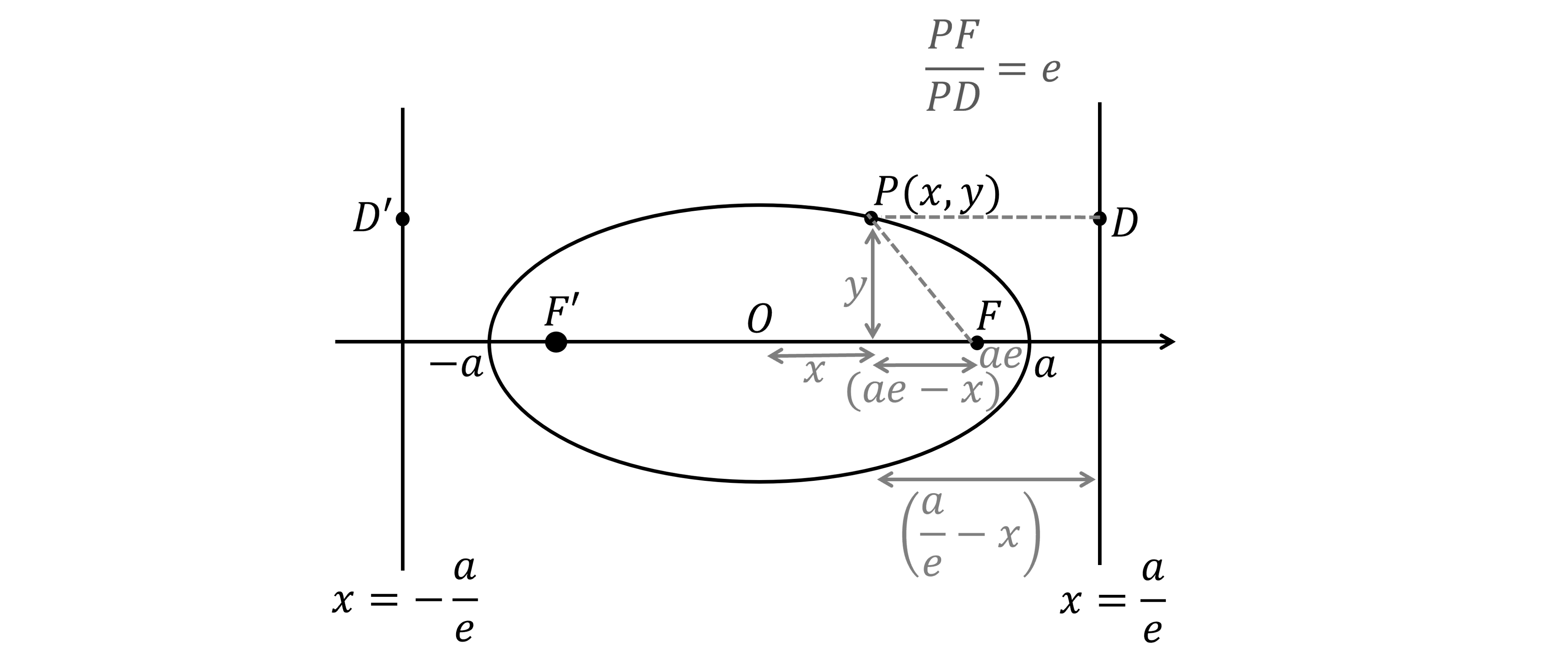
It helps to draw lengths x and y from P(x, y) on the diagram and the foci (±ae, 0)

Create a right-angled triangle whose hypotenuse is PF with base (aex) and height y

An ellipse with foci F, F' and directrices x=a/e and x=-a/e. The point P(x,y) is on the ellipse and the points  D and D' are on the directrices at the same height. The lines PF and PD are shown. The formula PF/PD=e is shown. A right-angled triangle has hypotenuse PF and base (ae-x) and height y. The distance from P to D is (a/e-x).

Use Pythagoras' theorem to find PF2

PF2=(aex)2+y2

Find the length PD from x to the directrix

PD=(aex)

Rearrange PFPD=e to make PF2 the subject

PF2=e2PD2

Substitute in expressions for PF2 and PD2 from above

(aex)2+y2=e2(aex)2

Expand, cancel and factorise

a2e22aex+x2+y2=e2(a2e22axe+x2)a2e22aex+x2+y2=a22aex+e2x2(1e2)x2+y2=a2(1e2)

Divide both sides by a2(1e2)

x2a2+y2a2(1e2)=1

This is now in the correct form of an ellipse

The Cartesian equation is x2a2+y2b2=1, where b2=a2(1e2)

Unlock more, it's free!

Join the 100,000+ Students that ❤️ Save My Exams

the (exam) results speak for themselves:

Build on this topic

Mark Curtis

Author: Mark Curtis

Expertise: Maths Content Creator

Mark graduated twice from the University of Oxford: once in 2009 with a First in Mathematics, then again in 2013 with a PhD (DPhil) in Mathematics. He has had nine successful years as a secondary school teacher, specialising in A-Level Further Maths and running extension classes for Oxbridge Maths applicants. Alongside his teaching, he has written five internal textbooks, introduced new spiralling school curriculums and trained other Maths teachers through outreach programmes.