Properties of Parabolas (Edexcel A Level Further Maths: Further Pure 1): Revision Note
Exam code: 9FM0

Written by: Mark Curtis
Updated on
Properties of parabolas
What is a parabola?
A standard parabola is a curve with the Cartesian equation
where
which looks like has been rotated 90° clockwise
Its line of symmetry is (the -axis)
Its vertex is at
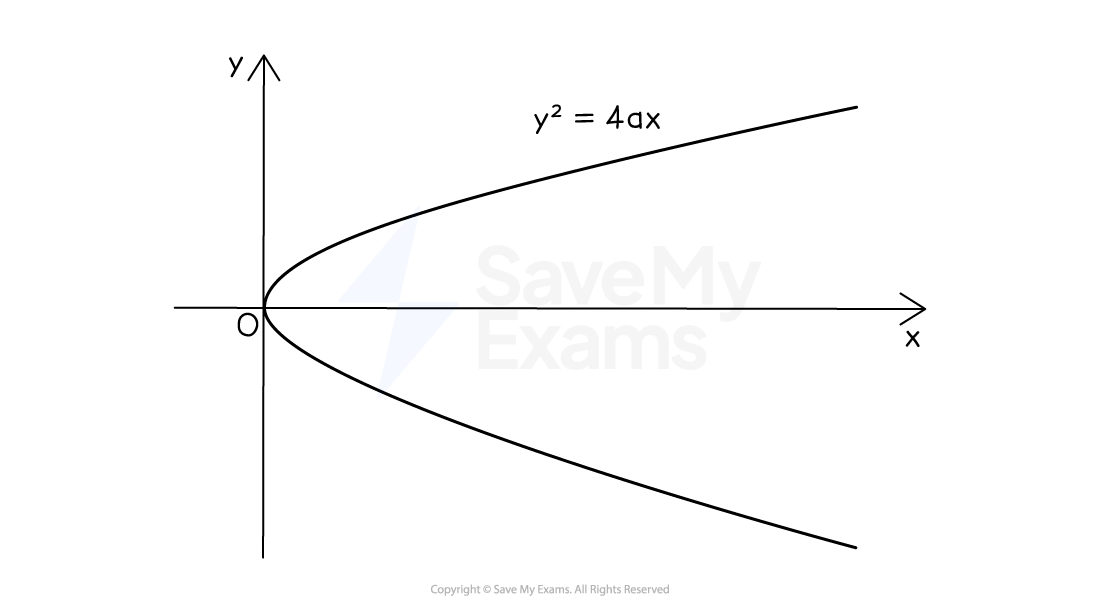
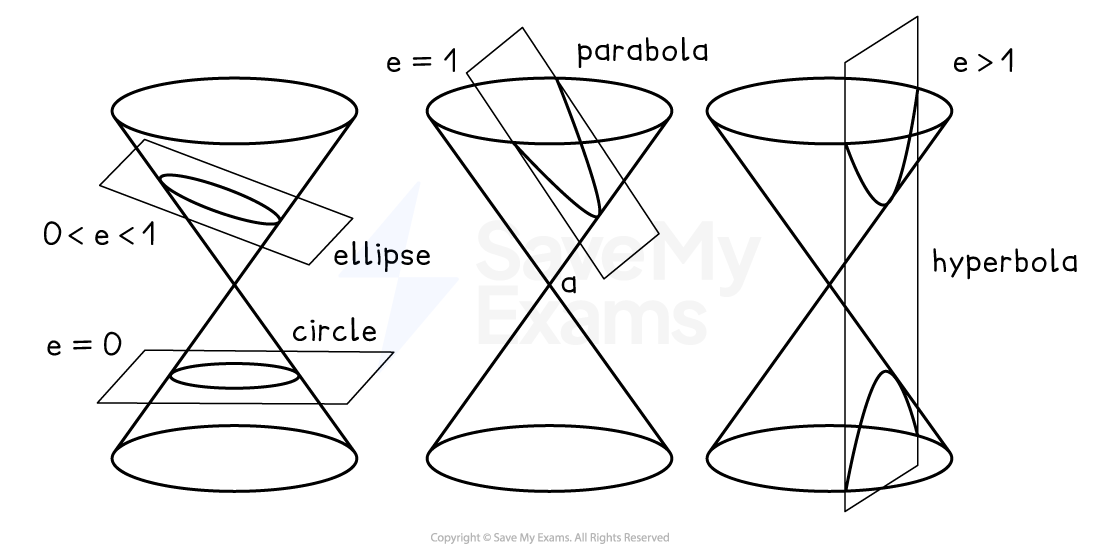
A parabola is one of the conic curves
with eccentricity
Examiner Tips and Tricks
You are given the Cartesian equation of a parabola in the formulae booklet.
What are the parametric equations of a parabola?
The parametric equations of a parabola are
where
Eliminating the parameter, , gives the Cartesian equation
Examiner Tips and Tricks
You are given the parametric equations of a parabola in the formulae booklet.
What are the coordinates of a general point on a parabola?
A general point on the parabola has coordinates given by its parametric equations,
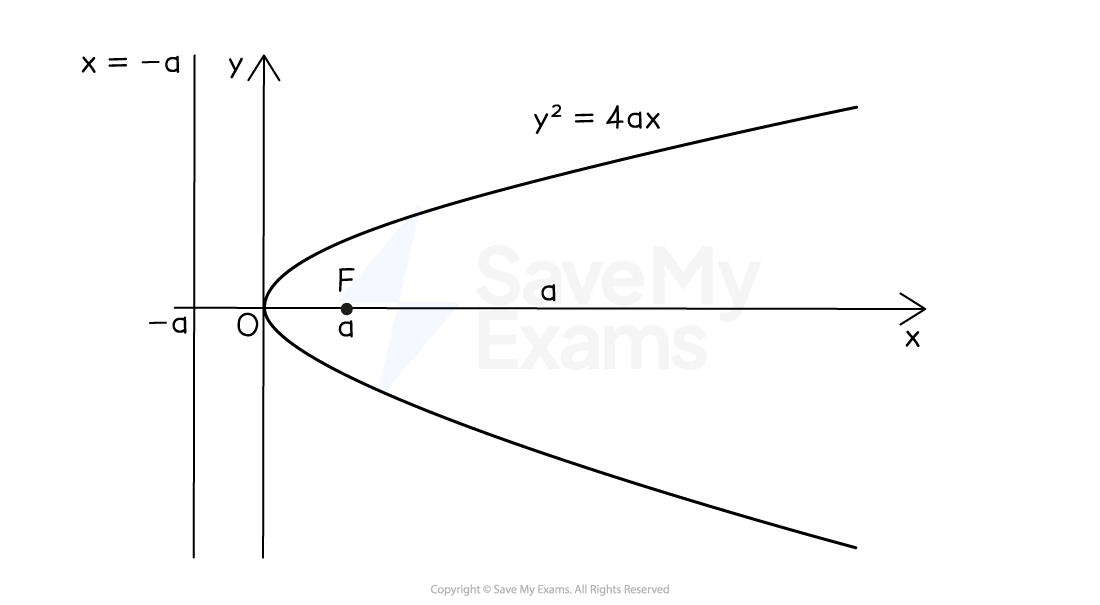
e.g. is a general point on the parabola (where )
It satisfies the equation of the curve
It moves around the curve depending on the value of
This is different to, say,
which is a fixed point on the parabola
What is the eccentricity, focus and directrix of a parabola?
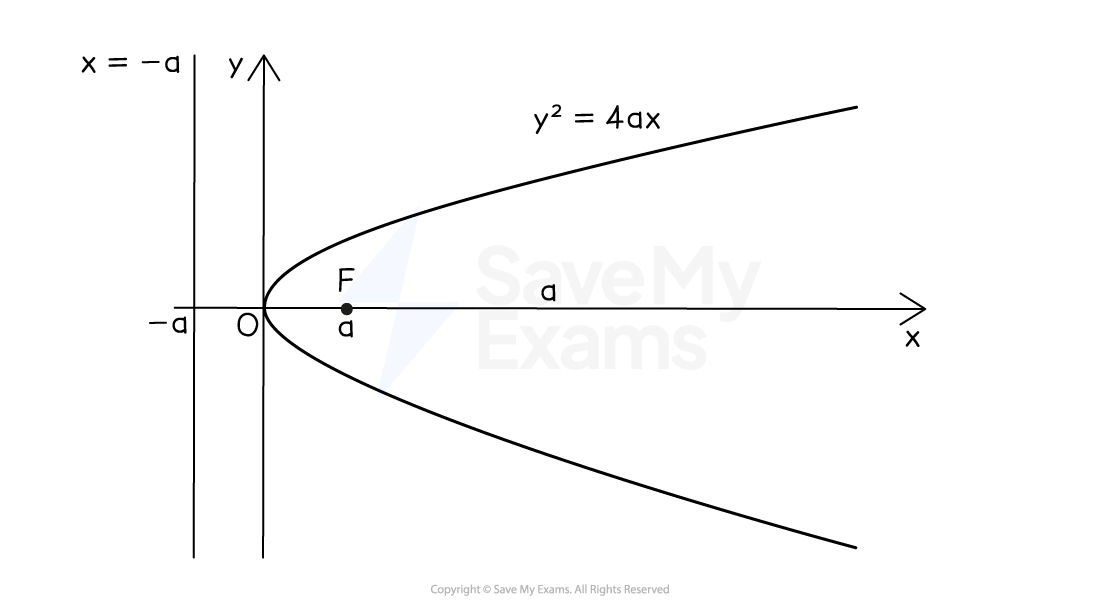
The eccentricity of a parabola, , is always one
The focus, , is the point on the x-axis
The directrix is the vertical line with equation
Examiner Tips and Tricks
You are given the eccentricity, focus and directrix of a parabola in the formulae booklet.
Worked Example
A parabola has the equation .
Calculate
(a) the coordinates of the focus,
(b) the equation of the directrix.
Answer:
(a)
Find by comparing to the general equation
Substitute into
The focus has coordinates
(b)
Substitute into the equation of a directrix,
The directrix has the equation
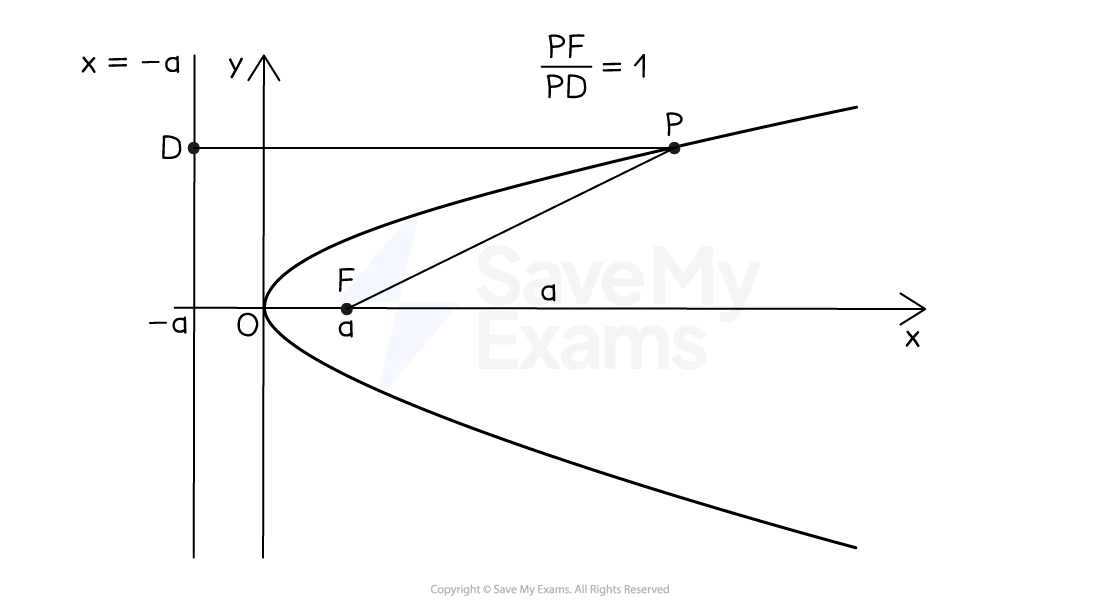
What is the focus-directrix property of a parabola?
The focus-directrix property says that, if you take any point on a parabola, then
the distance from to the focus,
divided by the shortest distance from to the directrix (at point )
is always equal to , the eccentricity, where
i.e.
sometimes rearranged to
Examiner Tips and Tricks
You are not given the focus-directrix property in the exam (you must learn it).
Worked Example
A parabola with focus at and directrix is shown below.
The point on the parabola has coordinates and the point is on the directrix, at the same height as .
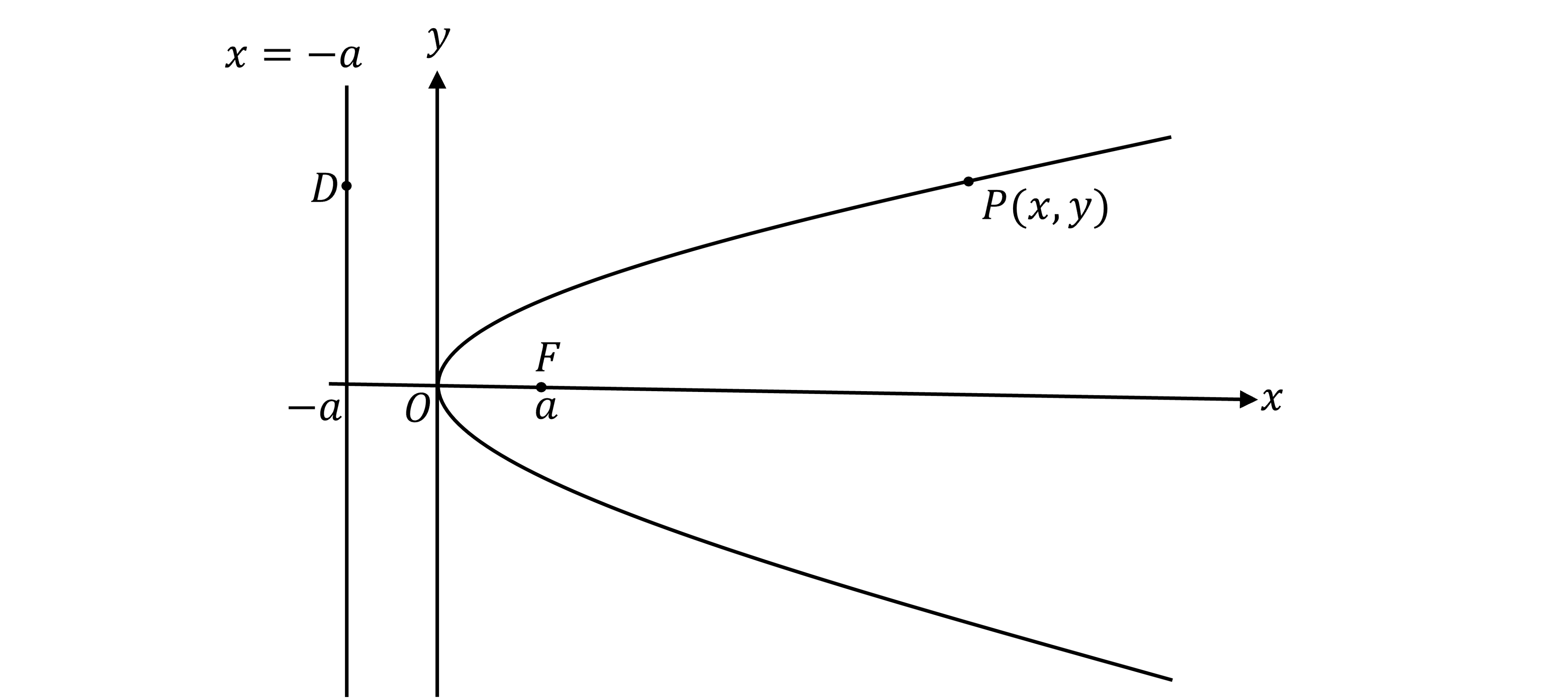
Using only the focus-directrix property, derive the Cartesian equation of a parabola, .
Answer:
Use the focus-directrix property on , and (draw on the lines and )
It helps to draw the lengths and from on the diagram
Create a right-angled triangle whose hypotenuse is with base and height
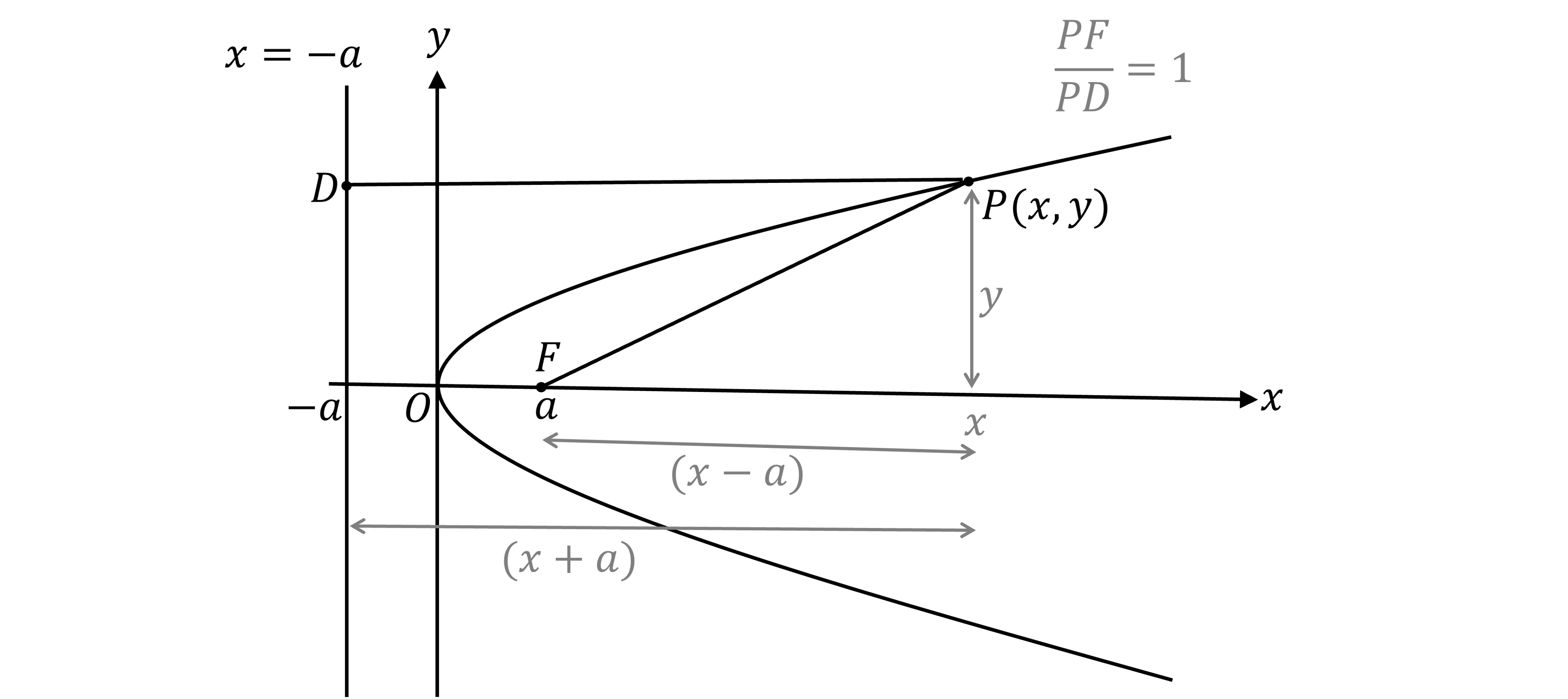
Use Pythagoras' theorem to find
Find the length from to the directrix
Rearrange to make the subject
Substitute in expressions for and from above
Expand and cancel
Add to both sides
The Cartesian equation is

Unlock more, it's free!
Join the 100,000+ Students that ❤️ Save My Exams
the (exam) results speak for themselves:

Was this revision note helpful?
Build on this topic