14 marks
Outline the processes of glacial erosion.
Was this exam question helpful?
Exam code: 7037
Outline the processes of glacial erosion.
Was this exam question helpful?
Outline the differences between warm-based and cold-based glaciers.
Was this exam question helpful?
Outline the processes by which ice moves within a glacier.
Was this exam question helpful?
Outline processes by which glaciers erode the landscape.
Was this exam question helpful?
Outline the geomorphological process of nivation.
Was this exam question helpful?
Outline the process of internal deformation.
Was this exam question helpful?
Explain the development of warm based glaciers.
Was this exam question helpful?
Figure 8 shows the location of three US glaciers.
Figure 9 shows the change in their size (mass balance) between 1958 and 2005.
Figure 10 shows the cumulative impact of the annual change in mass balance within the three glaciers.
Figure 8 Figure 9

Figure 10

Using Figures 8, 9 and 10, compare the differences between the glaciers.
Was this exam question helpful?
Figure 7
The surface velocity of various glaciers, including Thwaites Glacier, Antarctica

Note: At the grounding line, glacier ice comes into contact with the sea and starts to float.
Figure 7 shows the surface velocity of various glaciers, including Thwaites Glacier, Antarctica.
Analyse the data shown in Figure 7.
Was this exam question helpful?
Figure 7 shows the mean mass balance and cumulative mass balance for selected glaciers around the world.
Figure 7
The mean mass balance and cumulative mass balance for selected glaciers around the world

Analyse the data shown in Figure 7.
Was this exam question helpful?
Figure 7a shows the number of days where ablation exceeds accumulation across the Greenland ice sheet between 1 January and 31 December 2017.
Figure 7b shows the number of melting days difference from the 1981–2010 average across the Greenland ice sheet between 1 January and 31 December 2017.
Figure 7c shows the percentage of the Greenland ice sheet experiencing melting in 2017. This is compared to the 1981–2010 median.
Figure 7a – Number of days where ablation exceeded accumulation | Figure 7b – Number of melting days difference from the 1981–2010 average |
|---|

Figure 7c – Percentage of Greenland ice sheet experiencing melting
in 2017, compared to 1981–2010 median

Analyse the data shown in Figure 7a, Figure 7b and Figure 7c.
Was this exam question helpful?
Analyse the data shown in Figure 1.
Figure 1: Selected Alpine glaciers — length change and mass balance, 1900–2022
Glacier | Country | Length change 1900–2000 (km) | Length change 2000–2022 (km) | 2022 annual mass balance (m w.e./yr) |
|---|---|---|---|---|
Rhône Glacier | Switzerland | −1.8 | −1.9 | −3.2 |
Mer de Glace | France | −1.7 | −0.8 | −2.8 |
Gorner Glacier | Switzerland | −2.1 | −1.3 | −3.0 |
Careser Glacier | Italy | −1.2 | −2.3 | −4.1 |
Findelen Glacier | Switzerland | −0.5 | −1.1 | −2.9 |
Source: adapted from World Glacier Monitoring Service (WGMS) Glacier Change Bulletin, 2022; and ETH Zurich alpine glacier monitoring programme. Length change values are net change from start of period. Mass balance in metres water equivalent per year; all negative values indicate net annual mass loss.
Was this exam question helpful?
Figure 7a shows cumulative length change in selected Scandinavian glaciers, 1896-2016. Figure 7b shows the cumulative mass balance change in selected Scandinavian glaciers, 1960-2014.
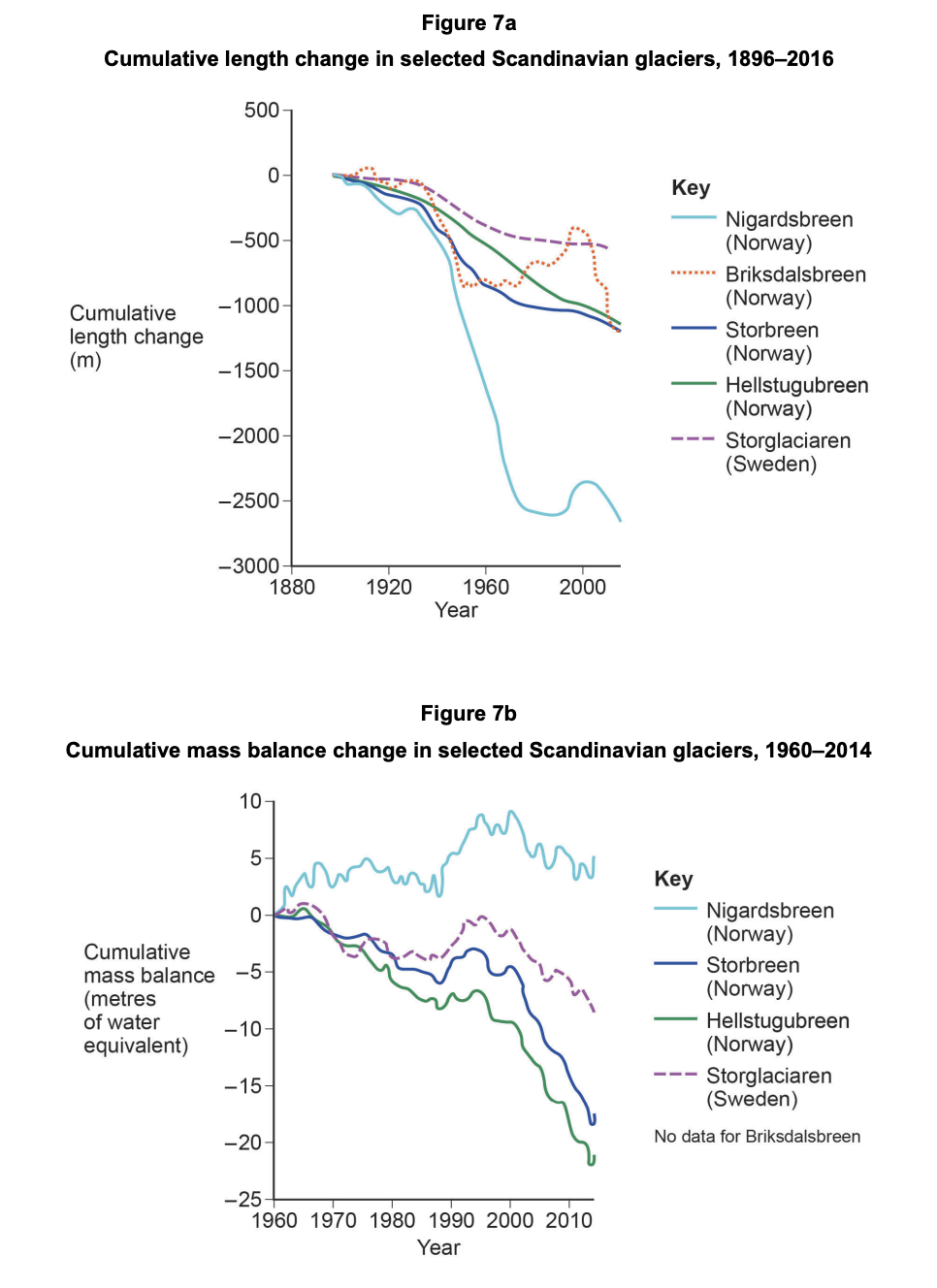
Analyse the data shown in Figure 7a and Figure 7b.
Was this exam question helpful?
'Abrasion is the most important process of glacial erosion.'
To what extent do you agree?
Was this exam question helpful?
Assess the importance of whether a glacier is warm or cold based in determining the processes that operate within a glacial system.
Was this exam question helpful?
'Freeze-thaw is the most important process operating in periglacial environments.'
To what extent do you agree?
Was this exam question helpful?