12 marks
The function has derivatives of all orders for all real numbers. It is known that , , , and . Write the third-degree Taylor polynomial for about and use it to approximate the value of .
Was this exam question helpful?
The function has derivatives of all orders for all real numbers. It is known that , , , and . Write the third-degree Taylor polynomial for about and use it to approximate the value of .
Was this exam question helpful?
The Maclaurin series for the exponential function is
Let be the function defined by . Write the third-degree Taylor polynomial for about .
Was this exam question helpful?
A function is given in power series form as .
Use the ratio test to determine the radius of convergence of the series.
By testing the endpoints, determine the full interval of convergence for . Show the work that leads to your answer.
Was this exam question helpful?
A function is given in power series form as .
Show that the power series is a geometric series, and hence determine the interval of convergence for .
Was this exam question helpful?
The function is defined by . Find .
The Maclaurin series for is given by +..., which converges to for .
Find the first three nonzero terms and the general term for the Maclaurin series for .
Use your results from parts (a) and (b) to find the sum of the infinite series .
Was this exam question helpful?

The function has derivatives of all orders for all real numbers . A portion of the graph of is shown above, including the tangent line to the graph of at . Selected derivatives for at are given in the table below.
2 | |
3 | |
4 |
Write the third-degree Taylor polynomial for about .
Write the first three nonzero terms of the Taylor series for about . Write the second-degree Taylor polynomial for about .
Was this exam question helpful?
The function has derivatives of all orders for all real numbers. It is known that and .
Let be the function such that and . Write the second-degree Taylor polynomial for about .
Was this exam question helpful?
The Taylor series for about is given by
,
which converges to on its interval of convergence.
Let be the function defined by .
Write the first four nonzero terms and the general term of the Taylor series for about .
Determine the interval of convergence of the Taylor series for about . Show the work that leads to your answer.
Was this exam question helpful?
The Taylor series for a function about is given by . Find the first three nonzero terms and the general term of the Taylor series for , the derivative of , about .
Was this exam question helpful?
The Maclaurin series for a function is given by , which converges for all real numbers . If the first three nonzero terms of the series are used to approximate on the interval , use the alternating series error bound to determine an upper bound for the error of the approximations.
Was this exam question helpful?
A function has derivatives of all orders for all real numbers . The fourth-degree Taylor polynomial for about is used to approximate . Given that for , use the Lagrange error bound to show that this approximation is within of the exact value of .
Was this exam question helpful?
Let be the particular solution to the differential equation with initial condition . It can be shown that .
Write the second-degree Taylor polynomial for about . Use the Taylor polynomial to approximate .
Was this exam question helpful?
It can be shown that and that the first three terms of this series sum to . Show that .
Was this exam question helpful?
Let . Use the ratio test to determine the radius of convergence of the Maclaurin series for .
Was this exam question helpful?
Let be the particular solution to the differential equation with the initial condition . It can be shown that .
Write the second-degree Taylor polynomial for about , and use the polynomial to approximate .
Was this exam question helpful?
The function has derivatives of all orders for all real numbers. It is known that , , and . Write the fourth-degree Taylor polynomial for about . Show the work that leads to your answer.
Was this exam question helpful?
A function is such that and the Taylor series of its derivative is given by . Use this function to determine explicitly within the radius of convergence of the series.
Was this exam question helpful?
The Maclaurin series for a function is given by , which converges on .
Write the first four nonzero terms of the Maclaurin series for . Given that , use the first two nonzero terms of the Maclaurin series for to approximate .
Show that your approximation in part (a) must differ from by less than . Justify your answer.
Was this exam question helpful?
Let the function be defined by . The Taylor series for about is given by , which converges on the interval . Use the Taylor series to find a rational number such that . Justify your answer.
Was this exam question helpful?
Let the function be defined by . The fourth-degree Taylor polynomial for about is used to approximate . Use the Lagrange error bound to show that this approximation will be within of the exact value of for all in the interval .
Was this exam question helpful?
For a function , the Maclaurin series is given by . For , where is the radius of convergence of the series, show that is a solution to the differential equation .
Was this exam question helpful?
The function has a Taylor series about that converges to for all in the interval of convergence. It is known that , , and the th derivative of at is given by for .
Write the first four nonzero terms and the general term of the Taylor series for about .
The Taylor series for about has a radius of convergence of . Find the interval of convergence. Show the work that leads to your answer.
The Taylor series for about can be used to represent as an alternating series. Use the first three nonzero terms of the alternating series to approximate .
Show that the approximation found in part (c) is within of the exact value of .
Was this exam question helpful?
The function is defined by the power series for all real numbers for which the series converges.
Using the ratio test, find the interval of convergence of the power series for . Justify your answer.
Show that . Justify your answer.
Write the first four nonzero terms and the general term for an infinite series that represents .
Was this exam question helpful?
The Maclaurin series for is given by
On its interval of convergence, this series converges to . Let be the function defined by .
Write the first four nonzero terms and the general term of the Maclaurin series for .
Determine the interval of convergence of the Maclaurin series for . Show the work that leads to your answer.
Let be the fourth-degree Taylor polynomial for about . Use the alternating series error bound to find an upper bound for .
Was this exam question helpful?
The Taylor series for a function about is given by
and converges to on its interval of convergence.
Using the ratio test, find the interval of convergence of the Taylor series for about . Justify your answer.
Find the first three nonzero terms and the general term of the Taylor series for , the derivative of , about .
Was this exam question helpful?
A function has derivatives of all orders for . The derivatives of satisfy the following.
for all
The Maclaurin series for converges to for .
Show that the first four nonzero terms of the Maclaurin series for are , and write the general term of the Maclaurin series for .
Was this exam question helpful?
A function has derivatives of all orders for all real numbers . A portion of the graph of is shown below, along with the line tangent to the graph of at . Selected derivatives of at are given in the table below.
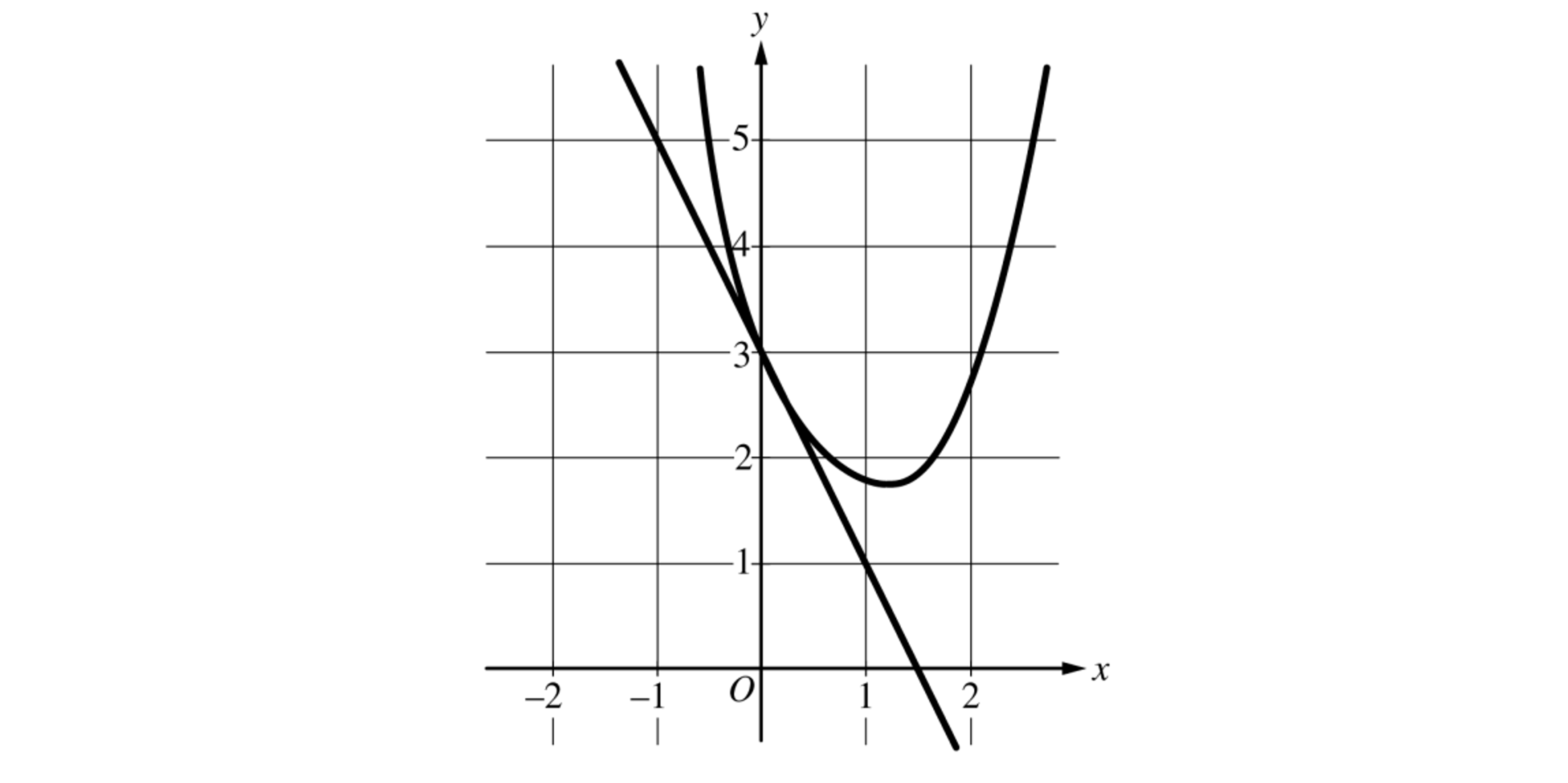
2 | 3 |
3 | |
4 | 54 |
Write the third-degree Taylor polynomial for about .
Write the first three nonzero terms of the Maclaurin series for . Write the second-degree Taylor polynomial for about .
Let be the function defined by . Use the Taylor polynomial found in part (a) to find an approximation for .
It is known that the Maclaurin series for converges to for all real numbers . It is also known that the individual terms of the series for alternate in sign and decrease in absolute value to . Use the alternating series error bound to show that the approximation found in part (c) differs from by at most .
Was this exam question helpful?
The function has derivatives of all orders for all real numbers. It is known that , , , and .
Find , the fourth derivative of with respect to . Write the fourth-degree Taylor polynomial for about . Show the work that leads to your answer.
The fourth-degree Taylor polynomial for about is used to approximate . Given that for , use the Lagrange error bound to show that this approximation is within of the exact value of .
Let be the function such that and . Write the second-degree Taylor polynomial for about .
Was this exam question helpful?