Taylor Polynomial Approximation of a Function (College Board AP® Calculus BC): Revision Note

Roger B

Written by: Roger B

Reviewed by: Mark Curtis

Updated on

Taylor & Maclaurin polynomials

What is a Taylor polynomial approximation of a function?

  • A Taylor approximation about the point x=a is a way of approximating a function near to that point using a polynomial

    • This polynomial is called a Taylor polynomial

  • Let f be a function

    • If the function and its first n derivatives all exist at x=a, then the nth degree Taylor polynomial for f about x=a is

 pn(x)=f(a)+f'(a)(xa)+f''(a)2!(xa)2+...+f(n)(a)n!(xa)n

Examiner Tips and Tricks

The formulas for the coefficients of the polynomial can be derived using differentiation. Set Pn(x)=a0+a1(xa)+a2(xa)2+...+an(xa)n.

Substitute x=a and use  f(a)=Pn(a)to find a0.

Differentiate both sides, substitute x=a and use  f'(a)=Pn'(a)to find a1.

This process can be repeated to find all the coefficients. You can use this derivation if you forget the formula.

  • Note that

    •  pn(a)=f(a)+f'(a)(aa)+f''(a)2!(aa)2+...+f(n)(a)n!(aa)n=f(a)

      • A Taylor polynomial is always exactly equal to its function at x=a

    •  p1(x)=f(a)+f'(a)(xa)

      • This is the equation of a line with slope f'(a), that goes through the point (a, f(a))

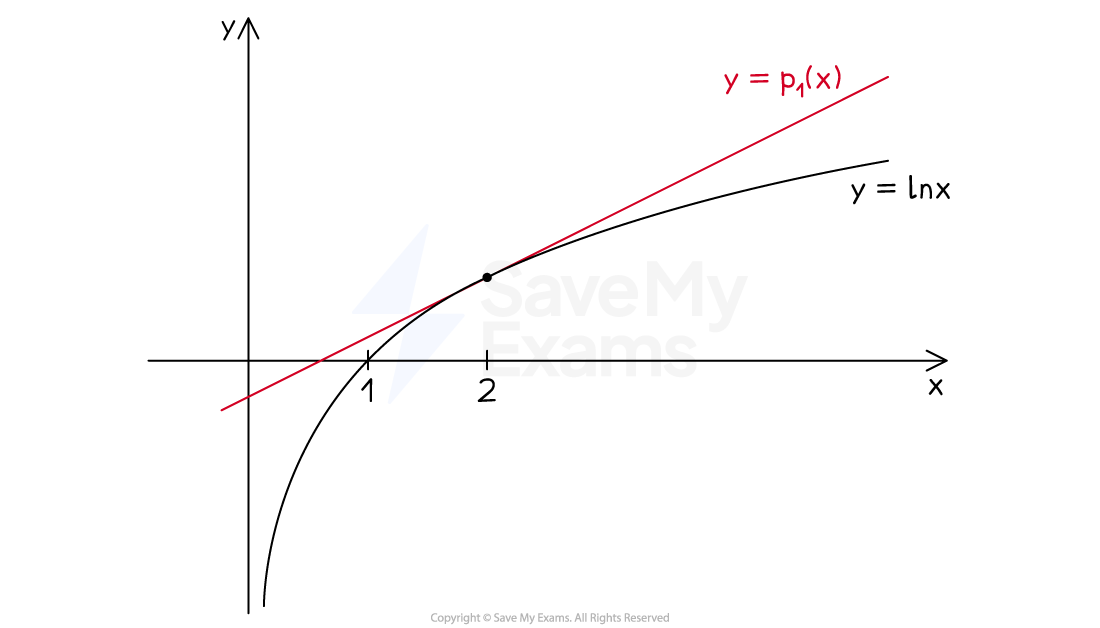
      • The first-degree Taylor polynomial is the equation of the tangent line to the graph of f at the point (a, f(a))

  • For example, the first few Taylor polynomials for f(x)=lnx about x=2 are:

    •  p1(x)=ln2+x22

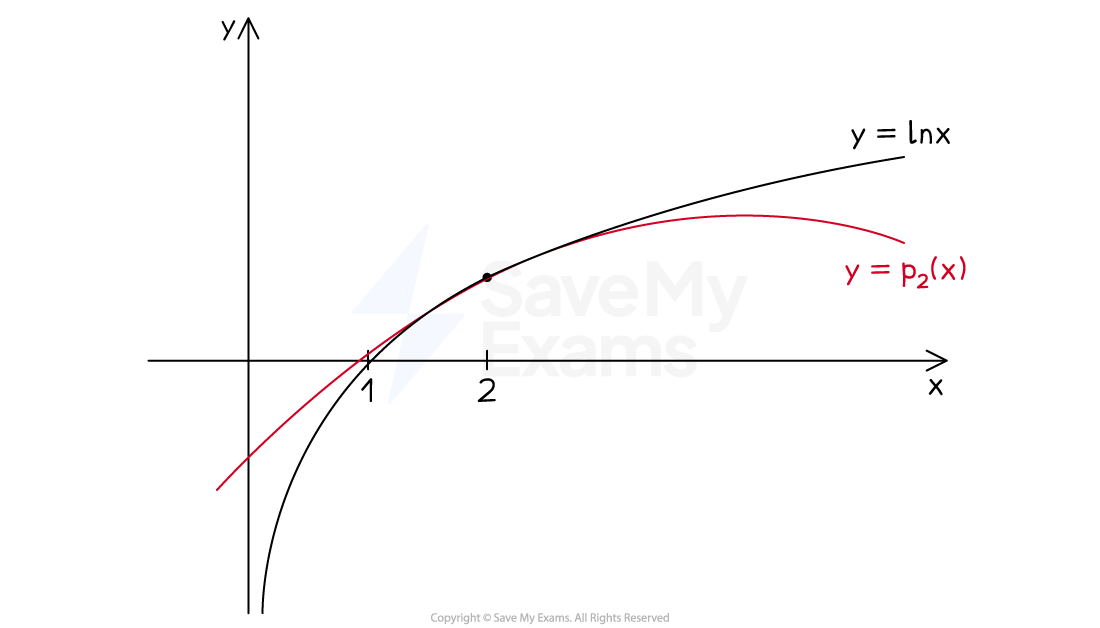
    •  p2(x)=ln2+x22(x2)28

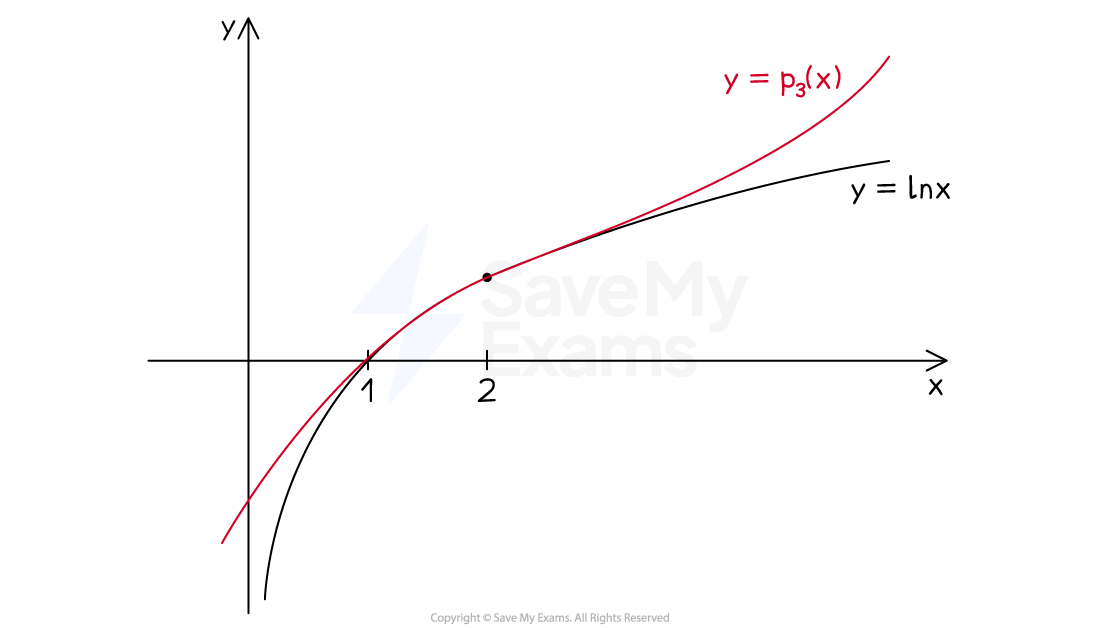
    •  p3(x)=ln2+x22(x2)28+(x2)324

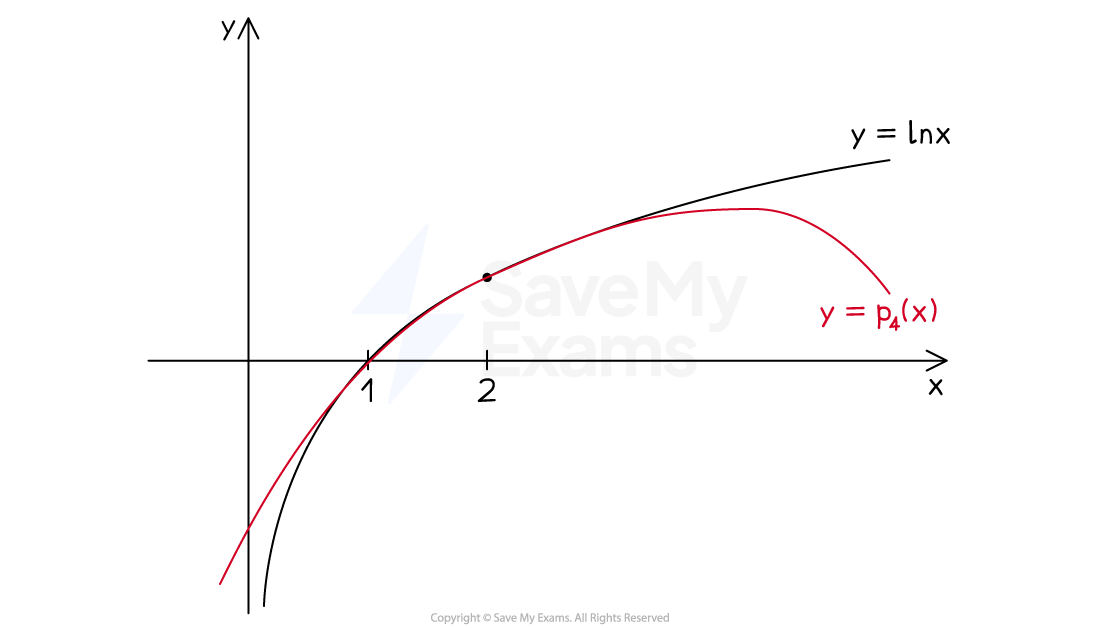
    •  p4(x)=ln2+x22(x2)28+(x2)324(x2)464

  • The graphs of those polynomials about x=2 and f(x)=lnx can be seen in the following diagrams
A graph of y=lnx and its first order Taylor approximation at x=2, drawn on the same set of axes
Taylor polynomial of degree 1
A graph of y=lnx and its second order Taylor approximation at x=2, drawn on the same set of axes
Taylor polynomial of degree 2
A graph of y=lnx and its third order Taylor approximation at x=2, drawn on the same set of axes
Taylor polynomial of degree 3
A graph of y=lnx and its fourth order Taylor approximation at x=2, drawn on the same set of axes
Taylor polynomial of degree 4
  • The diagrams illustrate the following general facts about Taylor polynomials:

    • Their accuracy as an approximation decreases as you move away from x=a

    • They become a more accurate approximation (and more accurate further away from x=a) if you increase the degree of the polynomial

      • Adding additional terms in higher powers of x increases the accuracy

Worked Example

Find the Taylor polynomial for the function g(x)=sinx about x=π3, up to and including the term in x3.

Answer:

Use  pn(x)=f(a)+f'(a)(xa)+f''(a)2!(xa)2+...+f(n)(a)n!(xa)n

Start by calculating the first three derivatives of the function g(x)=sinx

g'(x)=cosx

g''(x)=sinx

g(3)(x)=cosx

Substitute those and x=π3 into the formula and simplify

 p3(x)=g(π3)+g'(π3)(xπ3)+g''(π3)2!(xπ3)2+g(3)(π3)3!(xπ3)3=sin(π3)+cos(π3)(xπ3)+sin(π3)2(xπ3)2+cos(π3)6(xπ3)3=32+12(xπ3)+322(xπ3)2+126(xπ3)3=32+12(xπ3)34(xπ3)2112(xπ3)3

32+12(xπ3)34(xπ3)2112(xπ3)3

What is a Maclaurin polynomial approximation of a function?

  • A Maclaurin polynomial approximation of a function is a special case of a Taylor approximation

  • It is the Taylor approximation of a function about the point x=0

    • If the function f and its first n derivatives all exist at x=0, then the nth degree Maclaurin polynomial for f about x=0 is

    pn(x)=f(0)+f'(0)x+f''(0)2!x2+...+f(n)(0)n!xn

Worked Example

Find the Maclaurin polynomial for the function f(x)=ex up to and including the term in x3.

Answer:

Recall that this is the Taylor approximation about x=0

Use pn(x)=f(0)+f'(0)x+f''(0)2!x2+...+f(n)(0)n!xn

Start by calculating the first three derivatives

f'(x)=ex

f''(x)=ex

f(3)(x)=ex

Substitute those and x=0 into the formula and simplify

p3(x)=f(0)+f'(0)x+f''(0)2!x2+f(3)(0)3!x3=e0+e0x+e02x2+e06x3=1+x+12x2+16x3

1+x+12x2+16x3

Unlock more, it's free!

Join the 100,000+ Students that ❤️ Save My Exams

the (exam) results speak for themselves:

Build on this topic

Roger B

Author: Roger B

Expertise: Development Editor

Roger's teaching experience stretches all the way back to 1992, and in that time he has taught students at all levels between Year 7 and university undergraduate. Having conducted and published postgraduate research into the mathematical theory behind quantum computing, he is more than confident in dealing with mathematics at any level the exam boards might throw at you.

Mark Curtis

Reviewer: Mark Curtis

Expertise: Maths Content Creator

Mark graduated twice from the University of Oxford: once in 2009 with a First in Mathematics, then again in 2013 with a PhD (DPhil) in Mathematics. He has had nine successful years as a secondary school teacher, specialising in A-Level Further Maths and running extension classes for Oxbridge Maths applicants. Alongside his teaching, he has written five internal textbooks, introduced new spiralling school curriculums and trained other Maths teachers through outreach programmes.