Motion with Parametric Equations (College Board AP® Calculus BC): Revision Note

Motion with parametric equations
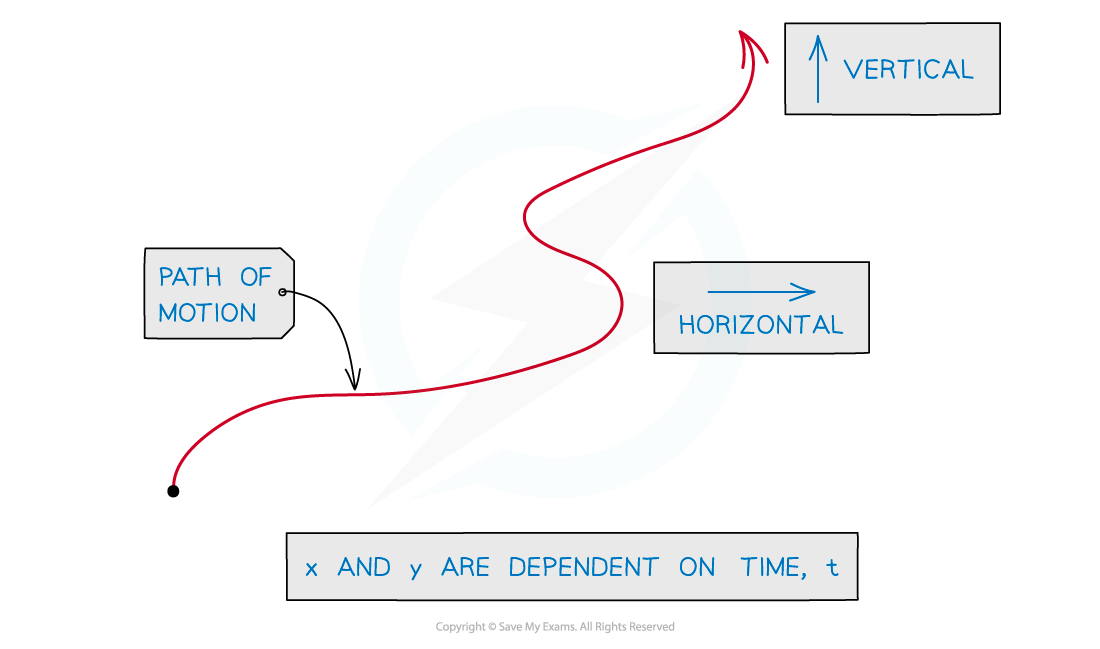
How do I model a particle moving in 2D using parametric equations?
A particle moving in two-dimensions follows a path (curve) in the -plane
This path can be given parametrically as and
is the displacement in the -direction
is the displacement in the -direction
Displacement is measured relative to a fixed origin,
The parameter, , represents time, where
The coordinates of the particle's position at time are
The direction of motion is the direction along the curve as increases
The initial position of the particle is the point at which
The coordinates of the initial position are
This may not be at the origin
Sometimes a time interval for the motion is given,
How do I find the velocity and acceleration in 2D?
Recall the ideas in the study guide on 'Motion in a Straight Line'
Velocity, , is the rate of change of displacement, , with respect to time
Acceleration, , is the rate of change of velocity, , with respect to time
In two dimensions, the displacement, velocity and acceleration of a particle each have two components in perpendicular directions
Displacement splits into and components
Often horizontal and vertical
Derivatives of these are as follows:
Derivative | Shorthand | Interpretation |
|---|---|---|
The velocity of the particle in the -direction at time If the -axis is horizontal then means moving to the right and means moving to the left | ||
The velocity of the particle in the -direction at time If the -axis is vertical then means moving upwards and means moving downwards | ||
The acceleration of the particle in the -direction at time | ||
The acceleration of the particle in the -direction at time |
Examiner Tips and Tricks
If no units are given in a question, you don't need units in your answers.
How do I calculate the speed of a particle in 2D?
The speed of a particle at time is given by the formula:
This is because speed is the magnitude (hypotenuse) of a velocity triangle formed out of:
the velocity of the particle in the -direction, , at time
and the velocity of the particle in the -direction , , at time
By Pythagoras' theorem, this gives
The velocity triangle also gives the direction of motion of the particle at that time
The particle is at rest if the speed is zero

Examiner Tips and Tricks
Do not confuse the word 'speed' with 'velocity'!
How do I calculate the slope of a line that is tangent to the path of the particle?
The slope of the line that is tangent to the path of the particle (a tangent to the curve) at time is given by the formula:
See the study guide on 'Derivatives of Parametric Equations'

This is the same slope as the velocity triangle at that time (see above)
Note that the direction of motion could be either way along the tangent
It will follow the direction in which is increasing
How do I use indefinite integration for particles moving in 2D?
Indefinite integration can be used to find
displacement, or , by integrating velocity, or
velocity, or , by integrating acceleration, or
Always remember to add a constant of integration each time you integrate
Then use information in the question to find the constant
e.g. you may be told that when
Indefinite integration is good when you need an algebraic expression in terms of time
You can then evaluate it at different times
How do I use definite integration for particles moving in 2D?
If an algebraic expression in terms of is not required but a specific value of a quantity is required (e.g. find at time ) then definite integration can be used
Below are the commonly used definite integrals in motion questions:
Integral | Shorthand | Interpretation |
|---|---|---|
The change in the position of the -coordinates | ||
The change in the position of the -coordinates | ||
The change in the velocity of the particle in the -direction | ||
The change in the velocity of the particle in the -direction |
Definite integrals often need rearranging to find the specific value of a quantity at either end of the time interval
e.g. rearranges to either
or
Examiner Tips and Tricks
Motion questions are often found in the calculator sections of the exam, where you are expected to use your calculator to:
evaluate any definite integrals,
solve any equations.
How do I calculate the distance traveled by a particle in 2D?
The distance traveled by a particle between time and time is the arc length of the path traveled, given by the definite integral:
See the study guide on 'Arc Lengths of Parametric Equations'
This is always positive

Examiner Tips and Tricks
Do not confuse the word 'distance' with 'displacement'!
Worked Example
A particle travels along a curve in the -plane. The particle is at the point at time where . The derivatives of and are:
At time , the particle is at the point .
(a) Find the acceleration of the particle in the -direction at time .
(b) Find an expression for in terms of time, .
(c) Find the value of at time .
(d) Find the slope of the line tangent to the path of the particle at time .
(e) Show that the particle is not initially at rest.
(f) Find the total distance traveled by the particle from time to time .
Answer:
(a)
Differentiate the velocity of the particle in the -direction, , to get the acceleration in the -direction,
Substitute in
Acceleration of the particle in the -direction at time is 34
(b)
Integrate the velocity of the particle in the -direction, , to find
Remember to add a constant of integration
Use the fact that when (in the question) to find
Substitute this value of back into the expression for
(c)
You know the displacement of the particle in the -direction at time from the question ()
Use the fundamental theorem of calculus
(to 3 decimal places)
(d)
The slope of the line tangent to the path of the particle has the formula
Substitute in
Slope is 0.197 (to 3 decimal places)
(c)
To be initially at rest, the speed must equal zero when
Find an expression for the speed
Substitute in to see if the speed is zero
The particle is not initially at rest, as its initial speed is 2.236
(f)
The total distance traveled is given by where and
Evaluate this definite integral on your calculator
Total distance traveled by the particle from time to time is 356.534 (to 3 decimal places)

Unlock more, it's free!
Join the 100,000+ Students that ❤️ Save My Exams
the (exam) results speak for themselves:

Was this revision note helpful?
Build on this topic
