Optimization Problems (College Board AP® Calculus BC): Revision Note

Optimization problems
What is an optimization problem?
Recall that differentiation is about the rate of change of a function and provides a way of finding minimum and maximum values of a function
Anything that involves maximizing or minimizing a quantity can be modelled using differentiation; for example
minimizing the cost of raw materials used in manufacturing a product
finding the maximum height a football reaches when kicked
These are called optimization problems
How do I solve an optimization problem?
In optimization problems, variables other than x, y and f are often used
V is often used for volume, S for surface area
r for radius if a circle, cylinder or sphere is involved
Derivatives can still be found
but be clear about which letter is representing the independent (x) variable
and which letter is representing the dependent (y) variable
Problems often start by linking two connected quantities together, for example volume and surface area
If more than one variable is involved, constraints will usually be given
so that the quantity being optimized can be rewritten in terms of one variable
Once the quantity being optimized is written as a function of a single variable, differentiation can be used to maximize or minimize the quantity as required
Steps to solve an optimization problem
STEP 1
Rewrite the quantity to be optimized in terms of a single variable, using any constraints given in the question
STEP 2
Differentiate and solve the derivative equal to zero to find the “x"-coordinate(s) of any critical points
STEP 3
If there is more than one critical point, or you are required to justify the nature of the critical point, differentiate again or use the candidates test
STEP 4
Use the second derivative to determine the nature of each critical point and select the maximum or minimum point as necessary or use the candidates test
STEP 5
Interpret the answer in the context of the question
Worked Example
A large flower bed is being designed as a rectangle with a semicircle on each end, as shown in the diagram below.
The total area of the bed is to be meters squared.
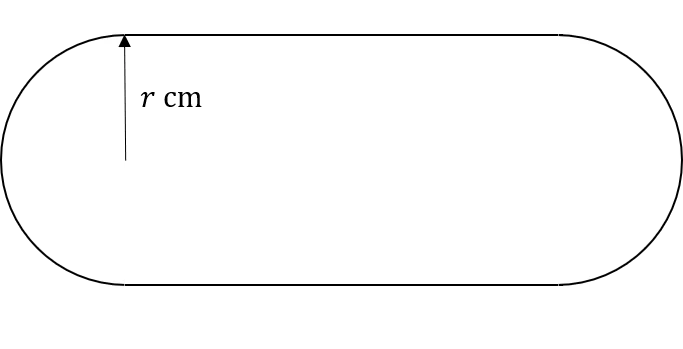
(a) Show that the perimeter of the bed is given by the formula
(b) Find the value of that minimizes the perimeter, and find the minimum value of the perimeter.
(c) Justify that this is the minimum perimeter.
Answer:
(a)
The width of the rectangle is meters, and its length is meters
The area consists of a semi circle, plus a rectangle, plus another semi circle
Simplify and write in terms of
The perimeter of the flower bed consists of two semi-circular arcs, and two straight lengths
Substitute in the expression for , and simplify to the desired expression for
(b)
To find the minimum value of , we need to find the minimum point on a graph of against
To do this, we need to differentiate with respect to
Start by writing in terms of , using the answer from part (a)
Differentiate with respect to
At the minimum point, the derivative will be zero (assuming the minimum is at a critical point)
is a length, so -10 can be ignored
Find the minimum value of the perimeter by substituting into the equation for
meters minimizes the perimeter
The minimum value of the perimeter will be 20π meters
(c)
To prove it is a minimum, show that the second derivative is positive (and the graph is therefore concave up) at this point
Start by finding the second derivative
Substitute in
Note that we don't need to check endpoints here: as the perimeter function becomes unbounded, while as the perimeter also goes to infinity
Second derivative is positive at , therefore 20π meters is the minimum value for the perimeter
Worked Example
A manufacturer produces custom electronic components. The daily cost to produce x batches of components, measured in dollars, is modeled by the function for the interval .
Find the absolute minimum and absolute maximum daily cost to produce the components on the closed interval . Justify your answers.
Answer:
Find the derivative of the function
Set the derivative equal to zero to find critical points and solve
Evaluate the function at the critical points and the endpoints
Justify the use of the candidates test
is a polynomial, so it is continuous over
The extreme value theorem guarantees that has a global maximum and a global minimum
These occur at the critical points or at the endpoints
State the minimum and maximum values
The absolute minimum daily cost is $125 (when 5 batches are produced)
The absolute maximum daily cost is $152 (when 2 batches are produced)

Unlock more, it's free!
Join the 100,000+ Students that ❤️ Save My Exams
the (exam) results speak for themselves:

Was this revision note helpful?
Build on this topic