Area Between Two Curves (College Board AP® Calculus BC): Revision Note

Area between two curves in terms of x
How do I find the area between two curves?
Consider the diagram below where
The area between two curves, and is being found
bounded by the lines and
This region is labeled
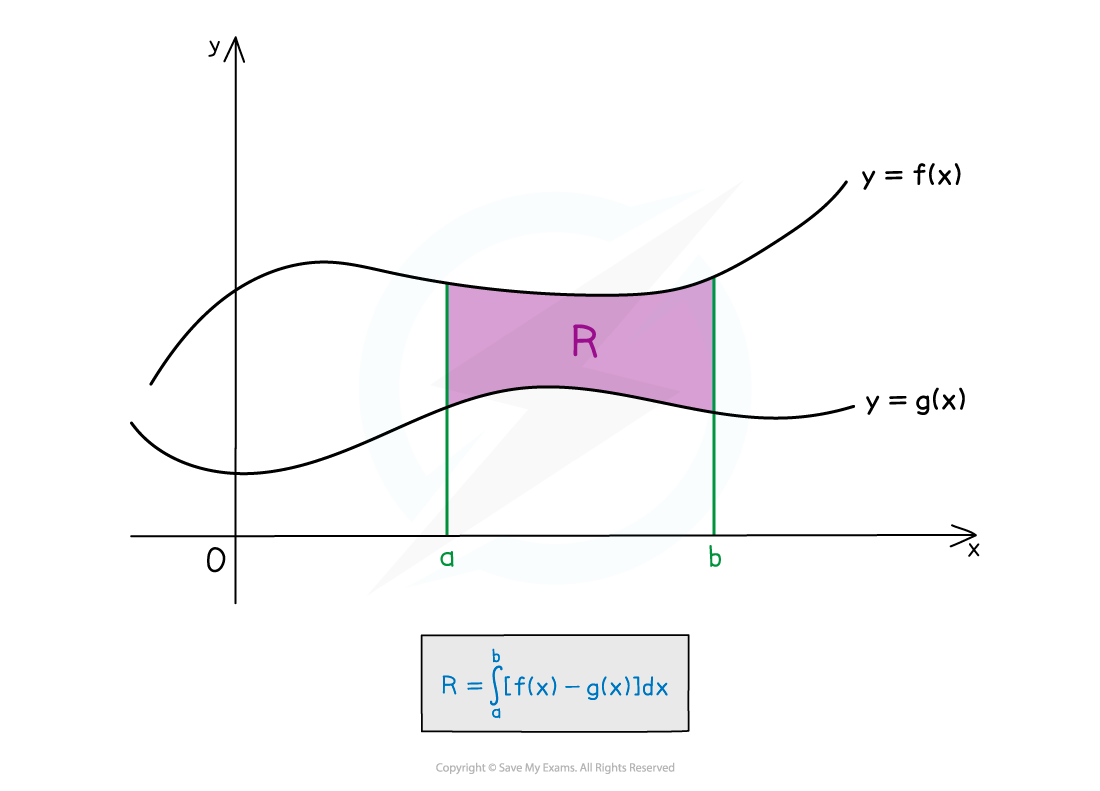
The region is the difference between the two areas found by:
Integrating between and
Integrating between and
As for all of this interval, this area can be calculated as
This is equivalent to
It is essential to have the function that is "above" the other be first inside the integral
If the curves overlap and form multiple regions, see the method outlined in the 'Multiple Areas' study guide
Also note that if the graph of is above the graph of on
then everywhere on that interval
This means that you don't need to worry about negative integrals when integrating
The integral will give the correct area value whether the area is above or below the -axis
What if I am not told the limits of integration?
If you are not told the limits, it is likely you are finding the area enclosed by two curves, and , which intersect each other
Find the -values of the points of intersection of the two curves by solving
These will be the limits for the integral
Examiner Tips and Tricks
In an FRQ, make sure you clearly state the integrand and the limits of integration.
Worked Example
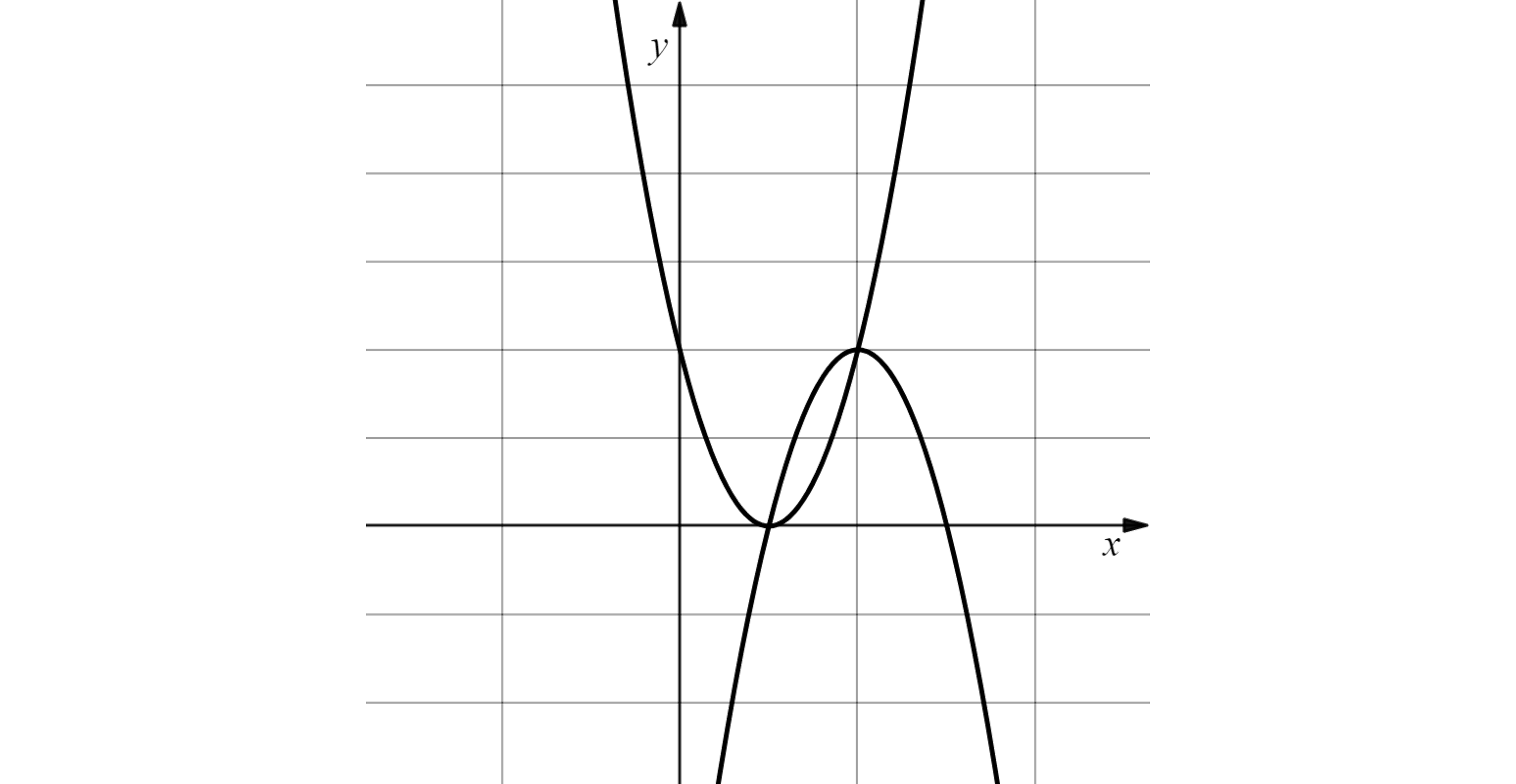
Find the area of the region enclosed by the two curves with equations and .
The curves are shown on the graph below.
Answer:
Find the points where the two curves intersect, by setting their equations equal to one another and solving
or
Between the intersections, the n-shaped graph (the negative quadratic) is above the u-shaped graph (the positive quadratic) so the area integral will be of the following form
Simplify and then find the value of the definite integral
units squared
Area between two curves in terms of y
How do I find the area between two curves when the functions are in terms of y?
The same concepts apply as when the functions are in terms of
but the process is followed relative to the -axis instead of the -axis
Consider the diagram below where
The area between two curves, and is being found
bounded by the lines and
This region is labeled
![Graph showing a shaded region R between curves x=f(y) and x=g(y) from y=a to y=b, with an integral formula for R: ∫[a to b] (f(y) - g(y)) dy.](https://cdn.savemyexams.com/cdn-cgi/image/f=auto,width=3840/https://cdn.savemyexams.com/uploads/2024/09/18005_area-between-2-curves-and-y-axis.png)
The region is the difference between the two areas found by:
Integrating between and
Integrating between and
As for all of this interval, this area can be calculated as
I.e. is closer to the -axis than is on this interval
This is equivalent to
It is essential to have the function that is further away from the -axis, be first inside the integral
If the curves overlap and form multiple regions, see the method outlined in the 'Multiple Areas' study guide
In these scenarios we are integrating an equation for in terms of
If you are given an equation for in terms of
you need to rearrange the equation for in terms of
What if I am not told the limits?
If you are not told the limits, it is likely you are finding the area enclosed by the two curves, and , which intersect each other
Find the -values of the points of intersection of the two curves by solving
These will be the limits for the integral
Worked Example
The graph below shows two curves with the following equations
and
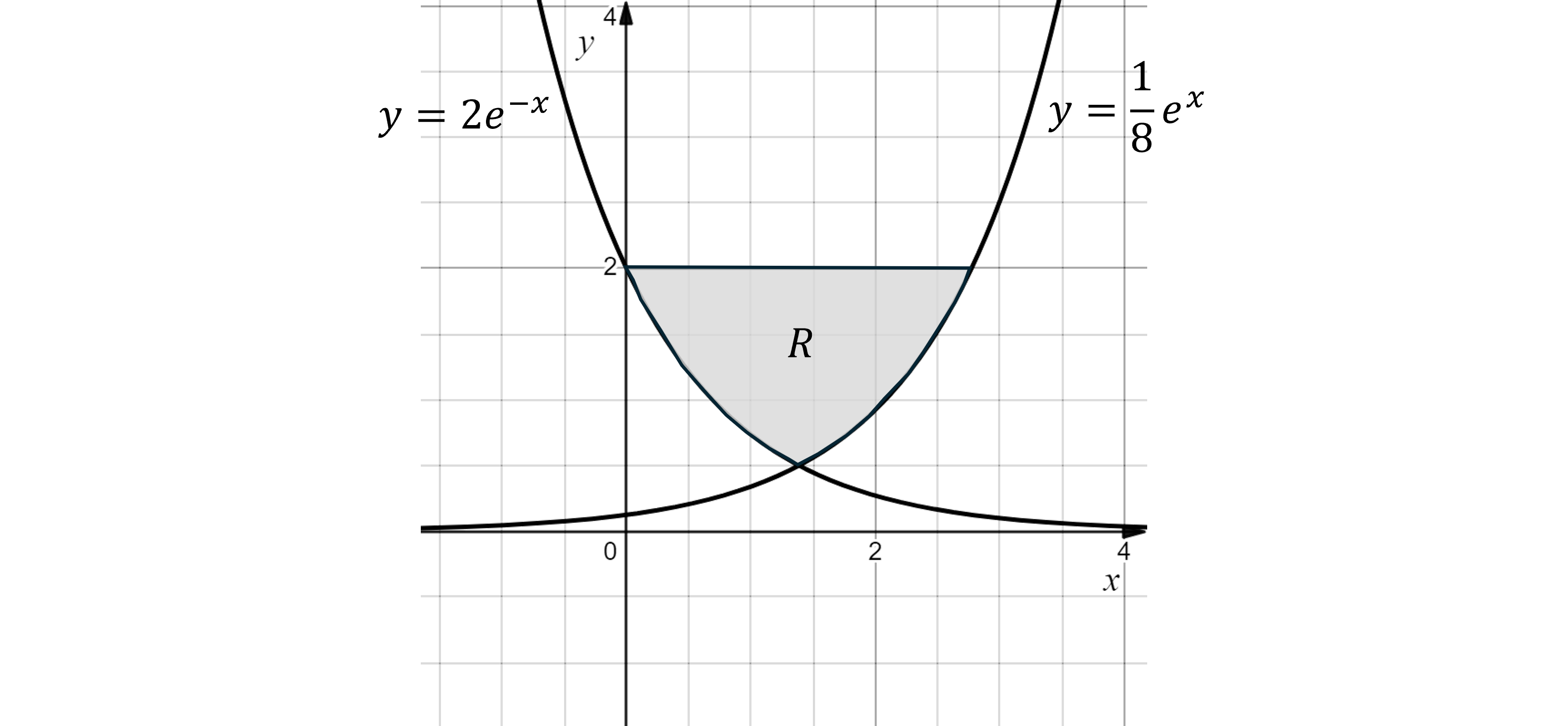
The region is bounded by the line and the two curves. Find the area of region .
Answer:
Start by working out the integral limits
The upper limit is and the lower limit will be the value of the point of intersection of the two curves
As we are working in terms of , rewrite each equation as in terms of
For
For
Find the -value of the point of intersection by setting these equations equal to each other; this will be the lower limit for the integral
You could also use your calculator to find this
must be positive as neither graph has any negative values
Use an integral of the form
The curve with equation (or ) is furthest away from the -axis, so will come first in the integral
You could use your calculator at this point to evaluate the integral, or you can simplify first using laws of logarithms
Use your calculator to evaluate the integral
Round to 3 decimal places
2.545 units squared
Examiner Tips and Tricks
Note that the area in the example above can also be found by using areas between the curves and the -axis, and subtracting them from the rectangular area underneath the line forming the upper boundary of region

Unlock more, it's free!
Join the 100,000+ Students that ❤️ Save My Exams
the (exam) results speak for themselves:

Was this revision note helpful?
Build on this topic
