Integral Test for Convergence (College Board AP® Calculus BC): Study Guide

Integral test
What is the integral test?
The integral test is a method of determining whether an infinite series converges or diverges
The integral test states that:
Given that , where is a continuous, positive, decreasing function on
If the improper integral exists
Then the series converges
If the improper integral doesn't exist then the series diverges
For example, you can use the function to test whether converges
is continuous, positive, and decreasing for
Examiner Tips and Tricks
For an FRQ, be sure to state that your function is continuous, positive, and decreasing.
How does the integral test work?
Each term in the infinite series can be represented by the area of a rectangle of width 1 and height
The integral represents the area under the curve from to
In the first image, is an underestimate of the rectangles
so
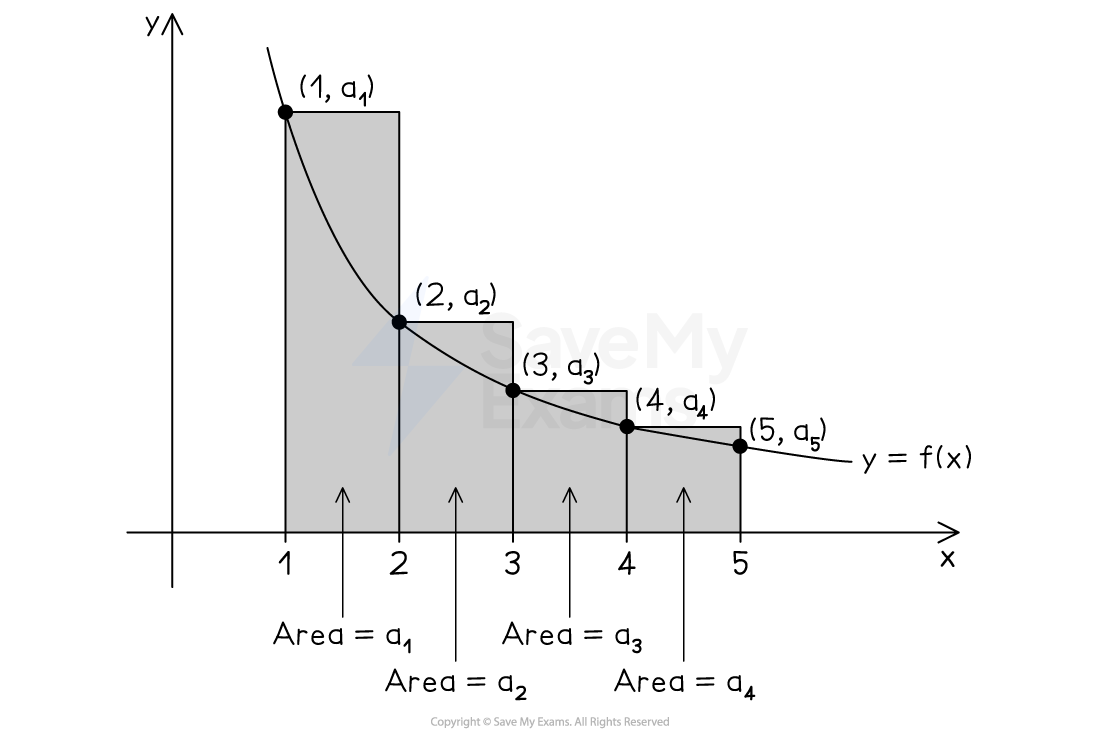
In the next image, is an overestimate of the rectangles
Adding to both sides gives
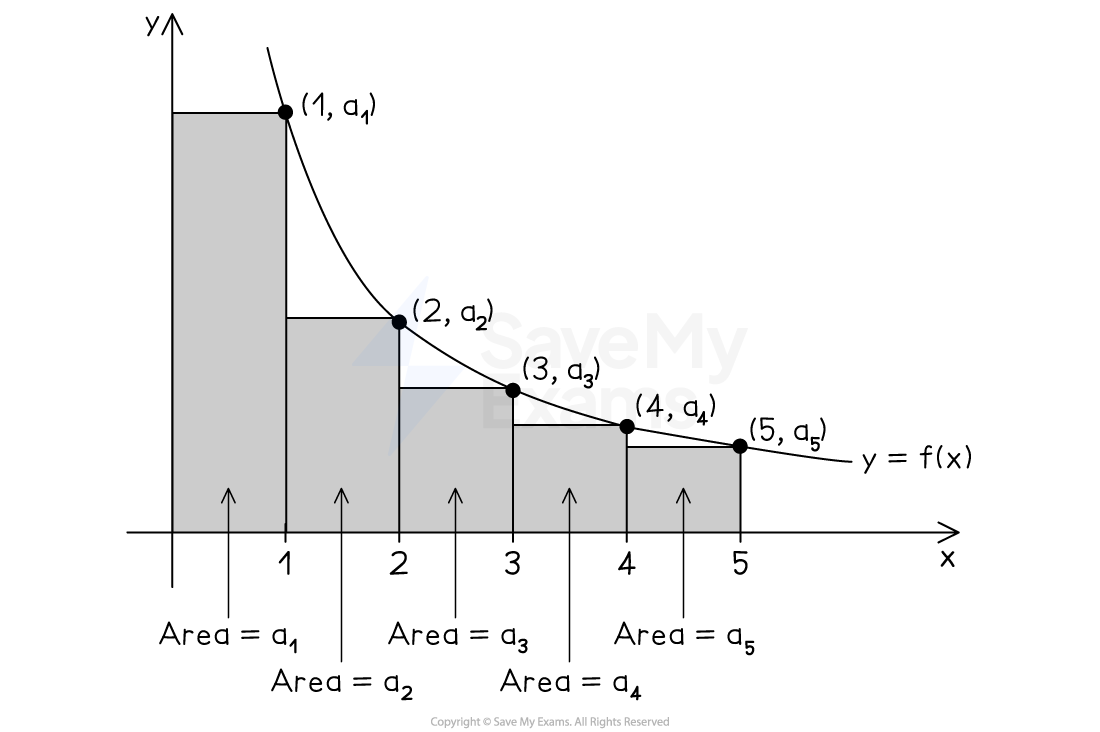
So which means
if is finite, then must have a finite value (the series converges)
if is infinite, then must also be infinite (the series diverges)
Worked Example
Use the integral test to determine whether each of the following series converges or diverges.
(a)
(b)
Answer:
(a)
Note that this series is the harmonic series
is continuous, positive and decreasing for
Evaluate the improper integral
The improper integral diverges to infinity (as logarithmic growth tends to infinity, as ), so the series diverges
The integral diverges to infinity, so by the integral test the series is divergent
(b)
Note that this is a p-series with
is continuous, positive and decreasing for
Evaluate the improper integral
The improper integral converges to a finite value, so the series converges
The integral exists with a finite value, so by the integral test the series is convergent

Unlock more, it's free!
Join the 100,000+ Students that ❤️ Save My Exams
the (exam) results speak for themselves:

Was this revision note helpful?
Build on this topic