Fundamental Theorem of Calculus (College Board AP® Calculus BC): Study Guide

Fundamental theorem of calculus
What is the fundamental theorem of calculus?
The fundamental theorem of calculus is a key result in the study of calculus
It formalizes the idea that 'integration and differentiation are inverse operations'
and expresses several useful facts that follow on from this basic idea
There are two parts of the fundamental theorem that you should be familiar with and be able to use
The first fundamental theorem of calculus
and the second fundamental theorem of calculus
What is the first fundamental theorem of calculus?
The first fundamental theorem of calculus connects antiderivatives with the value of definite integrals
It provides a simple way to find the value of definite integrals
The first fundamental theorem of calculus
If
is a function that is continuous on the closed interval
and is an antiderivative of on
Then
See the 'Evaluating Definite Integrals' study guide for details on how this is used
You can use this theorem to find an expression for a differentiable function if you know its derivative and the value of the function at a point
The fundamental theorem of calculus gives
This can be rearranged to give
Examiner Tips and Tricks
You can use to write an expression for a function without needing to find the constant of integration. This is especially useful on a calculator question.
For example, suppose you are given and and you are asked to find , then you can just type the following into your calculator:
What is the second fundamental theorem of calculus?
The second fundamental theorem of calculus allows an antiderivative to be expressed in the form of an accumulation function
Recall that an accumulation function is a function of where the variable occurs as an integration limit:
E.g.
The second fundamental theorem of calculus
If
is a function that is continuous on an interval containing
Then for values of in that interval
The function defined by is an antiderivative of
and
Examiner Tips and Tricks
Be sure you are familiar with the implications of the second fundamental theorem!
Exam questions will probably not refer explicitly to the theorem, but they will expect you to recognize that:
is an antiderivative of
and especially that
Can the limits of integration be functions of x?
The limits of integration can be functions of
You can use the chain rule and the second fundamental theorem of calculus together
For example,
Examiner Tips and Tricks
The chain rule with the second fundamental theorem of calculus is tested regularly as an MCQ. It can be extended to both limits being functions of .
This can be shown by writing .
This can then be rewritten as .
However, this version is rarely tested.
Worked Example
is a differentiable function which satisfies and .
Use your calculator to find the value of .
Answer:
Use the fundamental theorem of calculus
Rearrange and substitute the values and expressions into the formula
(to 3 decimal places)
Worked Example
The graph of a differentiable function is shown below.
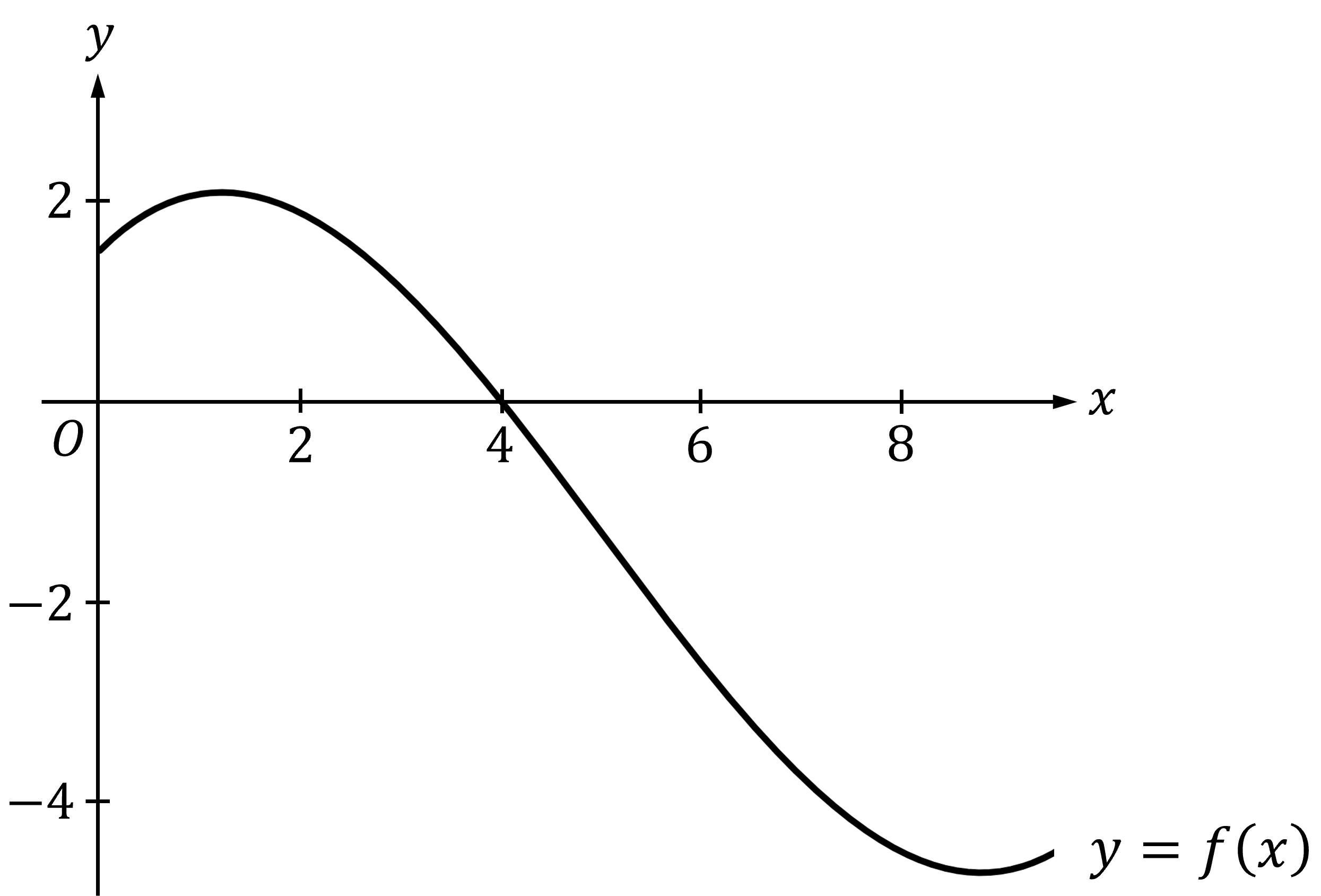
If , which of the following is true?
(A)
(B)
(C)
(D)
(E)
Answer:
We need to see what information we can deduce about , and
, which is calculating the accumulated change between 0 and 4
is positive on as the graph is above the -axis for this interval
So that means that
We are told that is differentiable
Therefore is continuous and the second fundamental theorem of calculus is valid
By the second fundamental theorem of calculus,
Therefore
So , as we can see from the graph
From the graph we can see that is a decreasing function in the vicinity of 4
Therefore
It follows that
Option (E)

Unlock more, it's free!
Join the 100,000+ Students that ❤️ Save My Exams
the (exam) results speak for themselves:

Was this revision note helpful?
Build on this topic
