Estimating the Derivative at a Point (College Board AP® Calculus BC): Study Guide

Jamie Wood

Written by: Jamie Wood

Reviewed by: Dan Finlay

Updated on

Estimating derivatives at a point using a graph

How can I estimate a derivative at a point using points on the graph?

  • The coordinates of the points that lie on the graph of a function can be used to estimate the derivative at a point

  • Recall that the derivative of f open parentheses x close parentheses at the point where x equals a, denoted as f to the power of apostrophe open parentheses a close parentheses,

    • is equal to the slope of the tangent to the graph of f open parentheses x close parentheses at x equals a

  • To approximate the slope of the tangent to the graph of f open parentheses x close parentheses at x equals a:

    • Find the slope of line segments joining nearby points that lie on the graph

  • The function must be continuous and differentiable within the relevant interval for this method to be valid

  • Consider the graph of f open parentheses x close parentheses below, where points A comma space B comma space C comma space D comma space E are labeled with their coordinates

A graph of the function f(x) with labeled points: A (1, -6), B (2, -6), C (3, -4), D (4, 0), and E (5, 6). The graph follows a curved path.
  • To estimate the derivative at point C you can find the slope of the nearest secant line

    • Finding the slope between B and D

      • fraction numerator 0 minus negative 6 over denominator 4 minus 2 end fraction equals 6 over 2 equals 3

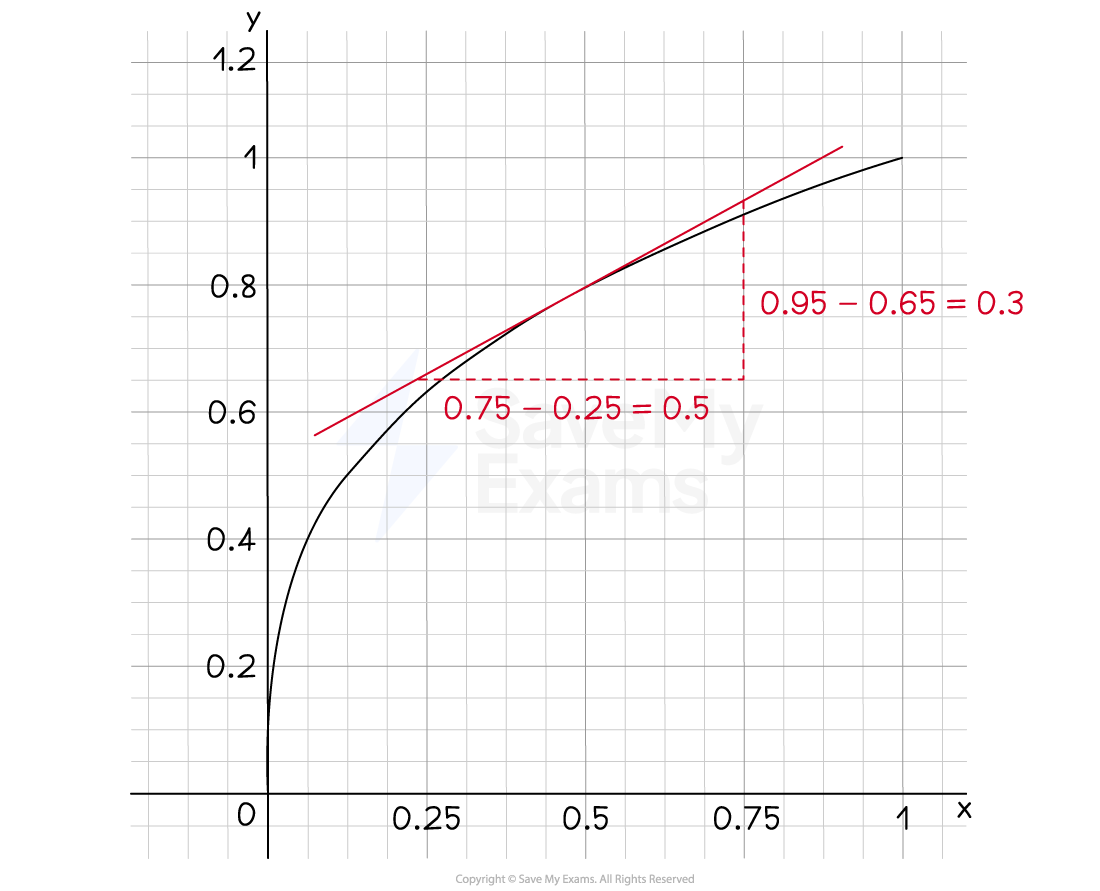
How can I estimate a derivative at a point using a tangent line?

  • To estimate the derivative of a function at a point

    • Draw a tangent to the curve at the point

    • Pick two points on the line

    • Calculate the slope

Finding the slope of tangent
Example of estimating the derivative at a point using a tangent line

Estimating derivatives at a point using a table

How can I estimate a derivative at a point using a table?

  • The same method can be used as for a graph, but with a table of values instead

  • Recall that the derivative of f open parentheses x close parentheses at the point where x equals a, denoted as f to the power of apostrophe open parentheses a close parentheses,

    • is equal to the slope of the tangent to the graph of f open parentheses x close parentheses at x equals a

  • To approximate the slope of the tangent to the graph of f open parentheses x close parentheses at x equals a:

    • Find the average rate of change using points on either side of x equals a

  • Consider the table of values below for the function g

    • g is a continuous and differentiable function within this interval

    • This must be true to use this method

x

g open parentheses x close parentheses

1

-16

3

-24

5

-24

7

-16

9

0

11

24

  • To find an estimate for g to the power of apostrophe open parentheses 7 close parentheses:

    • Find the average rate of change between x equals 5 and x equals 9

    • fraction numerator 0 minus open parentheses negative 24 close parentheses over denominator 9 minus 5 end fraction equals 6

  • To find an estimate for g to the power of apostrophe open parentheses 6 close parentheses:

    • Find the average rate of change between x equals 5 and x equals 7

    • fraction numerator negative 16 minus open parentheses negative 24 close parentheses over denominator 7 minus 5 end fraction equals 4

Examiner Tips and Tricks

In an exam, the question might ask you to estimate an instantaneous rate of change and give you a table with lots of values. According to the AP Calculus Chief Reader Reports, you are expected to estimate the derivative value using a difference quotient by drawing from the data in the table that most tightly bounds the specified point. This means you need to choose the two closest values. In every past FRQ, the test designers deliberately chose a target value that falls exactly in the middle of those two closest bounding points.

Worked Example

space x

1

2

3

4

5

space f open parentheses x close parentheses

0

4.5

7.2

9.1

12.4

Selected values of the differentiable function space f open parentheses x close parentheses are given in the table above.

Use the data in the table to approximate space f apostrophe open parentheses 2.5 close parentheses. Show the computations that lead to your answer.

Answer:

Identify the value of the function at the values closest to x equals 2.5

space f open parentheses 2 close parentheses equals 4.5 and space f open parentheses 3 close parentheses equals 7.2

Calculate the average rate of change between these two points

table row cell space f apostrophe open parentheses 2.5 close parentheses end cell almost equal to cell fraction numerator f open parentheses 3 close parentheses minus f open parentheses 2 close parentheses over denominator 3 minus 2 end fraction end cell row blank equals cell fraction numerator 7.2 minus 4.5 over denominator 1 end fraction end cell row blank equals cell 2.7 end cell end table

table row cell space f apostrophe open parentheses 2.5 close parentheses end cell almost equal to cell 2.7 end cell end table

Unlock more, it's free!

Join the 100,000+ Students that ❤️ Save My Exams

the (exam) results speak for themselves:

Jamie Wood

Author: Jamie Wood

Expertise: Maths Content Creator

Jamie graduated in 2014 from the University of Bristol with a degree in Electronic and Communications Engineering. He has worked as a teacher for 8 years, in secondary schools and in further education; teaching GCSE and A Level. He is passionate about helping students fulfil their potential through easy-to-use resources and high-quality questions and solutions.

Dan Finlay

Reviewer: Dan Finlay

Expertise: Maths Subject Lead

Dan graduated from the University of Oxford with a First class degree in mathematics. As well as teaching maths for over 8 years, Dan has marked a range of exams for Edexcel, tutored students and taught A Level Accounting. Dan has a keen interest in statistics and probability and their real-life applications.