Critical Points (College Board AP® Calculus BC): Study Guide

Jamie Wood

Written by: Jamie Wood

Reviewed by: Dan Finlay

Updated on

Local extrema versus global extrema

What is the difference between local and global extrema?

  • The term extremum (plural extrema) refers to maximum and minimum points on the graph of a function

  • An extremum can be either local (relative) or global

    • A global extremum is the maximum or minimum for the whole of a function's domain

    • A local or relative extremum is the maximum or minimum within a specific part of a function's domain

  • We can say that f open parentheses x close parentheses has a

    • global maximum at x equals c if

      • f open parentheses x close parentheses less or equal than f open parentheses c close parentheses for every x in the domain

    • local maximum at x equals c if

      • f open parentheses x close parentheses less or equal than f open parentheses c close parentheses for every x in some open interval around x equals c

    • global minimum at x equals c if

      • f open parentheses x close parentheses greater or equal than f open parentheses c close parentheses for every x in the domain

    • local minimum at x equals c if

      • f open parentheses x close parentheses greater or equal than f open parentheses c close parentheses for every x in some open interval around x equals c

  • Every global extremum will also be a local extremum

    • However, not all local extrema are global extrema
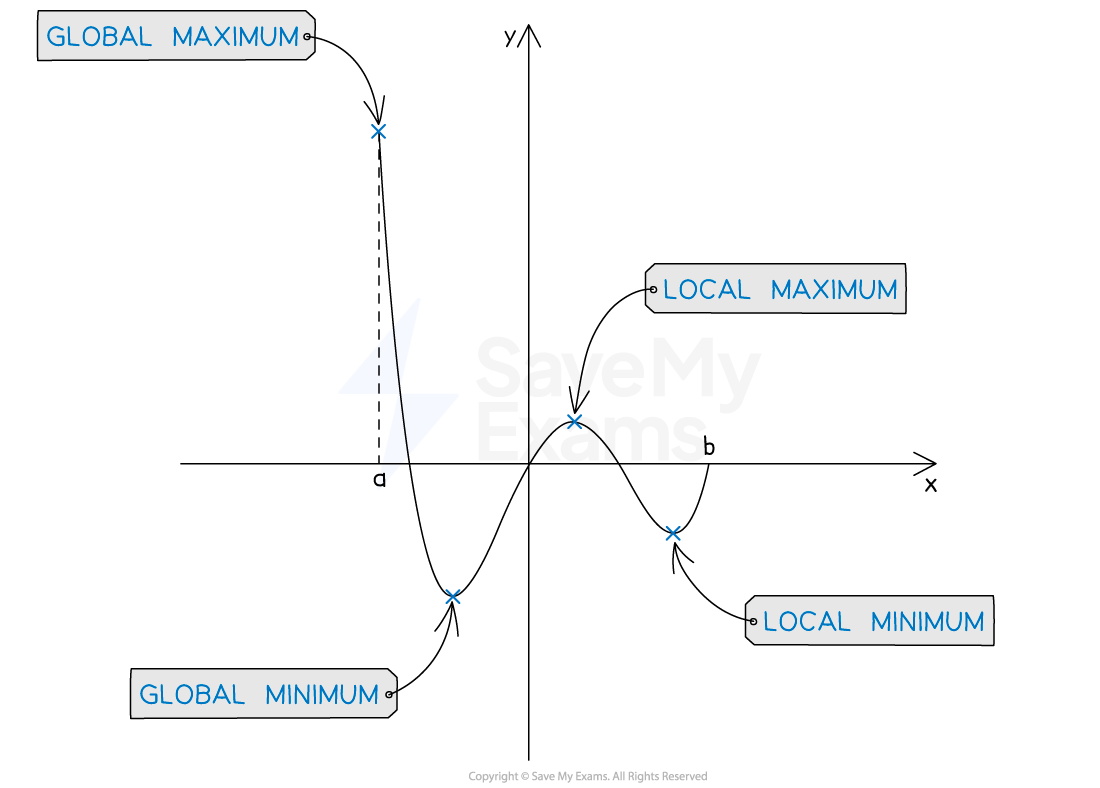
Graph with x and y axes showing a curve with labeled points: "global maximum" at point a, "local maximum," "global minimum," and "local minimum" at point b.
The graph of a quartic function with domain between a and b. Note that global extrema can occur at the endpoints, or within an interval.

Critical points

What is a critical point?

  • A critical point is a point where the first derivative of a function is

    • equal to zero,

    • or does not exist

      • In the case where f to the power of apostrophe open parentheses a close parentheses does not exist, the function itself must still be defined at x equals a (i.e. f open parentheses a close parentheses must exist) in order for x equals a to be a critical point

      • E.g. y equals 1 over x does not have a critical point at x equals 0, but y equals x to the power of 2 over 3 end exponent does

  • All local extrema occur at critical points

    • However, not all critical points are local extrema

What different types of critical points are there?

Local minimums and maximums

  • At local minimums and maximums, the derivative is most often equal to zero

    • I.e. for a function f, space f to the power of apostrophe open parentheses x close parentheses equals 0 at a local minimum or maximum

    • The tangent at these points is horizontal

  • Depending on the function, these can also be global extrema

    • E.g. The graph of y equals open parentheses x minus 2 close parentheses squared has a local minimum at (2,0), which is also a global minimum

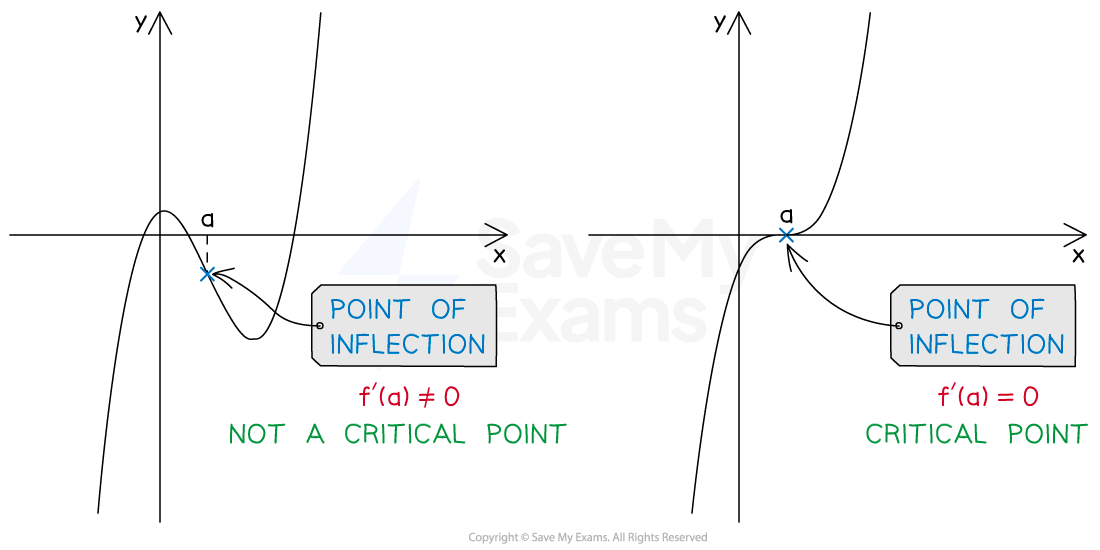
Points of inflection

  • A point of inflection is a point where a graph changes concavity

    • You can read more about concavity in the 'Concavity of Functions' study guide

  • Points of inflection are not local extrema

  • Only points of inflection where the first derivative is zero are critical points

    • It is possible for points of inflection to exist where the first derivative is not zero

  • A point of inflection with the first derivative zero is sometimes referred to as a saddle point

    • E.g. y equals x cubed has a saddle point at x equals 0

Side-by-side graphs showing points of inflection: left graph with f'(a) ≠ 0 and not a critical point; right graph with f'(a) = 0 and a critical point.
Examples of points of inflection

Points where the derivative does not exist

  • As well as where the derivative is zero, a critical point can occur at points where the derivative does not exist

    • If the derivative does not exist at a point, the function itself must still be defined at that point to be a critical point

  • Consider the function f defined by f open parentheses x close parentheses equals 1 over x,

    • The function is undefined at x equals 0, so will not have a critical point at x equals 0

  • Consider the function g defined by g open parentheses x close parentheses equals cube root of x equals x to the power of 1 third end exponent

    • The function is defined at x equals 0 (it has a value of g open parentheses 0 close parentheses equals 0)

    • It has a first derivative of g to the power of apostrophe open parentheses x close parentheses equals 1 third x to the power of negative 2 over 3 end exponent equals fraction numerator 1 over denominator 3 cube root of x squared end root end fraction

    • The first derivative does not exist at x equals 0

    • So g has a critical point at x equals 0

  • The image below shows a similar example
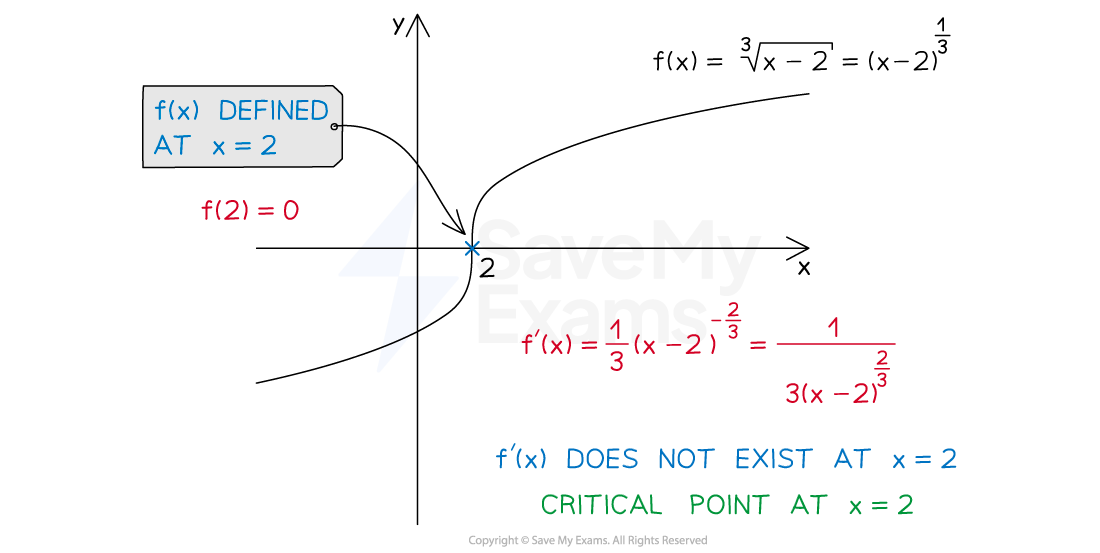
Graph of f(x) = (x - 2)^(1/3) with annotations. f(x) defined at x=2, f(2)=0. Critical point at x=2. f'(x)=1/3(x-2)^(-2/3). f'(x) does not exist at x=2.
An example of a critical point where the derivative is undefined
  • It is also possible for a critical point to exist at a point that is defined but not continuous

    • This means the derivative does not exist at that point

    • The function jumps to a higher or lower value
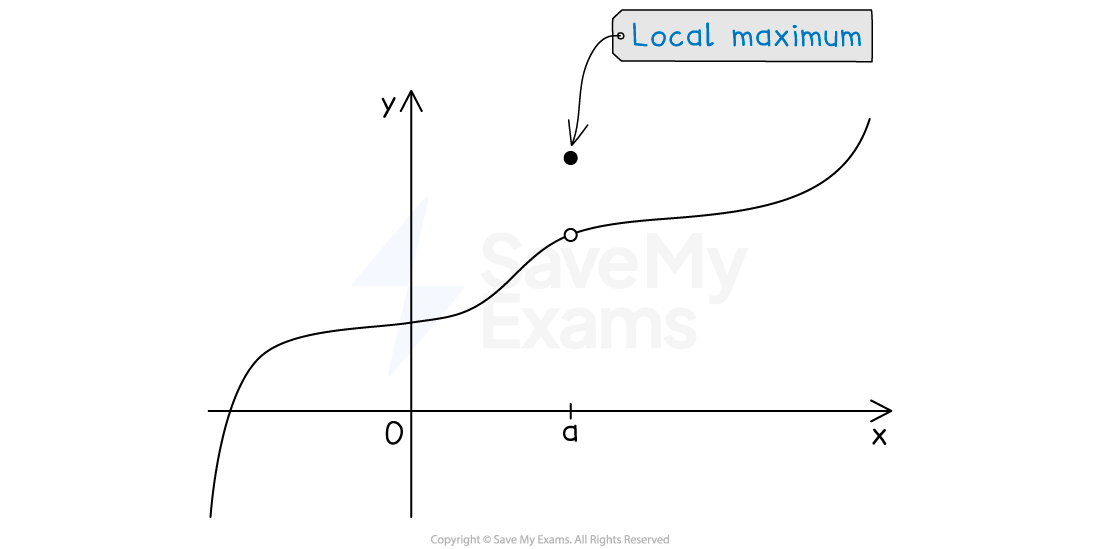
Graph of a curve with a discontinuity 'hole' at x=a (where a>0), and a single filled-in point above the curve also at x=a
An example of a local maximum point at a point which is not continuous

Examiner Tips and Tricks

It is very unlikely that this type of critical point will appear in the exam. However, it is good for you to understand them.

Worked Example

Find the coordinates of the critical point(s) on the graph of the function f defined by f open parentheses x close parentheses equals 4 x cubed minus 30 x squared plus 48 x plus 3.

Answer:

Find the points where the derivative is equal to zero

f to the power of apostrophe open parentheses x close parentheses equals 12 x squared minus 60 x plus 48

table row cell 12 x squared minus 60 x plus 48 end cell equals 0 row cell x squared minus 5 x plus 4 end cell equals 0 row cell open parentheses x minus 4 close parentheses open parentheses x minus 1 close parentheses end cell equals 0 end table

x equals 4 or x equals 1

f to the power of apostrophe open parentheses x close parentheses exists for all x, so there are no other critical points (i.e. where the derivative does not exist)

Find the corresponding y values for these two critical points

f open parentheses 1 close parentheses equals 25
f open parentheses 4 close parentheses equals negative 29

A graph of the function is shown below
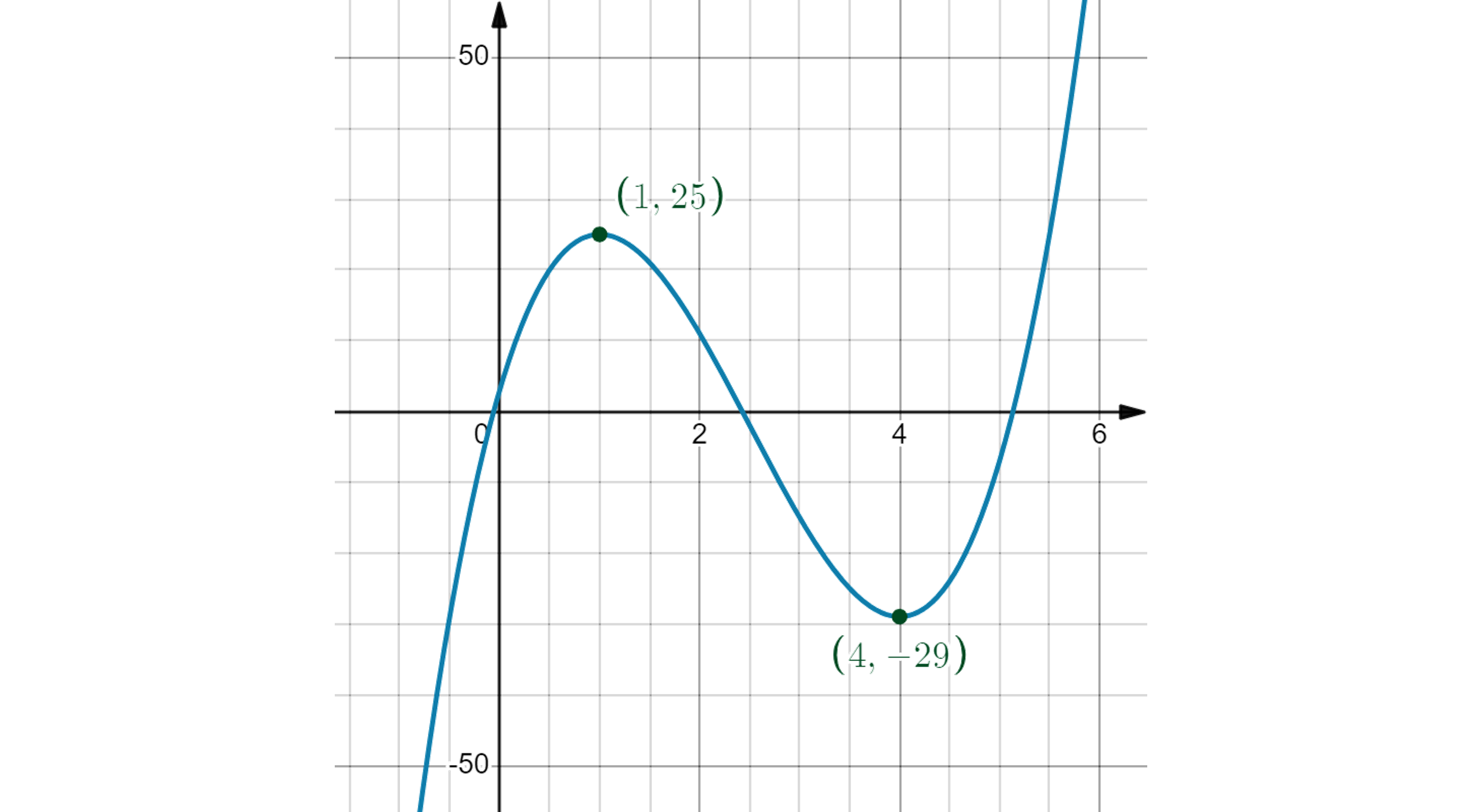
Graph of a cubic function with labeled points at (1, 25) and (4, -29). The curve increases, decreases, and then increases again with axes marked.

Critical points at (1, 25) and (4, -29)

Worked Example

Find the coordinates of the critical point(s) on the graph of the function g defined by g open parentheses x close parentheses equals open parentheses x minus 3 close parentheses to the power of 2 over 3 end exponent.

Answer:

Differentiate the function using the chain rule

g to the power of apostrophe open parentheses x close parentheses equals 2 over 3 open parentheses x minus 3 close parentheses to the power of negative 1 third end exponent equals fraction numerator 2 over denominator 3 open parentheses x minus 3 close parentheses to the power of 1 third end exponent end fraction

There are no points where the derivative is equal to zero

However the derivative will be undefined when x equals 3, as the denominator will be zero

The function is defined when x equals 3, as g open parentheses 3 close parentheses equals open parentheses 0 close parentheses to the power of 2 over 3 end exponent equals 0

However g to the power of apostrophe open parentheses 3 close parentheses is undefined, so there is a critical point at x equals 3

A graph of the function is shown below
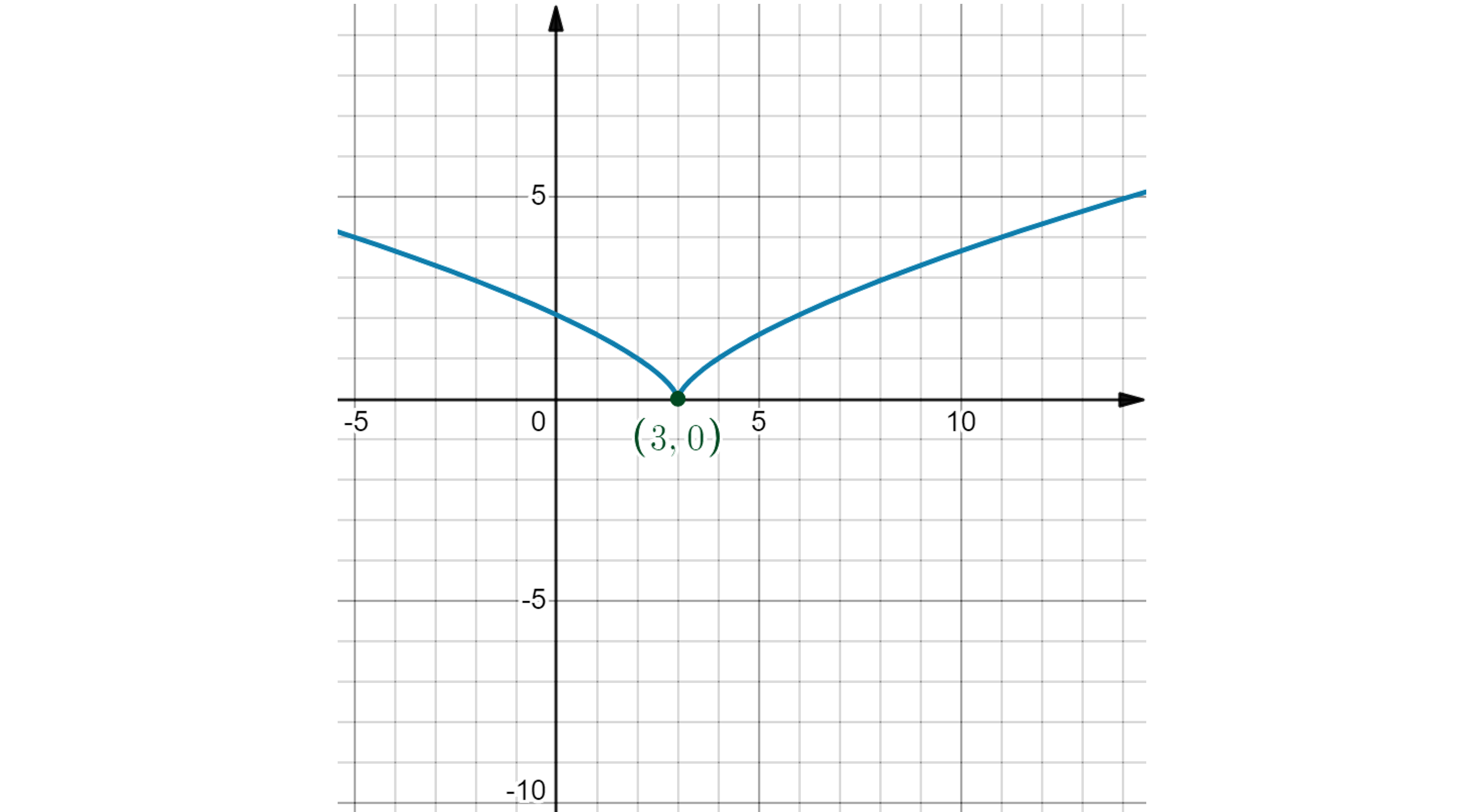
Graph of the quadratic function y = (x - 3)^(2/3) on a grid, with a cusp at (3, 0).

Critical point at (3, 0)

Unlock more, it's free!

Join the 100,000+ Students that ❤️ Save My Exams

the (exam) results speak for themselves:

Jamie Wood

Author: Jamie Wood

Expertise: Maths Content Creator

Jamie graduated in 2014 from the University of Bristol with a degree in Electronic and Communications Engineering. He has worked as a teacher for 8 years, in secondary schools and in further education; teaching GCSE and A Level. He is passionate about helping students fulfil their potential through easy-to-use resources and high-quality questions and solutions.

Dan Finlay

Reviewer: Dan Finlay

Expertise: Maths Subject Lead

Dan graduated from the University of Oxford with a First class degree in mathematics. As well as teaching maths for over 8 years, Dan has marked a range of exams for Edexcel, tutored students and taught A Level Accounting. Dan has a keen interest in statistics and probability and their real-life applications.