Defining Parametric Equations (College Board AP® Calculus BC): Study Guide

Defining parametric equations
What are parametric equations?
Parametric equations are an alternative way to represent the equation of a curve using a third variable called a parameter
The letter is often used for the parameter
The parametric equations are
For example
Sometimes a restricted range of values is given
e.g. where
How do I sketch parametric equations?
You can sketch parametric curves using your calculator
Change the type of graph to "parametric"
Parametric curves often have very interesting shapes
They can loop around and spiral etc.

Parametric curves have a direction of flow
e.g. anticlockwise around a loop
The direction can be found by looking at the equations as increases
You can find key features of the graph algebraically
The -intercepts are when
If then solve
The -intercepts are when
If then solve
Examiner Tips and Tricks
If parametric equations involve trig functions (e.g. ) then you should plot in radians on your calculator.
How do I eliminate the parameter?
Eliminating the parameter means rewriting a parametric curve as an equation in and only (no )
To do this:
Make the subject of one of the equations
Substitute this into the other equation
Simplify if required
e.g. make the subject of and substitute it into
This gives
There is no
You may need to convert a range of values into a range of or values
See the Worked Example
It is not always possible to eliminate the parameter
e.g. and
If it is possible, it is not always possible to make the subject
e.g.
How do I use trigonometric identities to eliminate the parameter?
Another way to eliminate the parameter is by substituting parametric equations into a trigonometric identity
e.g. rearrange and substitute and into the identity
This gives the equation
There is no
Worked Example
A curve is given parametrically by
where
(a) Find the coordinates of any points at which the curve intersects the coordinate axes.
(b) Sketch the curve. Indicate the direction of the curve as increases.
(c) Find the equation of the curve in the form .
Answer:
(a)
To find any points of intersection with the -axis, must equal zero
Solve this equation to find
However you are told so is not possible (there is no -intercept)
To find any points of intersection with the -axis, must equal zero
Solve this equation to find
Since this value of is in the range
Substitute into the equation for to find its coordinate
The only point at which the curve crosses the coordinate axes is
(b)
Change the input in your calculator to "parametric" and use it to sketch the graph for
The direction can be found by looking at the coordinates of two points as increases, e.g. and
When then and , and when then and
gives coordinates
gives coordinates
So direction of flow is from to
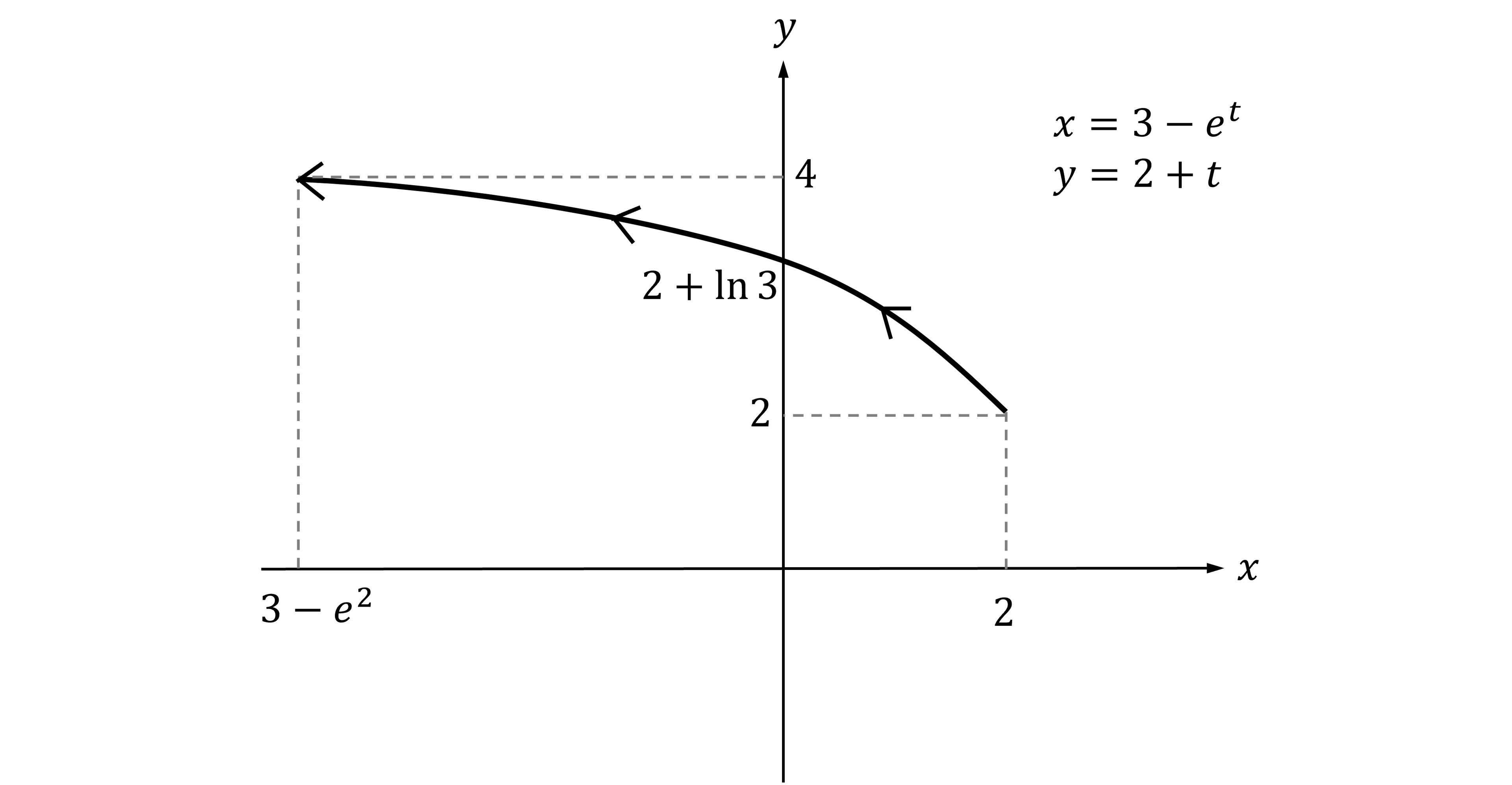
(c)
The form asked for has no in it, so make the subject of one of the equations and substitute it into the other
For example, make the subject of the equation
Then substitute this into the equation
The interval needs to be turned into a interval of values (for example, by looking at the -axis in the graph above)
where

Unlock more, it's free!
Join the 100,000+ Students that ❤️ Save My Exams
the (exam) results speak for themselves:

Was this revision note helpful?
Build on this topic
