Evaluating Limits Numerically & Graphically (College Board AP® Calculus BC): Study Guide

Limits from tables
How can I estimate a limit using values in a table?
Values of a function in a table can show the behavior of a function near a point
This can allow you to estimate the limit at that point
For example, let be the function defined by
The table below shows values of the function near
Note that the function is not defined at , because
x | f(x) |
|---|---|
-0.1 | 0.49958347 |
-0.01 | 0.49999583 |
-0.001 | 0.49999996 |
0 | not defined |
0.001 | 0.49999996 |
0.01 | 0.49999583 |
0.1 | 0.49958347 |
From the table we can see that gets nearer and nearer to 0.5 as gets nearer and nearer to 0
Therefore we can estimate that is equal to 0.5
Analytical methods would need to be used to confirm that this is indeed the limit
Examiner Tips and Tricks
In your exam, you might be asked to verify the value limit using a table. However, if you are asked to find the value of a limit, you should use an analytical method.
Limits from graphs
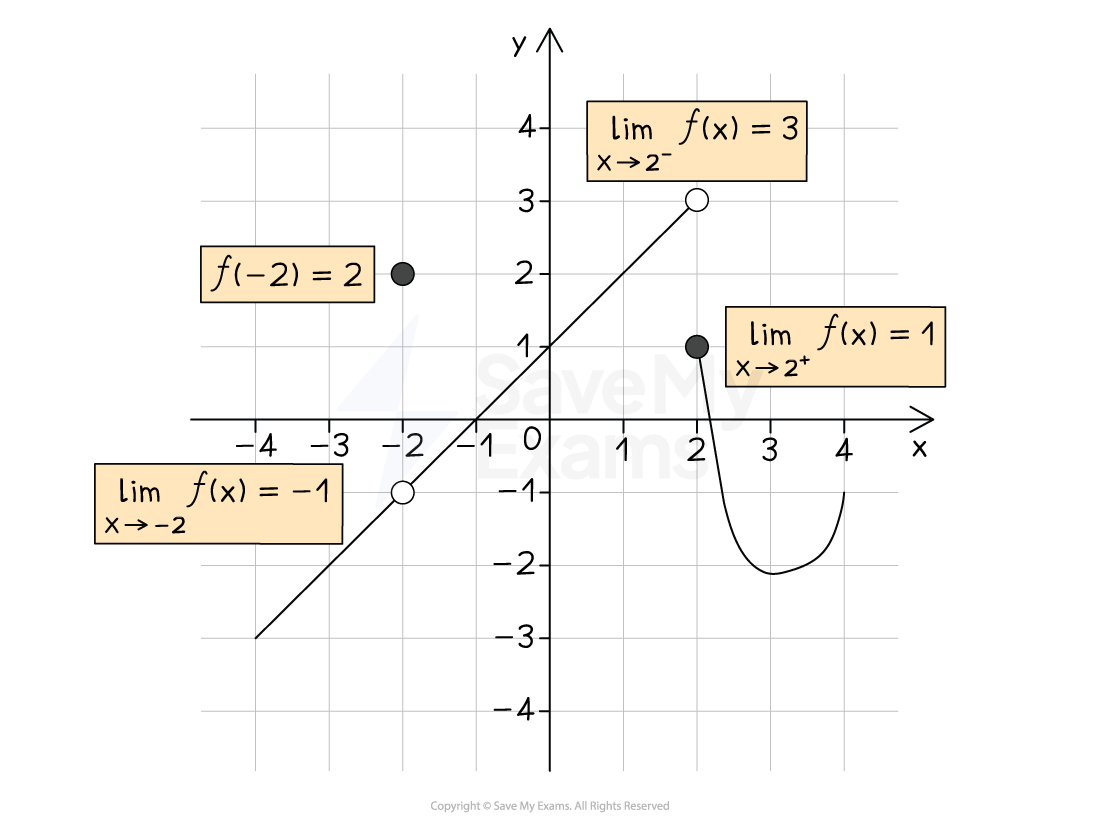
How can I find limits using a graph with given points?
To find
Look at the -values of points on the graph just before
To find
Look at the -values of points on the graph just after
Remember does not necessarily equal
Don't look at the point
Look at the points just before and after
How can I estimate a limit using a graph?
A graph can show the behavior of a function near a point
This can allow you to estimate the limit at that point
For example, let be the function defined by
The graph below shows the behavior of the function near
Note that the function is not defined at , because
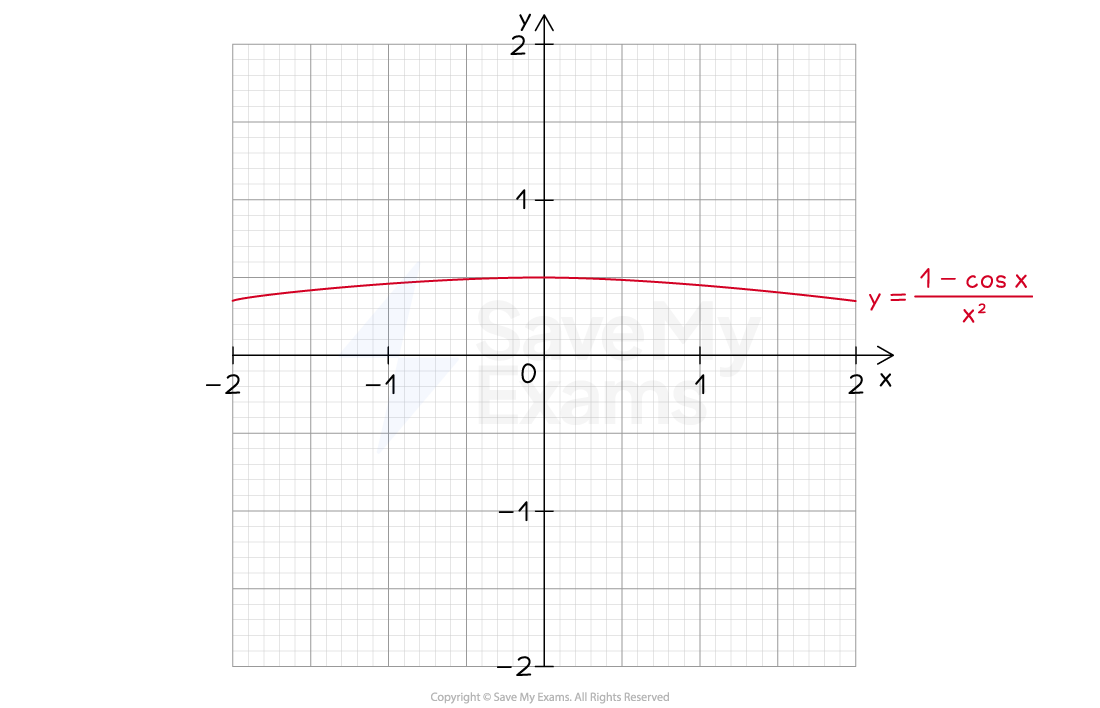
From the graph we can see that gets nearer and nearer to 0.5 as gets nearer and nearer to 0
Therefore we can estimate that is equal to 0.5
Analytical methods would need to be used to confirm that this is indeed the limit
Examiner Tips and Tricks
You can graph functions on your graphing calculator to check your answers when determining limits analytically.
Worked Example
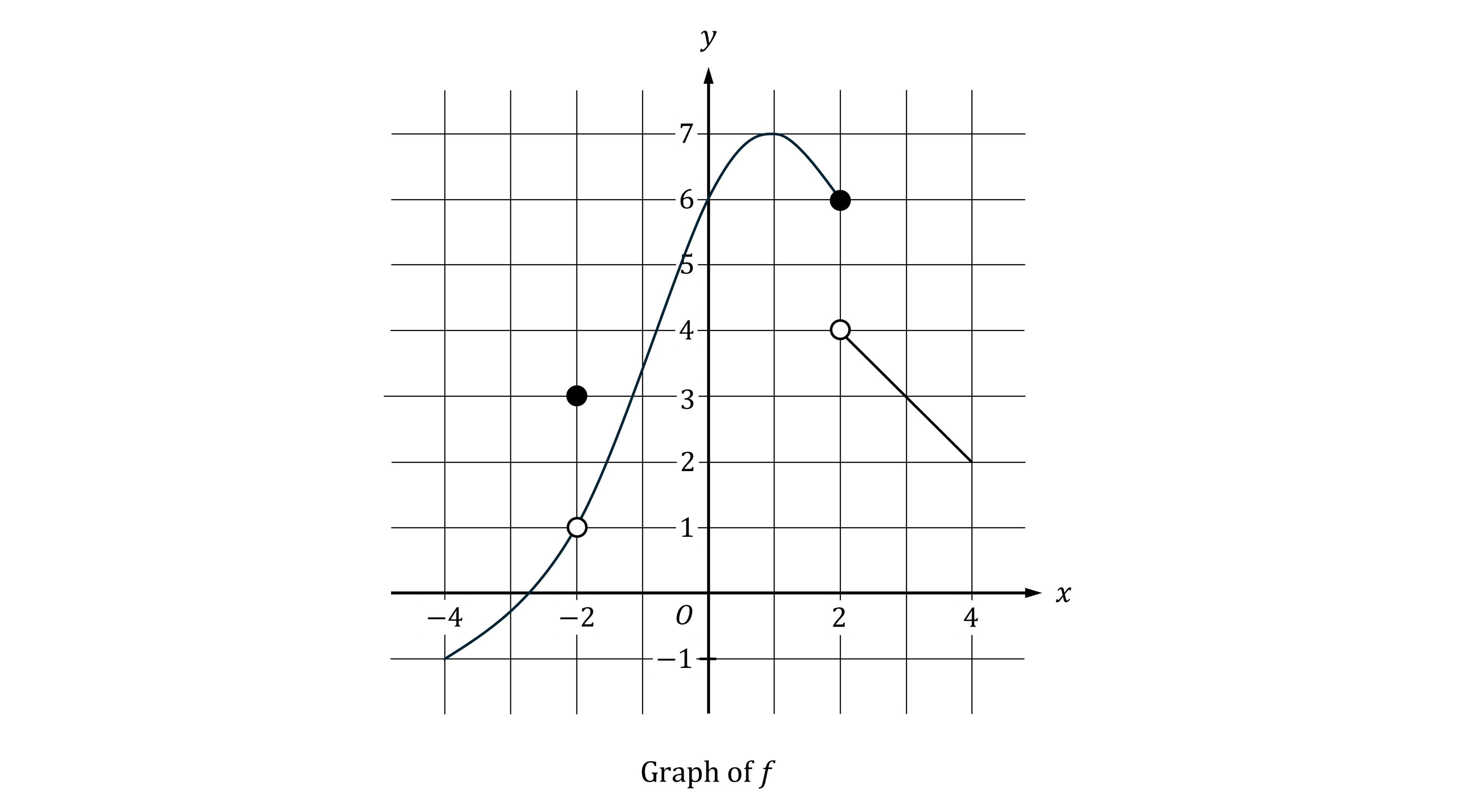
The figure above shows the graph of the function .
Use the graph to find the following limits or state they do not exist:
(a)
(b)
(c)
Answer:
(a)
Ignore the point when and look at the graph just before and just after this point
As from both sides,
Both parts of the graph are heading towards the point (-2, 1)
Therefore, this is the limit even though the graph does not go through that point
(b)
Look at the graph just after the point
As from the right,
The graph is heading towards the point (2, 4)
Therefore, this is the right-hand limit even though the graph does not go through that point
(c)
Ignore the point when and look at the graph just before and just after this point
As from the left,
The graph is heading towards the point (2, 6)
The right-hand side limit is equal to 4 using part (b)
Therefore, the left-hand limit and the right-hand limit are not equal
does not exist

Unlock more, it's free!
Join the 100,000+ Students that ❤️ Save My Exams
the (exam) results speak for themselves:

Was this revision note helpful?
Build on this topic
