Second Derivative Test for Local Extrema (College Board AP® Calculus BC): Study Guide

Jamie Wood

Written by: Jamie Wood

Reviewed by: Dan Finlay

Updated on

Second derivative test

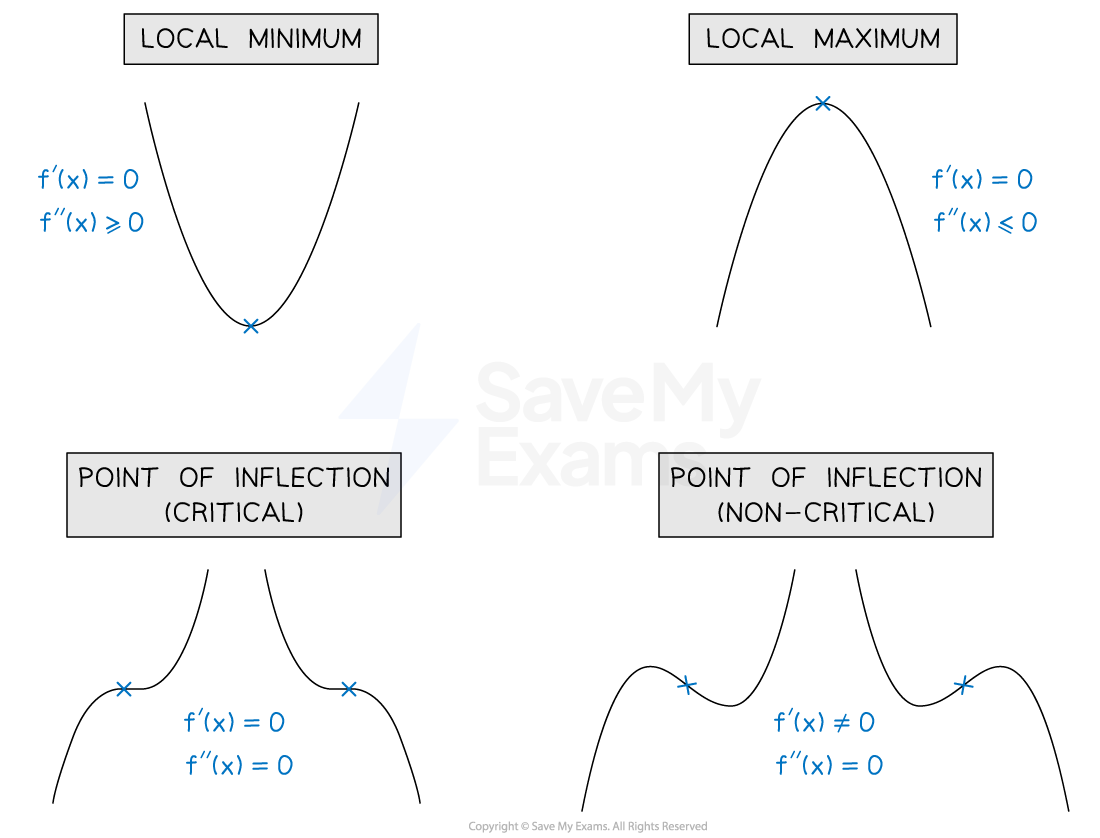
First and second derivatives at key points

  • To be able to classify key points on the graph of a function, it is important that you are confident with the properties of the first and second derivatives at these points

Type of point

First derivative

Second derivative

Local minimum

Zero

Positive or zero

Local maximum

Zero

Negative or zero

Point of inflection (critical)

Zero

Zero

Point of inflection (non-critical)

Non-zero

Zero

Diagram showing local minimum, local maximum, critical and non-critical points of inflection. Formulas included indicate first and second derivative conditions.
Example of critical points and points of inflection

What is the second derivative test?

  • The information above means the second derivative can be used to determine if a critical point is a local minimum or maximum

  • The second derivative test states that:

    • If f to the power of apostrophe open parentheses a close parentheses equals 0 and f to the power of apostrophe apostrophe end exponent open parentheses a close parentheses greater than 0,

      • then f open parentheses x close parentheses has a local minimum at x equals a

    • If f to the power of apostrophe open parentheses a close parentheses equals 0 and f to the power of apostrophe apostrophe end exponent open parentheses a close parentheses less than 0,

      • then f open parentheses x close parentheses has a local maximum at x equals a

    • If f to the power of apostrophe open parentheses a close parentheses equals 0 and f to the power of apostrophe apostrophe end exponent open parentheses a close parentheses equals 0 then this test does not give any information

      • it could be any of a local minimum, local maximum, or point of inflection

Which points have a second derivative of zero?

  • All points of inflection have a second derivative of zero

    • However, not all points with a second derivative of zero are points of inflection

  • It is possible for local minimums or maximums to have a second derivative of zero

    • It is also possible for the second derivative to be zero, but for the point to not be a critical point nor a point of inflection

  • The second derivative test is only for determining if a critical point is a local minimum or maximum

  • If you find that f apostrophe open parentheses x close parentheses equals 0 and f to the power of apostrophe apostrophe end exponent open parentheses x close parentheses equals 0 then you need to investigate further

    • You can check the sign of the first derivative on either side of the point

      • If it changes from positive to negative, it is a local maximum

      • If it changes from negative to positive, it is a local minimum

      • If it stays the same, it is a point of inflection

    • You can also check the sign of the second derivative on either side of the point

      • If it changes, it is a point of inflection

      • If it is positive on both sides, then it is a local minimum

      • If it is negative on both sides, then it is a local maximum

Worked Example

Let the function f be defined by f open parentheses x close parentheses equals x cubed minus 3 x squared plus 3.

Find the coordinates of any local extrema on the graph of f, and classify the nature of these extrema.

Answer:

Find the critical points by finding the first derivative and setting equal to zero

f to the power of apostrophe open parentheses x close parentheses equals 3 x squared minus 6 x

table row cell 3 x squared minus 6 x end cell equals 0 row cell x squared minus 2 x end cell equals 0 row cell x open parentheses x minus 2 close parentheses end cell equals 0 end table

x equals 2 or x equals 0

Find the y-coordinates at these points

f open parentheses 2 close parentheses equals negative 1

f open parentheses 0 close parentheses equals 3

Critical points at (2, -1) and (0, 3)

Classify these points by using the second derivative test

f to the power of apostrophe apostrophe end exponent open parentheses x close parentheses equals 6 x minus 6

Substitute the x value of each critical point into the second derivative

f to the power of apostrophe apostrophe end exponent open parentheses 2 close parentheses equals 6

f to the power of apostrophe apostrophe end exponent open parentheses 0 close parentheses equals negative 6

(2, -1) is a local minimum by the second derivative test because space f apostrophe open parentheses 2 close parentheses equals 0 and space f apostrophe apostrophe open parentheses 2 close parentheses greater than 0

(0, 3) is a local maximum by the second derivative test because space f apostrophe open parentheses 0 close parentheses equals 0 and space f apostrophe apostrophe open parentheses 0 close parentheses less than 0

Worked Example

Determine the nature of the critical point on the graph of space f open parentheses x close parentheses equals 3 x to the power of 4 plus 2 x to the power of 6.

Answer:

Find the critical point first, by using f apostrophe open parentheses x close parentheses equals 0

f apostrophe open parentheses x close parentheses equals 12 x cubed plus 12 x to the power of 5

table row cell 12 x cubed plus 12 x to the power of 5 end cell equals 0 row cell 12 x cubed open parentheses 1 plus x squared close parentheses end cell equals 0 end table

x equals 0 is the only real solution

Find the y-coordinate

f open parentheses 0 close parentheses equals 0

The critical point is at (0, 0)

To determine the nature of the critical point, start by finding the second derivative at this point

f apostrophe apostrophe open parentheses x close parentheses equals 36 x squared plus 60 x to the power of 4

f apostrophe apostrophe open parentheses 0 close parentheses equals 0

First derivative is zero, and second derivative is zero

Therefore could be any of minimum, maximum, or point of inflection

Method 1 - Using the first derivative

Check the first derivative either side of the point to determine the nature of the point

f apostrophe open parentheses negative 1 close parentheses equals 12 open parentheses negative 1 close parentheses cubed plus 12 open parentheses negative 1 close parentheses to the power of 5 equals negative 24

f apostrophe open parentheses 1 close parentheses equals 12 open parentheses 1 close parentheses cubed plus 12 open parentheses 1 close parentheses to the power of 5 equals 24

Just before x equals 0, space f is decreasing because space f apostrophe open parentheses x close parentheses less than 0

Just after x equals 0, space f is increasing because space f apostrophe open parentheses x close parentheses greater than 0

Therefore, space f has a local minimum at open parentheses 0 comma space 0 close parentheses by the first derivative test

Method 2 - Using the second derivative

Check the second derivative either side of the point to determine the nature of the point

f apostrophe apostrophe open parentheses negative 1 close parentheses equals 36 times open parentheses negative 1 close parentheses squared plus 60 times open parentheses negative 1 close parentheses to the power of 4 equals 96

f apostrophe apostrophe open parentheses 1 close parentheses equals 36 times open parentheses 1 close parentheses squared plus 60 times open parentheses 1 close parentheses to the power of 4 equals 96

Just before x equals 0, space f is concave up because space f apostrophe apostrophe open parentheses x close parentheses greater than 0

Just after x equals 0, space f is concave up because space f apostrophe apostrophe open parentheses x close parentheses greater than 0

Therefore, space f has a local minimum at open parentheses 0 comma space 0 close parentheses because space f apostrophe open parentheses 0 close parentheses equals 0 and space f is concave up around the point

Unlock more, it's free!

Join the 100,000+ Students that ❤️ Save My Exams

the (exam) results speak for themselves:

Jamie Wood

Author: Jamie Wood

Expertise: Maths Content Creator

Jamie graduated in 2014 from the University of Bristol with a degree in Electronic and Communications Engineering. He has worked as a teacher for 8 years, in secondary schools and in further education; teaching GCSE and A Level. He is passionate about helping students fulfil their potential through easy-to-use resources and high-quality questions and solutions.

Dan Finlay

Reviewer: Dan Finlay

Expertise: Maths Subject Lead

Dan graduated from the University of Oxford with a First class degree in mathematics. As well as teaching maths for over 8 years, Dan has marked a range of exams for Edexcel, tutored students and taught A Level Accounting. Dan has a keen interest in statistics and probability and their real-life applications.