Instantaneous Rate of Change (College Board AP® Calculus BC): Revision Note

Instantaneous rate of change
What is the instantaneous rate of change?
The instantaneous rate of change is the slope of a graph at a specific point, rather than between two points
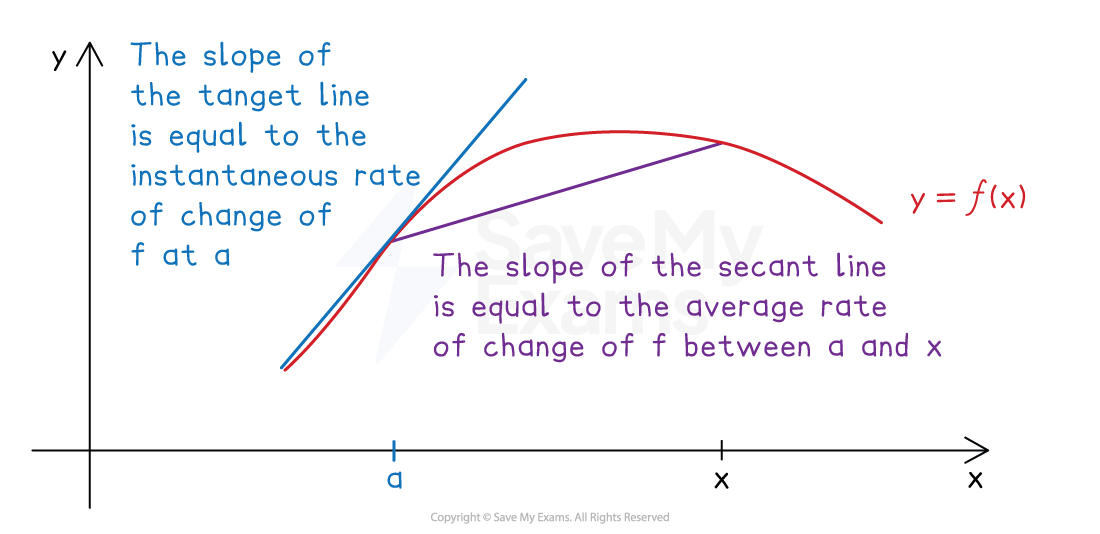
How do I find the instantaneous rate of change?
Consider the graph of a function with two points on the graph, and
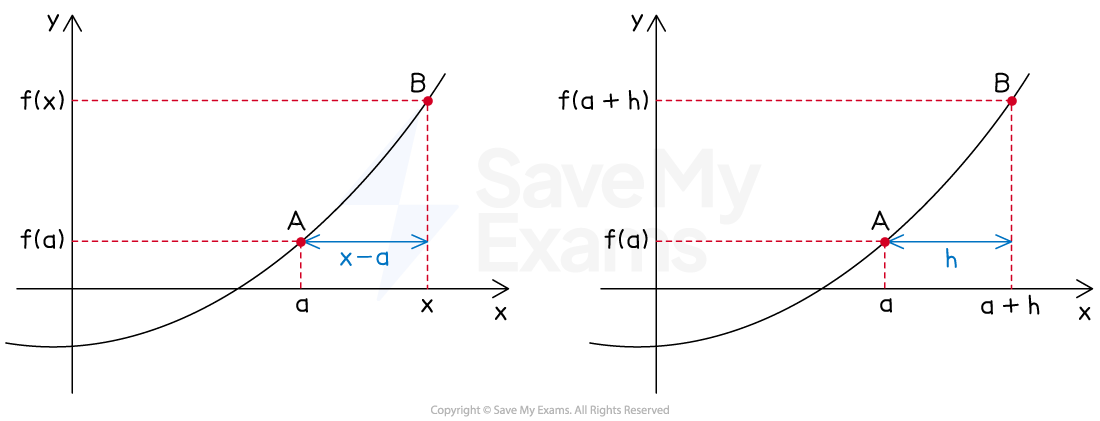
Using the labeling on the left,
the average rate of change from to can be written as
Using the labeling on the right,
the average rate of change from to can be written as
To find the instantaneous rate of change, consider finding the slope of the secant line between and as point moves closer to point
As the distance between the two points becomes smaller, the slope will become a more accurate estimate for the instantaneous rate of change at
Therefore the instantaneous rate of change will be the limit as this distance tends to zero
The instantaneous rate of change at can be written as
or
These only give a valid answer if the relevant limit exists
They are both equivalent forms of the definition of the derivative of the function at , denoted by
Worked Example
A function is defined by .
Find, using limits, the instantaneous rate of change of at the point where .
Answer:
Method 1
Consider the formula
Substitute into the formula
Evaluate the function, , at the two points
Factor the numerator
Simplify the fraction by cancelling terms
Evaluate the limit
Instantaneous rate of change at is
Method 2
Consider the formula
Substitute into the formula
Evaluate the function, , at and
Expand and simplify the numerator
Simplify the fraction by cancelling terms
Evaluate the limit
Instantaneous rate of change at is

Unlock more, it's free!
Join the 100,000+ Students that ❤️ Save My Exams
the (exam) results speak for themselves:

Was this revision note helpful?
Build on this topic