Differentiability & Continuity (College Board AP® Calculus BC): Revision Note

Differentiability & continuity
When is a function differentiable?
The derivative of a function is defined as
The derivative only exists if this limit exists
The derivative, if it exists, is itself a function
If a point is not in the domain of then it cannot be in the domain of
This means will not be differentiable at points where there is a vertical asymptote
E.g. is not differentiable at
A differentiable function is one for which its derivative exists at each point in its domain
This means that a function with points at which it is not differentiable can still be made a differentiable function by appropriately restricting its domain
How are differentiability and continuity related?
A function must be continuous at a point to be differentiable at that point
Therefore, if a function is differentiable at a point, then it is continuous at that point
And if a function is not continuous at a point, then it is not differentiable at that point
However, if a function is continuous at a point, it is not necessarily differentiable at that point
The function could have a corner at a point
This is where the one-sided limits of the derivative at the point are finite but unequal
E.g. has a corner at
The function could have a cusp at a point
This is where one of the one-sided limits of the derivative at the point tends to infinity and the other tends to negative infinity
E.g. has a cusp at
The function could have a vertical tangent at a point
This is where both the one-sided limits of the derivative at the point tend to infinity or they both tend to negative infinity
E.g. has a vertical tangent at
The function could not be differentiable at a point due to oscillation
This is where the derivative oscillates as it approaches the point
E.g. at
Examiner Tips and Tricks
Exam questions often state that a function is differentiable, and expect you to know (and use the fact) that this automatically means the function is continuous as well.
If a function is said to be twice differentiable, this means that the function's derivative is also continuous!
How can I show a function is not differentiable at a point?
If a function is not continuous at a point, then it is not differentiable at that point
That's the easiest way to show a function is not differentiable at a point!
If a function is continuous at a point, then to show it is not differentiable
you need to go back to the limit definition of the derivative
Recall that the limit of a function does not exist if the function inside the limit
is unbounded at the point in question
oscillates near the point in question
or has unequal one-sided limits at the point in question
Consider the graph of shown below
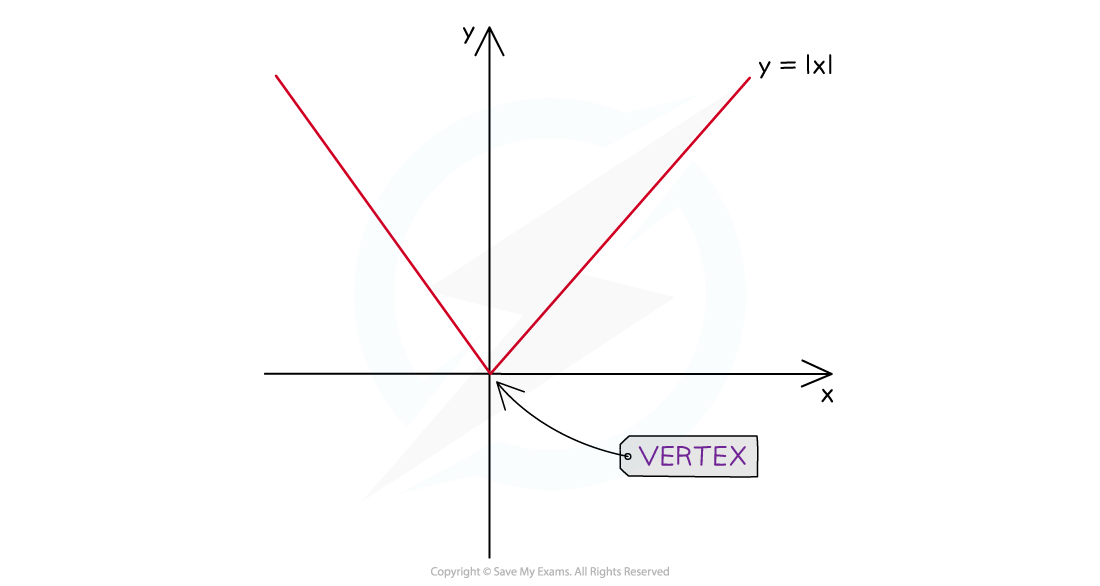
At (0, 0), is not differentiable
To show why, consider the derivative at (0, 0)
Consider the one-sided limit from the left
For ,
So
Consider the one-sided limit from the right
For ,
So
You can also see this visually from the graph
The slope for negative values of is -1
The slope for positive values of is 1
The one-sided limits do not agree, therefore the limit at (0, 0) does not exist
Therefore is not differentiable at (0, 0)
Examiner Tips and Tricks
If you have to explain why a derivative does not exist at a point where a function is continuous:
use the limit definition of a derivative,
and show that the limit does not exist
Consider the graph of shown below
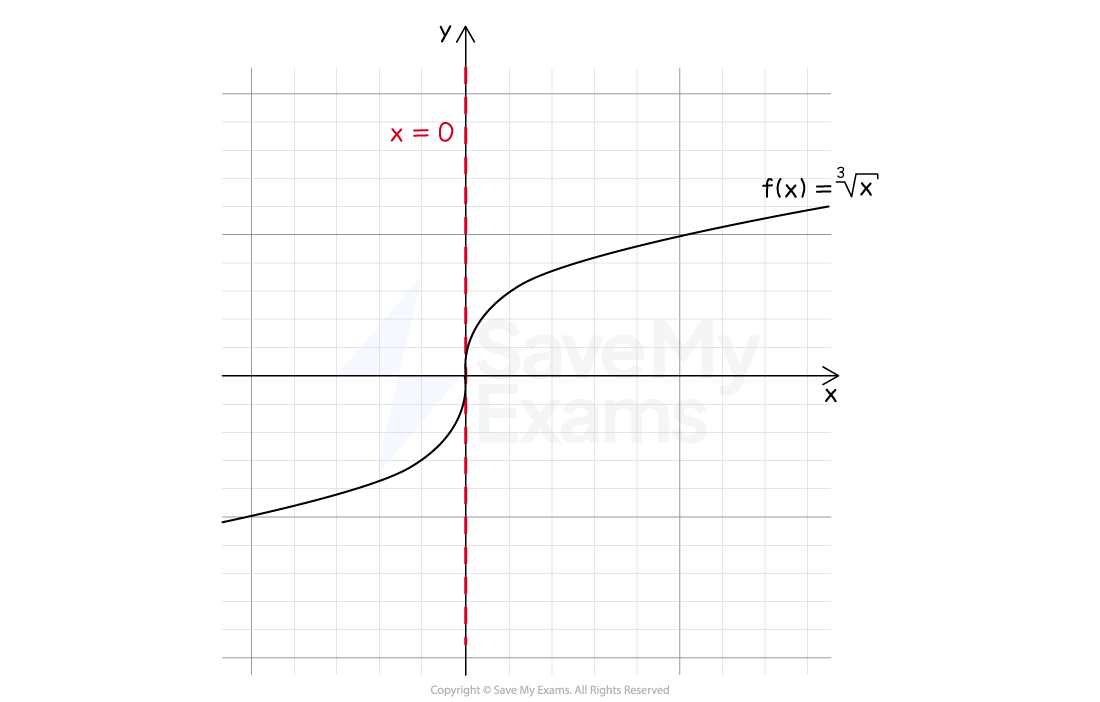
At (0, 0), is not differentiable
To show why, consider the derivative at (0, 0)
The limit approaches infinity from both sides, therefore the limit does not exist
Therefore is not differentiable at (0, 0)
Worked Example
Let be the function defined by for all . Which of the following statements is true?
(A) is a vertical asymptote of the graph of .
(B) is not continuous at .
(C)
(D) is continuous but not differentiable at .
Answer:
Consider option (A)
There will be a vertical asymptote if the function becomes unbounded at this point
Check by substituting in
The function has a well-defined value of 0 at , so there is not an asymptote
Consider option (B)
We have already checked the value of the function at and it has a value of 0
The limits from the left and right at are also equal to 0 (see below)
Therefore the function is continuous at
Consider option (C)
Check the one-sided limit from the left using substitution
Check the one-sided limit from the right using substitution
The two one-sided limits agree therefore
Consider option (D)
Having ruled out options (A), (B), and (C), only (D) can be correct
But we can also check this by inspecting the graph of
You could use your graphing calculator to do this
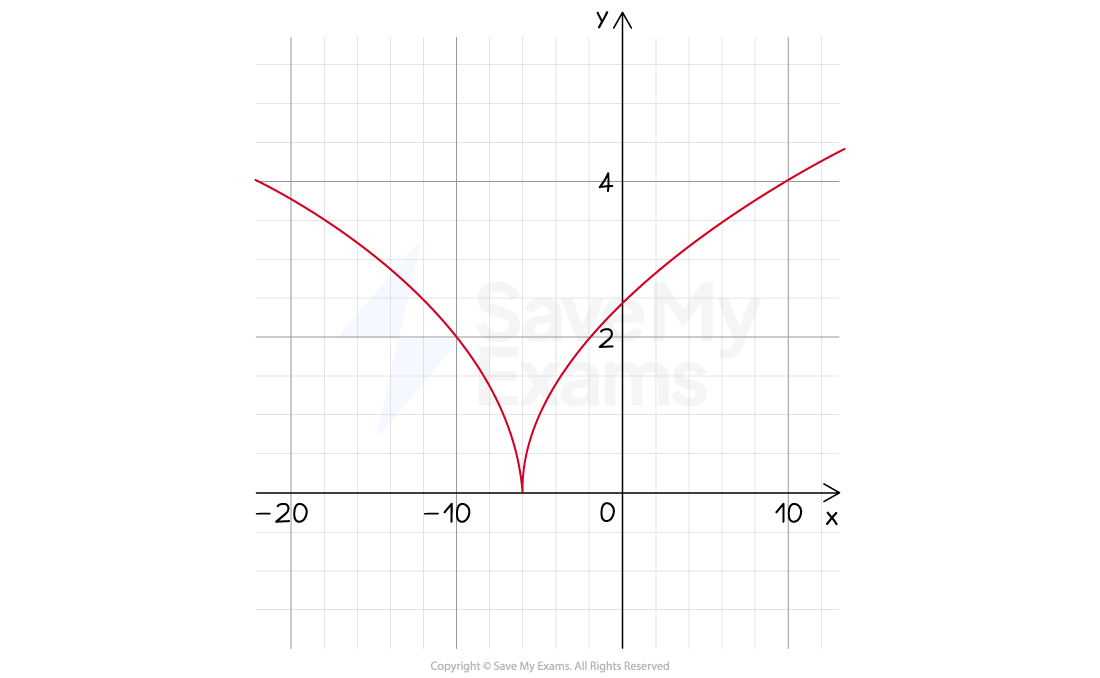
It can be seen that there is a cusp at (-6,0) so at this point the function is continuous, but not differentiable
Option (D)

Unlock more, it's free!
Join the 100,000+ Students that ❤️ Save My Exams
the (exam) results speak for themselves:

Was this revision note helpful?
Build on this topic
