Trapezoidal sums (College Board AP® Calculus BC): Revision Note

Trapezoidal sums
What is a trapezoidal sum?
A trapezoidal sum is another method for approximating the exact value of an accumulation of change
Equivalently, it is a method for approximating the exact value of a definite integral
Or the exact area between a curve and the x-axis
The approximation is made by adding up the areas of a number of trapezoids
How do I calculate a trapezoidal sum?
To calculate the trapezoidal sum of a function between and (where ):
Divide the interval into subintervals by choosing values such that
The intervals do not need to be the same size
Let this define trapezoids
The th trapezoid has a width of
This is the distance from the left-hand side of the trapezoid to the right-hand side
The parallel sides of the th trapezoid have heights of and
These are the values of the function at the left-hand side and right-hand side of the trapezoid
The area of the th trapezoid is
The trapezoidal sum is the sum of the areas of these trapezoids
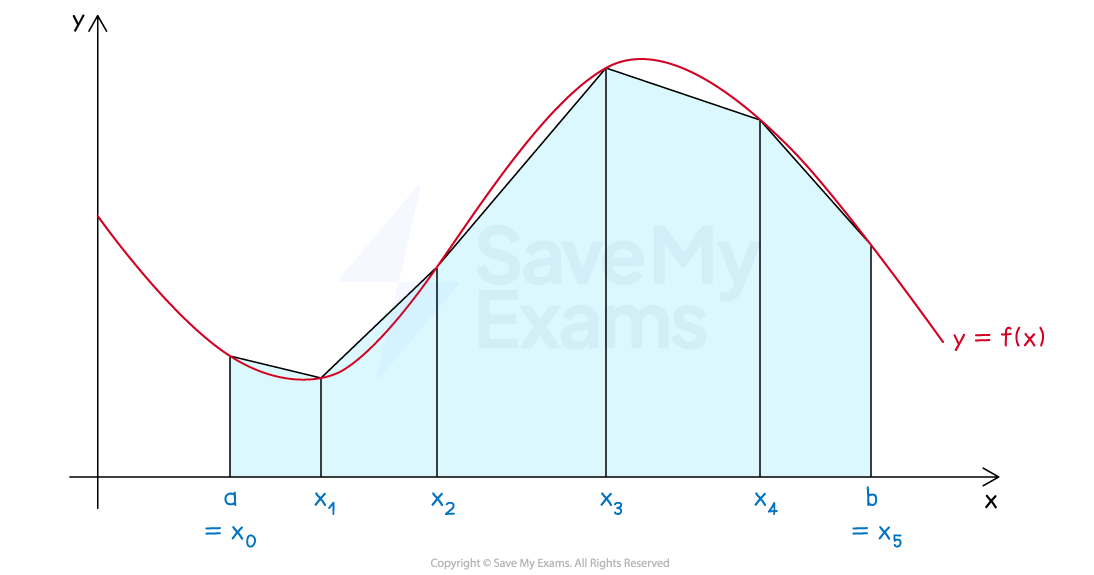
In general, increasing the number of trapezoids, , gives a more accurate approximation
On the exam you may just be given values of the function in a table, rather than being given the function explicitly
See the Worked Example
Examiner Tips and Tricks
The trapezoidal sum is the average of the left and right Riemann sums. You can use this fact to reduce the number of formulas you need to remember.
What if all the intervals in a trapezoidal sum have the same size?
If the intervals used for a trapezoidal sum all have the same size then the formula can be simplified slightly
The width of each trapezoid will be
So the trapezoidal sum will become
By collecting terms and simplifying, this can be rearranged as
or
It may be easier for you to understand how the trapezoidal sum is calculated
than to try and remember that formula
How can I tell if a trapezoidal sum is an underestimate or an overestimate?
If a function is concave up over the interval for which a trapezoidal sum is being calculated
then the trapezoidal sum will be an overestimate
If a function is concave down over the interval for which a trapezoidal sum is being calculated
then the trapezoidal sum will be an underestimate
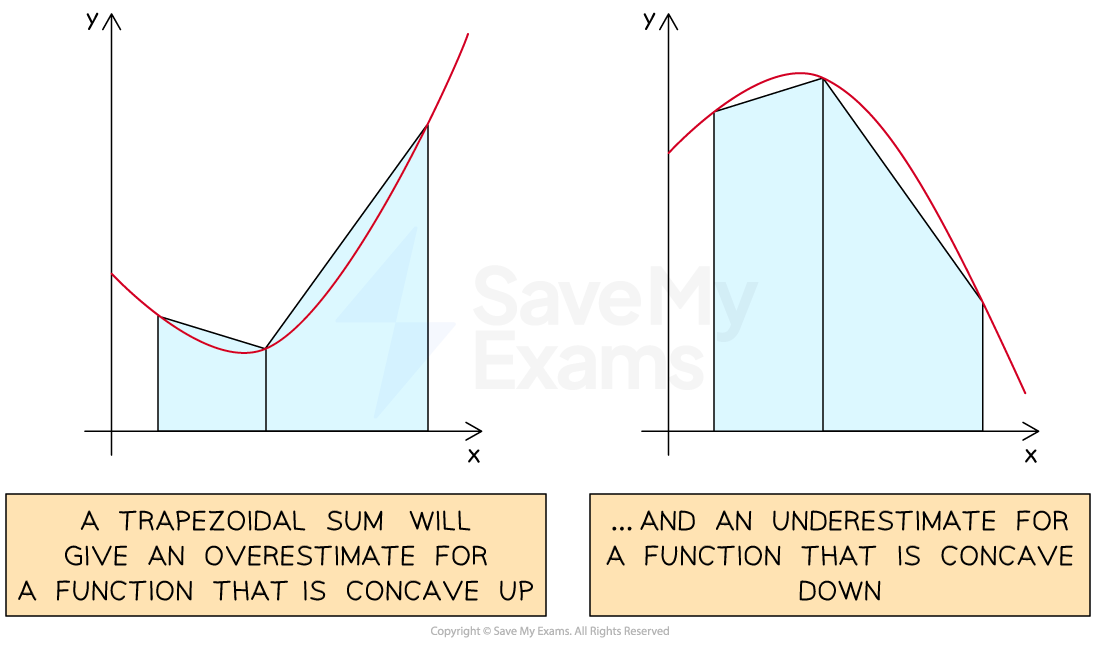
If a function has portions that are both concave up and concave down, then it is not immediately obvious whether a trapezoidal sum will be an underestimate or an overestimate
Worked Example
A social sciences researcher is using a function to model the total mass of all the garden gnomes appearing on lawns in a particular neighborhood at time . The function is twice-differentiable, with measured in kilograms and measured in days.
The table below gives selected values of , the rate of change of the mass, over the time interval . At time , kilograms.
(days) | 0 | 3 | 7 | 10 | 12 |
(kilograms per day) | 2.6 | 4.8 | 12.2 | 0.7 | -1.3 |
Use a trapezoidal sum with the four subintervals indicated in the table to find an estimate for the total mass of the garden gnomes at .
Answer:
The trapezoidal sum will be based on four trapezoids
The first trapezoid will have a width of (3-0) and parallel sides of height and
The second trapezoid will have a width of (7-3) and parallel sides of height and
The third trapezoid will have a width of (10-7) and parallel sides of height and
The fourth trapezoid will have a width of (12-10) and parallel sides of height and
This has units of kilograms, because each term is the product of a 'kg/day' quantity and a 'days' quantity
However that answer only approximates the change in mass
To find the estimate for the total final mass, add the initial mass of 24.9 kilograms
The total mass of garden gnomes at is approximately 88.75 kg

Unlock more, it's free!
Join the 100,000+ Students that ❤️ Save My Exams
the (exam) results speak for themselves:

Was this revision note helpful?
Build on this topic
