Areas between Two Polar Curves (College Board AP® Calculus BC): Revision Note

Mark Curtis

Written by: Mark Curtis

Reviewed by: Dan Finlay

Updated on

Areas between two polar curves

How do I find an area between two polar curves?

  • To find an area between two polar curves, r=f(θ) and r=g(θ):

    • Sketch the two curves

    • Find the angle(s) of intersection, θ=α

      • by solving f(θ)=g(θ)

    • Draw a ray in the direction of θ=α on your diagram

      • This is a straight line from the pole to the point of intersection

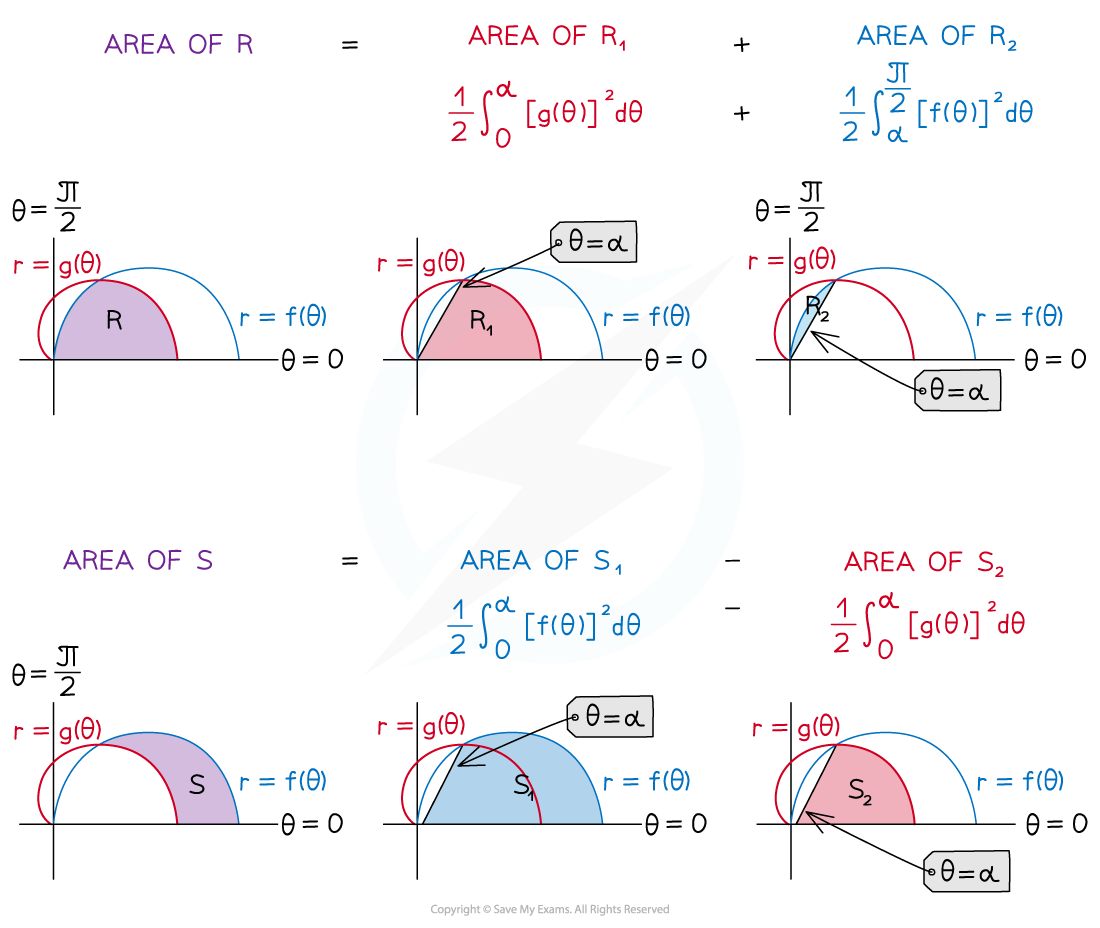
    • Split the area into either a sum or difference of two polar areas, for example:

      • Region R shown below is a sum

      • Region S shown below is difference

    • Use the area formula A=θ1θ2 12r2 dθ to find each area

Diagram showing two polar curves r=f(θ) and r=g(θ), split regions R and S, and integrals for areas R₁, R₂, S₁ and S₂ between θ=0, θ=α and θ=π/2
Finding areas between polar graphs

Examiner Tips and Tricks

If one of the polar areas is part of a circle, e.g. the circle r=a, then it can be quicker to use the formula for the area of a circle,πa2.

Worked Example

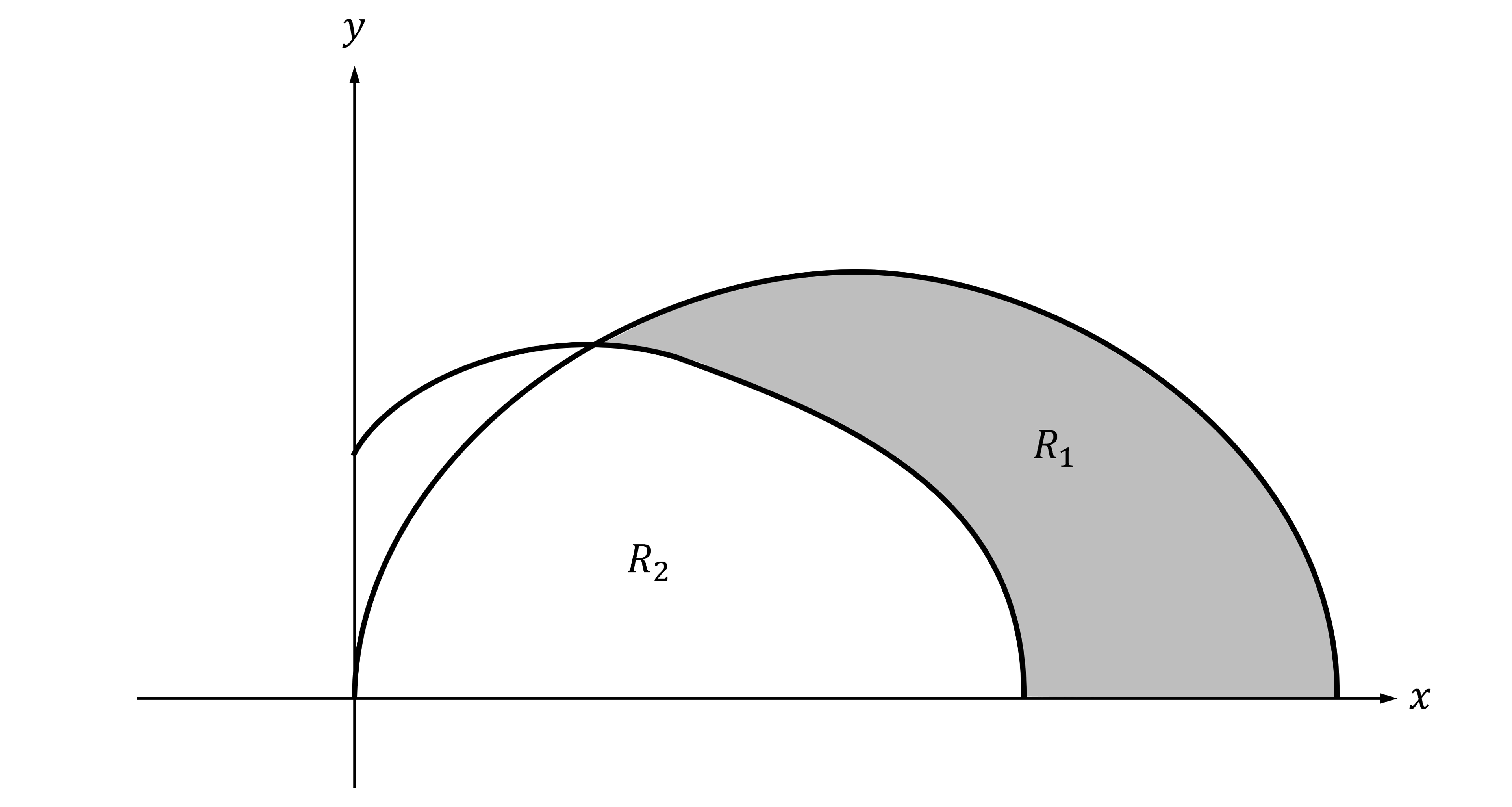
A sketch of the polar curves r=1+cos θ and r=3 cos θ where 0θπ2 is shown below.

The shaded region is labeled R1 and an unshaded region is labeled R2.

Graph showing two intersecting curves on axes, creating regions R1 and R2. Region R1 is shaded grey.

(a) Find the area of R1, leaving your answer as a single integral.

(b) Find the area of R2.

Answer:

(a)

When θ=0, r=3 cos θ is 3 and r=1+cos θ is 2, so r=3 cos θ is the larger curve

Find the angle at which the two curves intersect by setting 1+cos θ equal to 3 cos θ and solving

1+cos θ=3 cos θ1=2 cos θ12=cos θθ=π3

Draw the ray θ=π3 on the diagram to see how to form the area R1

It is the difference between the two polar areas shown below
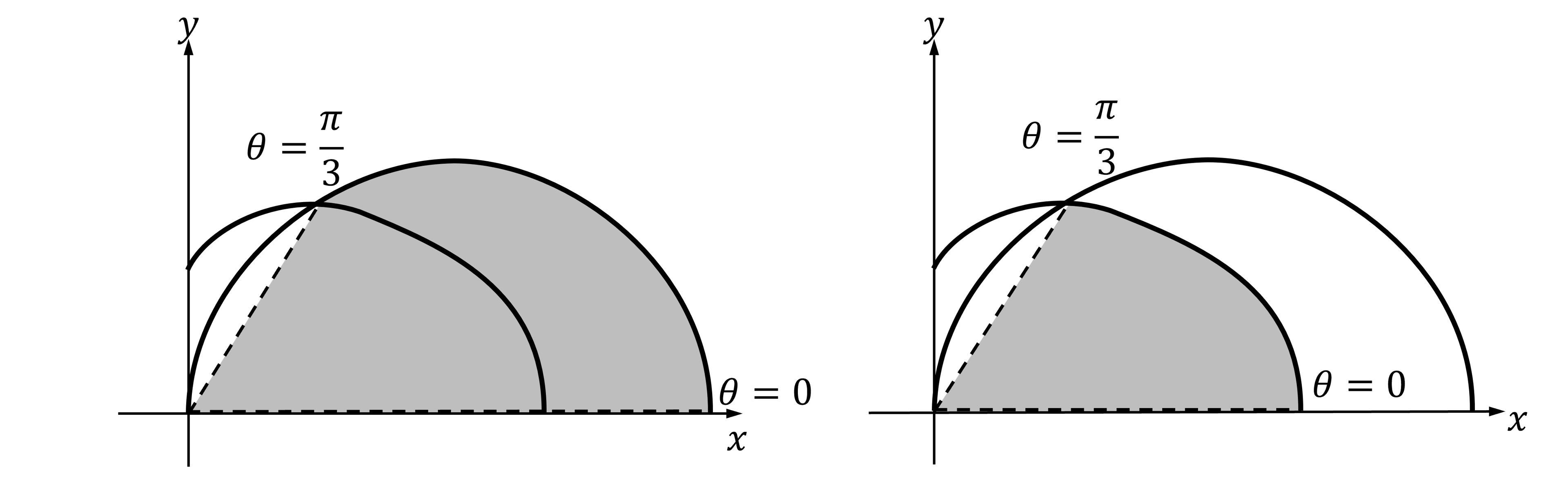
Two graphs showing a larger polar area from one curve on the left and a smaller polar area from the other curve on the right.

Use the formula A=θ1θ2 12r2 dθ to work out the two individual areas, then subtract the smaller area from the larger area

0π 312(3 cos θ)2 dθ0π 312(1+cos θ)2 dθ

The limits of the integrals are the same, so the integrals can be joined to form one single integral (as requested by the question)

0π 312[(3 cos θ)2 (1+cos θ)2] dθ

(b)

R2 is the sum of the two polar areas shown below

r=1+cos θ gives the part of the area from θ=0 to the point of intersection

r=3 cos θ gives the part of the area from the point of intersection to θ=π2 (where r=0), which is the end of the range given in the question
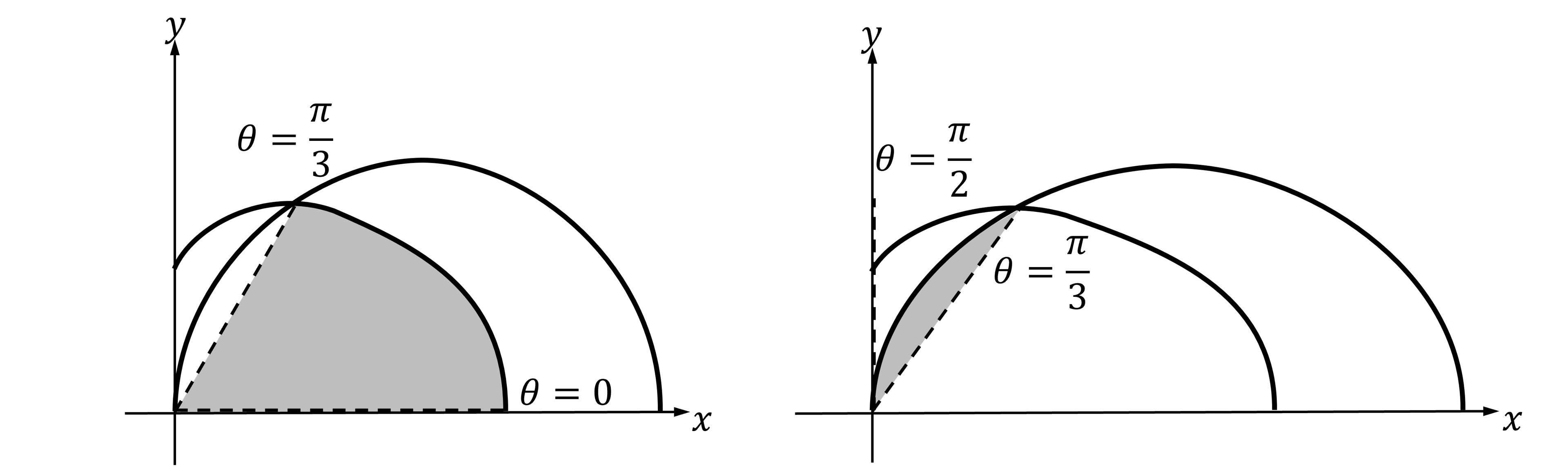
Two graphs, where the one on the left shows a polar region enclosed by one of the graphs and the one on the right shows a different polar region, which, when added to the first, gives the total area required.

Use the formula A=θ1θ2 12r2 dθ to work out the two individual areas, then add them together

0π 312(1+cos θ)2 dθ+π3π 212(3 cos θ)2 dθ

Evaluate the integrals above on your calculator

1.759676...+0.203818...

1.963 (to 3 decimal places)

Unlock more, it's free!

Join the 100,000+ Students that ❤️ Save My Exams

the (exam) results speak for themselves:

Build on this topic

Mark Curtis

Author: Mark Curtis

Expertise: Maths Content Creator

Mark graduated twice from the University of Oxford: once in 2009 with a First in Mathematics, then again in 2013 with a PhD (DPhil) in Mathematics. He has had nine successful years as a secondary school teacher, specialising in A-Level Further Maths and running extension classes for Oxbridge Maths applicants. Alongside his teaching, he has written five internal textbooks, introduced new spiralling school curriculums and trained other Maths teachers through outreach programmes.

Dan Finlay

Reviewer: Dan Finlay

Expertise: Portfolio Lead

Dan graduated from the University of Oxford with a First class degree in mathematics. As well as teaching maths for over 8 years, Dan has marked a range of exams for Edexcel, tutored students and taught A Level Accounting. Dan has a keen interest in statistics and probability and their real-life applications.