Unit 10 Overview (College Board AP® Calculus BC): Exam Questions

2 hours12 questions
1a
Sme Calculator
2 marks

Let y=f(x) be the particular solution to the differential equation dydx=y·(xlnx) with initial condition f(1)=4. It can be shown that f''(1)=4.

Write the second-degree Taylor polynomial for f about x=1. Use the Taylor polynomial to approximate f(2).

1b
Sme Calculator
2 marks

Use Euler's method, starting at x=1 with two steps of equal size, to approximate f(2). Show the work that leads to your answer.

1c
Sme Calculator
5 marks

Find the particular solution y=f(x) to the differential equation dydx=y·(xlnx) with initial condition f(1)=4.

2a
Sme Calculator
3 marks

Let y=f(x) be the particular solution to the differential equation dydx=(3x)y2 with initial condition f(1)=1.

Find f''(1), the value of d2ydx2 at the point (1,1). Show the work that leads to your answer.

2b
Sme Calculator
2 marks

Write the second-degree Taylor polynomial for f about x=1.

2c
Sme Calculator
2 marks

The second-degree Taylor polynomial for f about x=1 is used to approximate f(1.1). Given that |f'''(x)|60 for all x in the interval 1x1.1, use the Lagrange error bound to show that this approximation differs from f(1.1) by at most 0.01.

2d
Sme Calculator
2 marks

Use Euler's method, starting at x=1 with two steps of equal size, to approximate f(1.4). Show the work that leads to your answer.

3a
Sme Calculator
4 marks

The function f has a Taylor series about x=1 that converges to f(x) for all x in the interval of convergence. It is known that f(1)=1, f'(1)=12, and the nth derivative of f at x=1 is given by f(n)(1)=(1)n(n1)!2n for n2.

Write the first four nonzero terms and the general term of the Taylor series for f about x=1.

3b
Sme Calculator
2 marks

The Taylor series for f about x=1 has a radius of convergence of 2. Find the interval of convergence. Show the work that leads to your answer.

3c
Sme Calculator
1 mark

The Taylor series for f about x=1 can be used to represent f(1.2) as an alternating series. Use the first three nonzero terms of the alternating series to approximate f(1.2).

3d
Sme Calculator
2 marks

Show that the approximation found in part (c) is within 0.001 of the exact value of f(1.2).

4a
Sme Calculator
4 marks

The function f is defined by the power series f(x)=xx33+x55x77++(1)nx2n+12n+1+ for all real numbers x for which the series converges.

Using the ratio test, find the interval of convergence of the power series for f. Justify your answer.

4b
Sme Calculator
2 marks

Show that |f(12)12|<110. Justify your answer.

4c
Sme Calculator
2 marks

Write the first four nonzero terms and the general term for an infinite series that represents f'(x).

4d
Sme Calculator
1 mark

Use the result from part (c) to find the value of f'(16).

5a
Sme Calculator
2 marks

The Maclaurin series for ln(1+x) is given by

xx22+x33x44++(1)n+1xnn+

On its interval of convergence, this series converges to ln(1+x). Let f be the function defined by f(x)=xln(1+x3).

Write the first four nonzero terms and the general term of the Maclaurin series for f.

5b
Sme Calculator
5 marks

Determine the interval of convergence of the Maclaurin series for f. Show the work that leads to your answer.

5c
Sme Calculator
2 marks

Let P4(x) be the fourth-degree Taylor polynomial for f about x=0. Use the alternating series error bound to find an upper bound for |P4(2)f(2)|.

6a
Sme Calculator
5 marks

The Taylor series for a function f about x=4 is given by

n=1(x4)n+1(n+1)3n=(x4)22·3+(x4)33·32+(x4)44·33++(x4)n+1(n+1)3n+

and converges to f(x) on its interval of convergence.

Using the ratio test, find the interval of convergence of the Taylor series for f about x=4. Justify your answer.

6b
Sme Calculator
2 marks

Find the first three nonzero terms and the general term of the Taylor series for f', the derivative of f, about x=4.

6c
Sme Calculator
1 mark

The Taylor series for f' described in part (b) is a geometric series. For all x in the interval of convergence of the Taylor series for f', show that f'(x)=x47x.

6d
Sme Calculator
1 mark

It is known that the radius of convergence of the Taylor series for f about x=4 is the same as the radius of convergence of the Taylor series for f' about x=4. Does the Taylor series for f' described in part (b) converge to f'(x)=x47x at x=8? Give a reason for your answer.

7a
Sme Calculator
3 marks

The function g has derivatives of all orders for all real numbers. The Maclaurin series for g is given by g(x)=n=0(1)nxn2en+3 on its interval of convergence.

State the conditions necessary to use the integral test to determine convergence of the series n=01en. Use the integral test to show that n=01en converges.

7b
Sme Calculator
2 marks

Use the limit comparison test with the series n=01en to show that the series g(1)=n=0(1)n2en+3 converges absolutely.

7c
Sme Calculator
3 marks

Determine the radius of convergence of the Maclaurin series for g.

7d
Sme Calculator
1 mark

The first two terms of the series g(1)=n=0(1)n2en+3 are used to approximate g(1). Use the alternating series error bound to determine an upper bound on the error of the approximation.

8a
Sme Calculator
3 marks

A function f has derivatives of all orders for 1<x<1. The derivatives of f satisfy the following.

f(0)=0

f'(0)=1

f(n+1)(0)=nf(n)(0) for all n1

The Maclaurin series for f converges to f(x) for |x|<1.

Show that the first four nonzero terms of the Maclaurin series for f are xx22+x33x44, and write the general term of the Maclaurin series for f.

8b
Sme Calculator
2 marks

Determine whether the Maclaurin series described in part (a) converges absolutely, converges conditionally, or diverges at x=1. Explain your reasoning.

8c
Sme Calculator
3 marks

Write the first four nonzero terms and the general term of the Maclaurin series for g(x)=0xf(t)dt.

8d
Sme Calculator
1 mark

Let Pn(12) represent the nth-degree Taylor polynomial for g about x=0 evaluated at x=12, where g is the function defined in part (c). Use the alternating series error bound to show that |P4(12)g(12)|<1500.

9a
Sme Calculator
2 marks

Let f be the function defined by f(x)=32x27x+5.

Find the slope of the line tangent to the graph of f at x=3.

9b
Sme Calculator
2 marks

Find the x-coordinate of each critical point of f in the interval 1<x<2.5. Classify each critical point as the location of a relative minimum, a relative maximum, or neither. Justify your answers.

9c
Sme Calculator
3 marks

Using the identity that 32x27x+5=22x51x1, evaluate 5f(x)dx or show that the integral diverges.

9d
Sme Calculator
2 marks

Determine whether the series n=532n27n+5 converges or diverges. State the conditions of the test used for determining convergence or divergence.

10a
Sme Calculator
2 marks

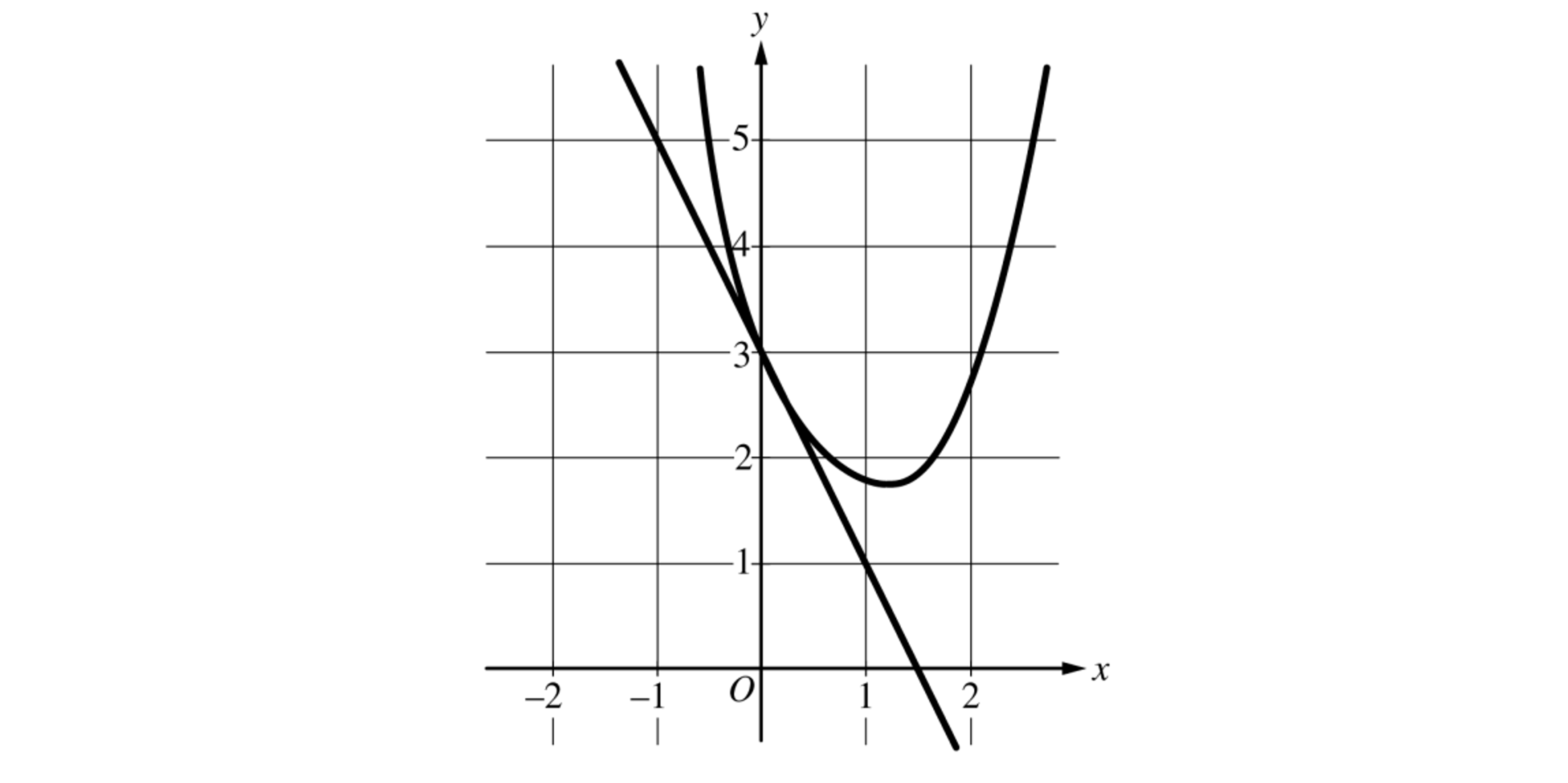
A function f has derivatives of all orders for all real numbers x. A portion of the graph of f is shown below, along with the line tangent to the graph of f at x=0. Selected derivatives of f at x=0 are given in the table below.

Graph of y = f(x) on an xy-grid. The curve comes down from the upper left, crosses the y-axis at y = 3, decreases to a minimum just to the right of x = 1 (a little below y = 2), then rises again. The straight line tangent to f at x = 0 is also drawn; it passes through (0, 3) and (1, 1)

n

f(n)(0)

2

3

3

232

4

54

Write the third-degree Taylor polynomial for f about x=0.

10b
Sme Calculator
2 marks

Write the first three nonzero terms of the Maclaurin series for ex. Write the second-degree Taylor polynomial for exf(x) about x=0.

10c
Sme Calculator
2 marks

Let h be the function defined by h(x)=0xf(t)dt. Use the Taylor polynomial found in part (a) to find an approximation for h(1).

10d
Sme Calculator
3 marks

It is known that the Maclaurin series for h converges to h(x) for all real numbers x. It is also known that the individual terms of the series for h(1) alternate in sign and decrease in absolute value to 0. Use the alternating series error bound to show that the approximation found in part (c) differs from h(1) by at most 0.45.

11a
Sme Calculator
4 marks

The function f has derivatives of all orders for all real numbers. It is known that f(0)=2, f'(0)=3, f''(x)=f(x2), and f'''(x)=2x·f'(x2).

Find f(4)(x), the fourth derivative of f with respect to x. Write the fourth-degree Taylor polynomial for f about x=0. Show the work that leads to your answer.

11b
Sme Calculator
2 marks

The fourth-degree Taylor polynomial for f about x=0 is used to approximate f(0.1). Given that |f(5)(x)|15 for 0x0.5, use the Lagrange error bound to show that this approximation is within 1105 of the exact value of f(0.1).

11c
Sme Calculator
3 marks

Let g be the function such that g(0)=4 and g'(x)=exf(x). Write the second-degree Taylor polynomial for g about x=0.

12a
Sme Calculator
2 marks

The Maclaurin series for a function f is given by n=1(n+1)xnn26n and converges to f(x) for all x in the interval of convergence. It can be shown that the Maclaurin series for f has a radius of convergence of 6.

Determine whether the Maclaurin series for f converges or diverges at x=6. Give a reason for your answer.

12b
Sme Calculator
2 marks

It can be shown that f(3)=n=1(n+1)(3)nn26n=n=1n+1n2(12)n and that the first three terms of this series sum to S3=125144. Show that |f(3)S3|<150.

12c
Sme Calculator
2 marks

Find the general term of the Maclaurin series for f', the derivative of f. Find the radius of convergence of the Maclaurin series for f'.

12d
Sme Calculator
3 marks

Let g(x)=n=1(n+1)x2nn23n. Use the ratio test to determine the radius of convergence of the Maclaurin series for g.