12 marks
Let be the region bounded by the graph of the polar curve for , as shown in the figure below.

Find the area of .
Was this exam question helpful?
Let be the region bounded by the graph of the polar curve for , as shown in the figure below.
Find the area of .
Was this exam question helpful?
The graph of the polar curve for is shown below. The region in the first quadrant bounded by the curve and the -axis is shaded.

Write an integral expression for the area of the shaded region.
Was this exam question helpful?
A curve in the -plane is described by the equation in polar coordinates.
For , is negative. What does this fact say about ? What does this fact say about the curve?
Was this exam question helpful?
A curve is given in polar coordinates by the equation for .
Find the angle that corresponds to the point on the curve with -coordinate .
Was this exam question helpful?
The graphs of the polar curves and are shown below. The curves intersect at and . The region shaded is inside the graph of and also outside the graph of .

Write an expression involving an integral for the area of the shaded region.
Was this exam question helpful?
The polar curves and are shown in the graph below for . Let be the shaded region inside the graph of and inside the graph of , as shown.

Find the area of .
Was this exam question helpful?
For the polar curve , find the value of at .
Was this exam question helpful?
A particle moves along a curve with polar equation so that for all times . Find the value of at the point when .
Was this exam question helpful?
The graphs of the polar curves and are shown below. The curves intersect when and .

Find the area of the shaded region.
Was this exam question helpful?
Find the slope of the line tangent to the polar curve at .
Was this exam question helpful?
The graph of the polar curve for is shown below.

There is a straight line through the origin with positive slope that divides the area of the region shown into two regions with equal areas.
Write, but do not solve, an equation involving one or more integrals whose solution gives the value of .
Was this exam question helpful?
The shaded region shown below is bounded by the graph of the polar curve for .

For , let be the area of the portion of the shaded region that is also inside the circle . Find .
Was this exam question helpful?
The figure below shows the polar curves and for .

For each in , let be the distance between the points with polar coordinates and . Write an expression for and find , the average value of over the interval .
Find the value of in the interval for which . Is the function increasing or decreasing at this value of ? Give a reason for your answer.
Was this exam question helpful?
A particle is moving along the polar curve so that at time seconds, . Find the position vector of the particle in terms of and find the velocity vector at time .
Was this exam question helpful?
For the polar curve , show that .
Show that where , and are positive integers that you should find.
Was this exam question helpful?
Curve is defined by the polar equation for . Curve and the semicircle for are shown in the -plane.
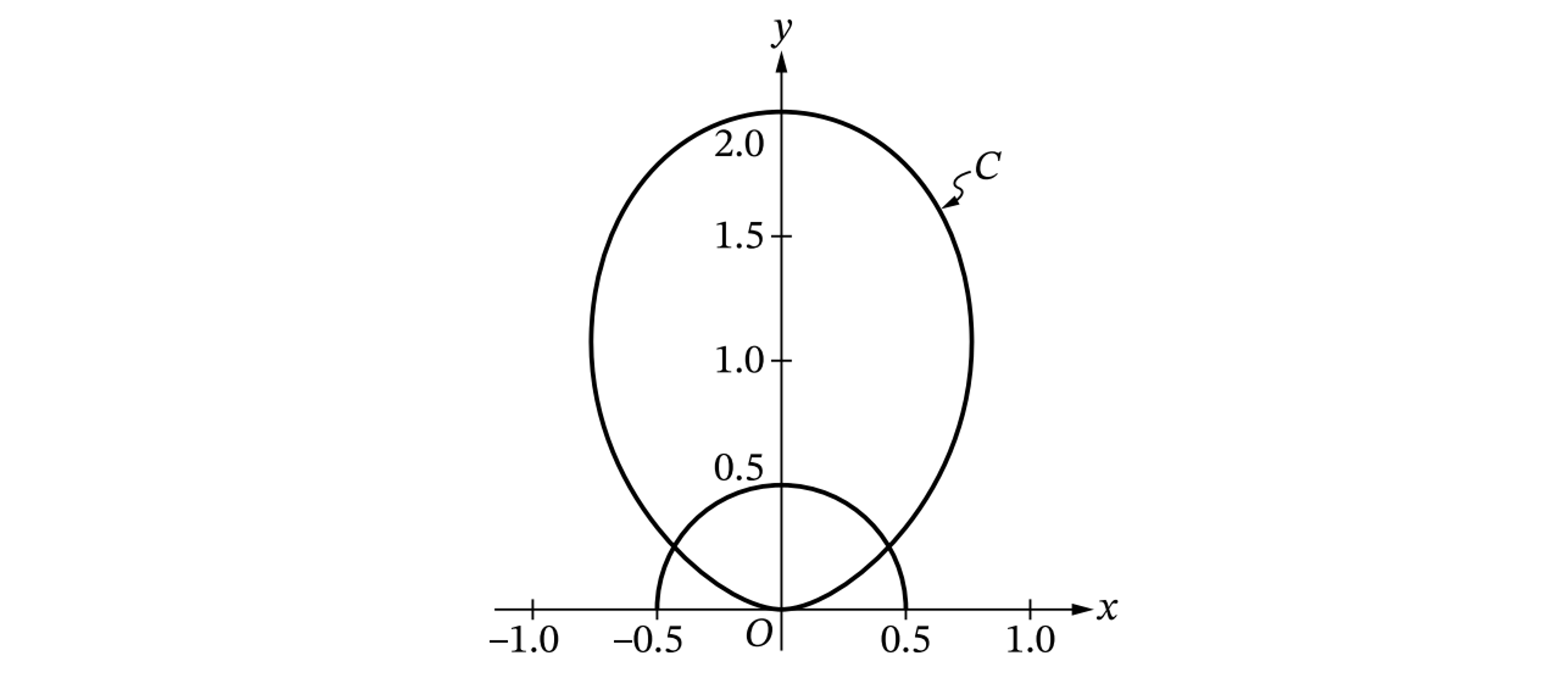
(Note: Your calculator should be in radian mode.)
Find the rate of change of with respect to at the point on curve where . Show the setup for your calculations.
Find the area of the region that lies inside curve but outside the graph of the polar equation . Show the setup for your calculations.
It can be shown that for curve . For , find the value of that corresponds to the point on curve that is farthest from the -axis. Justify your answer.
A particle travels along curve so that for all times . Find the rate at which the particle's distance from the origin changes with respect to time when the particle is at the point where . Show the setup for your calculations.
Was this exam question helpful?
The polar curves and for are shown below. Let be the region in the first quadrant bounded by the curve and the -axis. Let be the region in the first quadrant bounded by the curve , the curve , and the -axis.

Find the area of .
The ray , where , divides into two regions of equal area. Write, but do not solve, an equation involving one or more integrals whose solution gives the value of .
For each with , let be the distance between the points with polar coordinates and . Write an expression for . Find , the average value of over the interval .
Using the information from part (c), find the value of for which . Is the function increasing or decreasing at that value of ? Give a reason for your answer.
Was this exam question helpful?
Let be the region bounded by the graph of the polar curve for , as shown in the figure above.
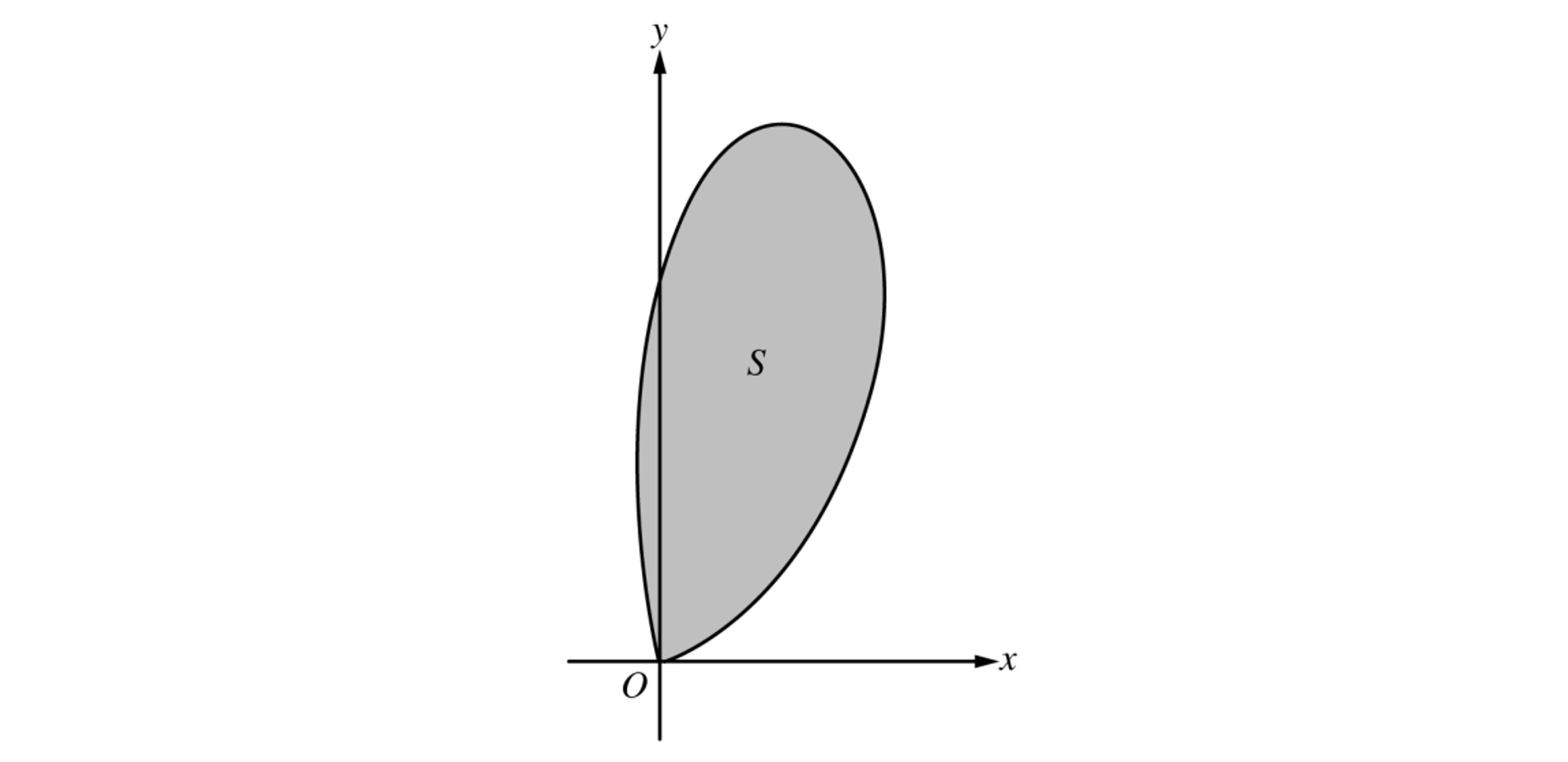
Find the area of .
What is the average distance from the origin to a point on the polar curve for ?
There is a line through the origin with positive slope that divides the region into two regions with equal areas. Write, but do not solve, an equation involving one or more integrals whose solution gives the value of .
For , let be the area of the portion of region that is also inside the circle . Find .
Was this exam question helpful?
The graphs of the polar curves and are shown in the figure below. The curves intersect at and .

Let be the shaded region that is inside the graph of and also outside the graph of . Write an expression involving an integral for the area of .
Find the slope of the line tangent to the graph of at .
A particle moves along the portion of the curve for . The particle moves in such a way that the distance between the particle and the origin increases at a constant rate of units per second. Find the rate at which the angle changes with respect to time at the instant when the position of the particle corresponds to . Indicate units of measure.
Was this exam question helpful?