Logistic Models (College Board AP® Calculus BC): Revision Note

Logistic models
What is a logistic model?
The standard logistic growth model is represented by the first-order logistic differential equation
represents the size of a quantity at time
Usually this will be the size of a population of some sort
This means will always be true
is a constant determining the relative rate of change of
In general , with a larger value of representing a faster rate of change
is a constant known as the carrying capacity
This is also usually a positive constant
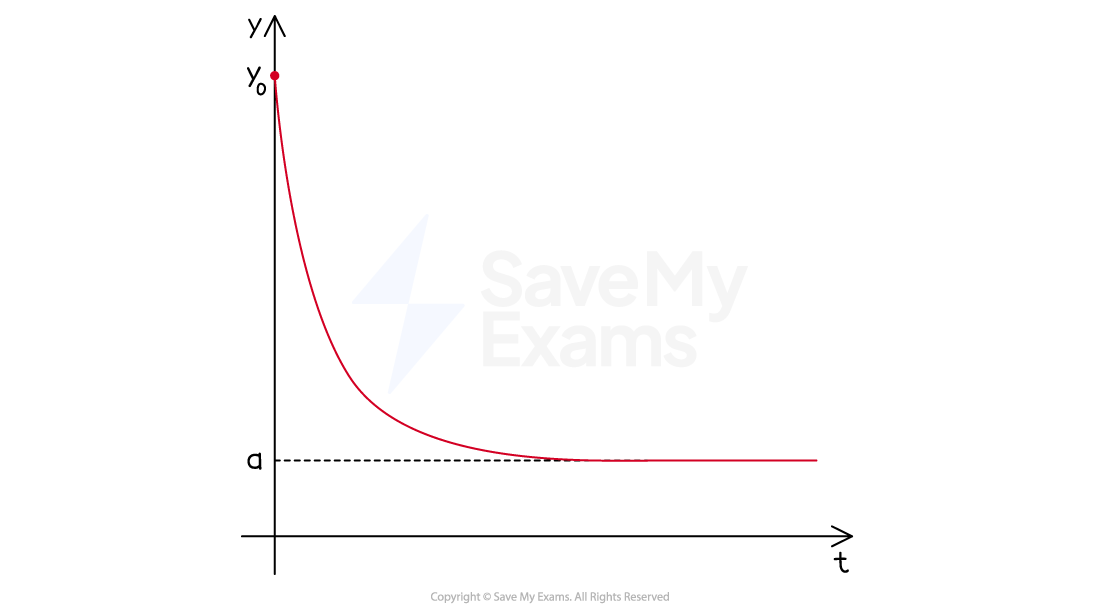
It places a limit on the size to which can grow (if is increasing) or shrink (if is decreasing)
will converge to the value as
Examiner Tips and Tricks
The typical statement that leads to a logistic growth model is: “The rate of change of a quantity is jointly proportional to the size of the quantity and the difference between the quantity and the carrying capacity”.
What information can I derive from the logistic differential equation?
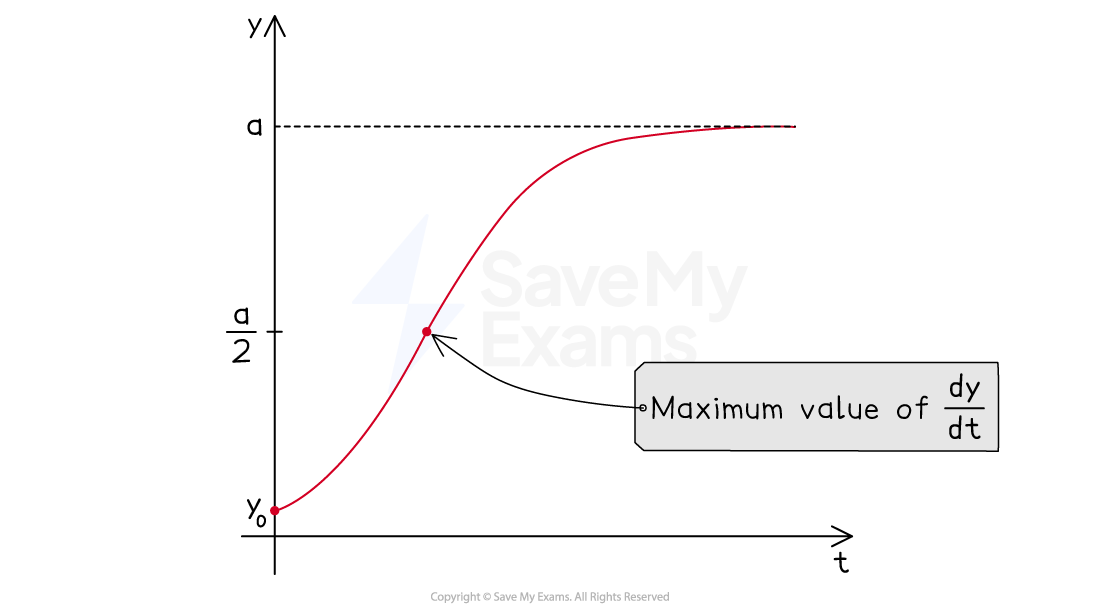
Consider different values of in relation to the equation with and
If or then the rate of change
i.e. is constant and will stay at that value forever
If , then
i.e. is increasing (and will continue to increase towards the value of )
If , then
i.e. is decreasing (and will continue to decrease towards the value of )
Also note that is a quadratic function in with a maximum value when
That is when the maximum value of occurs
So for the case where , and the initial value satisfies , the value of will be changing the fastest when is equal to half the carrying capacity
If you need to know the time when that occurs then you will need to solve the logistic equation
and then solve for the value of when
Examiner Tips and Tricks
Be sure to take account of the context of a question when answering the question or commenting on the model used.
How do I solve a logistic differential equation?
Solving the differential equation uses separation of variables
It also requires partial fractions to evaluate one of the integrals
Start by separating the variables
Use partial fractions to rewrite the integral on the left
See the 'Integration Using Partial Fractions' study guide
Integrate both sides of the equation
Don't forget a constant of integration
can be integrated using the substitution
See the 'Integration Using Substitution' study guide
As long as and initially, then will always remain true
In that case , so that
That can be solved algebraically for by making the subject to get
You can multiply top and bottom by and rewrite and a different constant
If you are given the initial condition that when , then you can also work out the value of
Note that is just a rewritten form of the constant of integration
Examiner Tips and Tricks
It is possible to memorize that the logistic equation , with and with satisfying , has the solution
where . But for the exam you must also know how to solve differential equations of that form using separation of variables!
Be careful if initially
In that case will always remain true
And , so that
The minus sign means the last few steps, along with the final solution, will be slightly different
You get
Worked Example
A group of ecologists are studying a population of rabbits on a particular island. The population of rabbits, , on the island is modelled by the logistic equation
where represents the time in years since the ecologists began their study. At the time the study begins there are 300 rabbits on the island.
(a) Show that the population of rabbits at time years is given by .
(b) Find the population of rabbits that the model predicts will be on the island two years after the beginning of the study.
(c) Determine the maximum size that the model predicts the population of rabbits can grow to. Justify your answer by an appropriate analysis of the equation found in part (a).
(d) At what time is the rabbit population changing fastest? Justify your answer.
Answer:
(a)
Start by separating the variables
Rewrite the integral on the left using partial fractions
Integrate
The initial number of rabbits, , is equal to 300
, so the modulus isn't needed in the solution
Rewrite with
Use to solve for
Substitute that value of into the solution and solve for
(b)
Substitute into the solution from part (a)
Round to the nearest rabbit
1352 rabbits
(c)
From the equation , you should be able to tell that the carrying capacity (the maximum possible size of the population) is 1500
You can justify that answer by taking the limit of the solution in part (a) as
, which goes to zero as (because as )
1500 rabbits is the maximum population predicted by the model
(d)
The population is changing fastest when is at its maximum
As it is a quadratic, this occurs when is the midpoint of the zeros
Use your answer from part (a)
0.770 years (to 3 decimal places)

Unlock more, it's free!
Join the 100,000+ Students that ❤️ Save My Exams
the (exam) results speak for themselves:

Was this revision note helpful?
Build on this topic