Derivatives & Tangents (College Board AP® Calculus BC): Revision Note

Derivatives and tangents
What is the derivative of a function?
The derivative of a function describes the instantaneous rate of change of a function at any given point
It is equal to the slope of the curve at that point
The derivative of the function is defined by
This is only valid for values of x where this limit exists
Note that the derivative is also a function of x
For example, represents the instantaneous rate of change of the function at the point
There are several ways to denote the derivative of
You may also see "the derivative of ..." written as " ... differentiated"
They mean the same thing
How are derivatives and tangents related?
A tangent line to a curve at a given point is a line that just touches the curve at the point but doesn't cut it at or near that point
However, it may cut the curve somewhere else
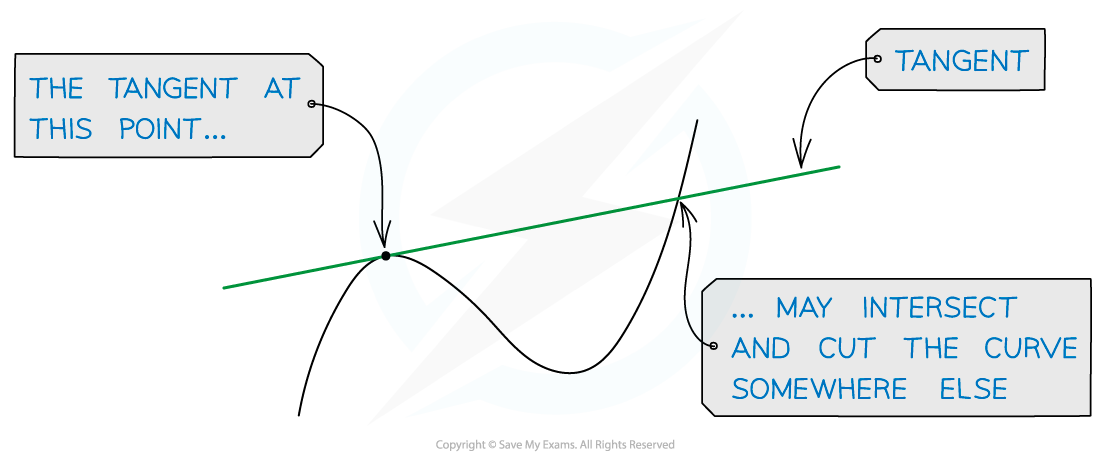
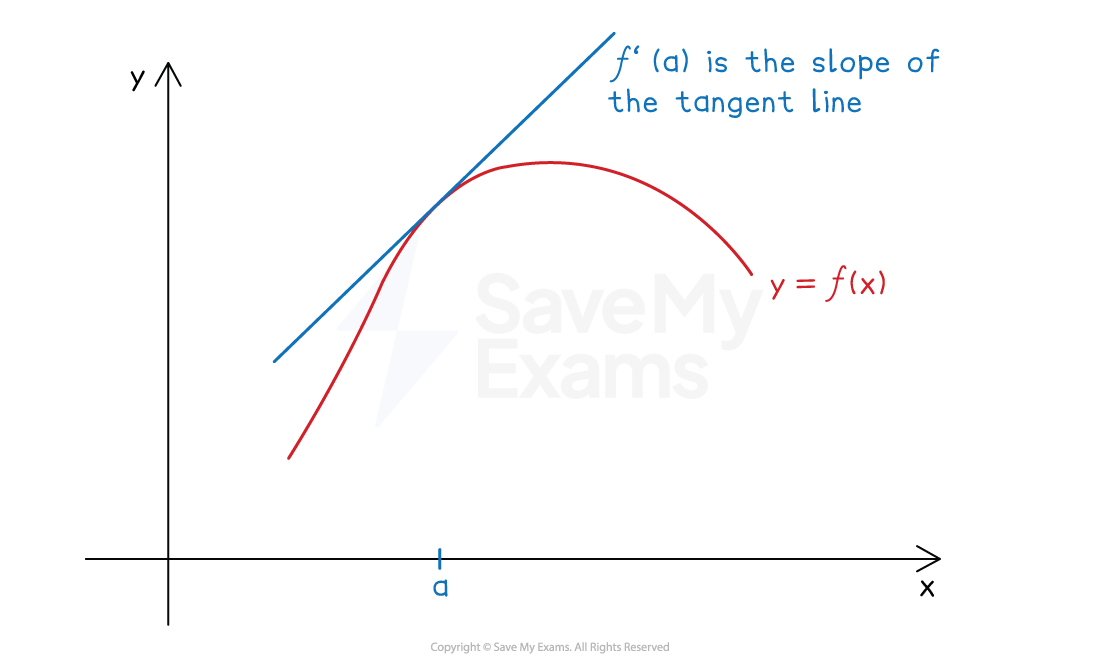
The value of the derivative of a function at a point is equal to the slope of the tangent to the graph at that point
For example, represents the slope of the tangent line to the graph at the point
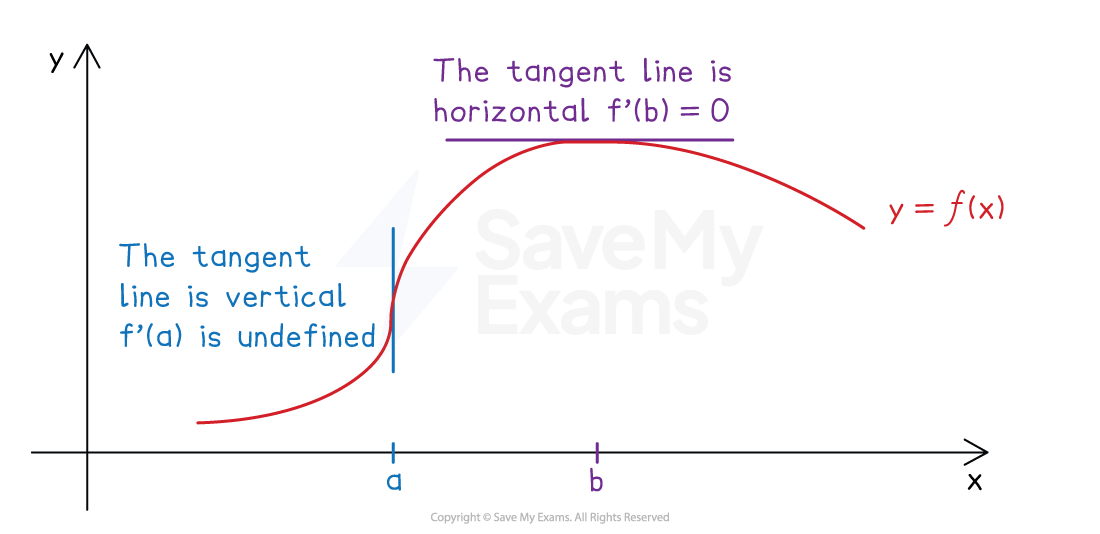
When will tangent lines be horizontal or vertical?
If the tangent line to the graph of a function is horizontal, then
Horizontal lines have a slope of zero
If the tangent line to the graph of a function is vertical, then is undefined
E.g. with derivative
, which is undefined, even though is defined at
Therefore the graph of has a vertical tangent at
But be careful, as there are other reasons a derivative might not be defined at a point
E.g. the derivative of is undefined at , because the left- and right-hand limits defining the derivative at that point are not equal
The graph of does not have a vertical tangent (or any tangent) at that point
Also don't confuse vertical tangents with vertical asymptotes
Tangents and curves intersect, but curves only approach asymptotes without ever intersecting with them
E.g. has a vertical asymptote at
But the function is not defined when , so it has no tangent at that point
How do I find the equation of a tangent to a curve using a derivative?
To find the equation of a tangent line to the graph of a function at the point using a derivative:
Represent the equation of the tangent using the general form for the equation of a straight line with slope that goes through point
Substitute in as the point
This is the point the tangent touches on the curve
Find the value of the derivative of at the point if it is not given; this is
The value of the derivative of at is equal to the slope of the tangent at
Substitute in as the value of in the equation of the tangent
The equation of the tangent will be of the form
This equation can then be rearranged to another desired form if needed
For example,
Worked Example
Let the function be defined by . It is known that at the point where , the instantaneous rate of change of is 5.
Find the equation of the line that is tangent to the graph of at the point where .
Answer:
The tangent is a straight line of the form
The question states that the instantaneous rate of change (the slope) of the curve when , is 5
This means the slope of the tangent, , will also be 5 at this point
The -coordinate of the point is known, but not the value
Find the value by substituting into
So the point where the tangent touches the curve is
Substitute the point, and the slope at this point, into the equation of the tangent
Simplify
or

Unlock more, it's free!
Join the 100,000+ Students that ❤️ Save My Exams
the (exam) results speak for themselves:

Was this revision note helpful?
Build on this topic
