Mark Scheme (AQA GCSE English Literature): Revision Note
Exam code: 8702

The mark scheme in English Literature can seem daunting, and difficult to understand. This is because there is no “correct answer” for any essay: the exam board does not provide points that need to be included in any essay, and instead, examiners have to use the mark scheme to place an answer into a level.
It is therefore essential to understand the mark scheme really well yourself: if you understand exactly what you are being assessed on, you understand how to improve. Below you will find sections on:
Translating the mark scheme
Understanding the different levels
How to get a Level 6
Student-friendly mark scheme
Tick list for success
Translating the mark scheme
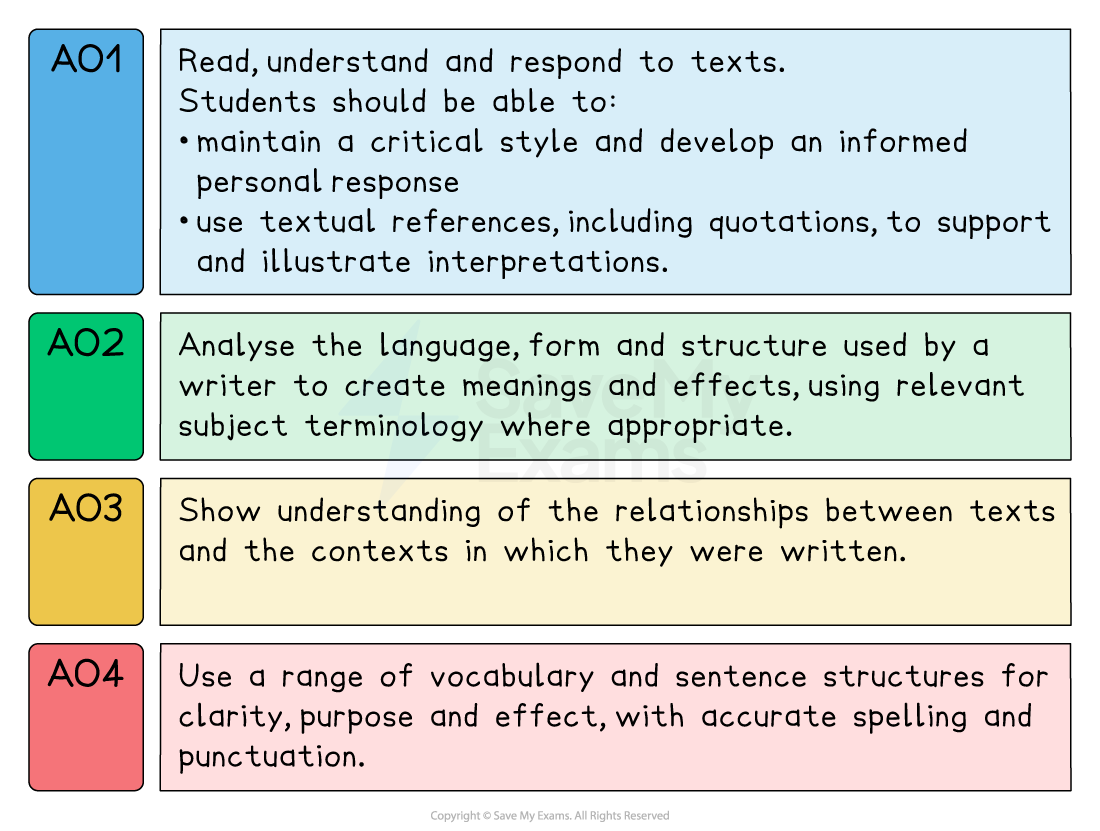
Here is a simple version of the AQA mark scheme for the modern text question, and below, a student-friendly translation of the mark scheme with expert advice and guidance, broken down into the different assessment objectives.
AO1: Answering the question and using evidence
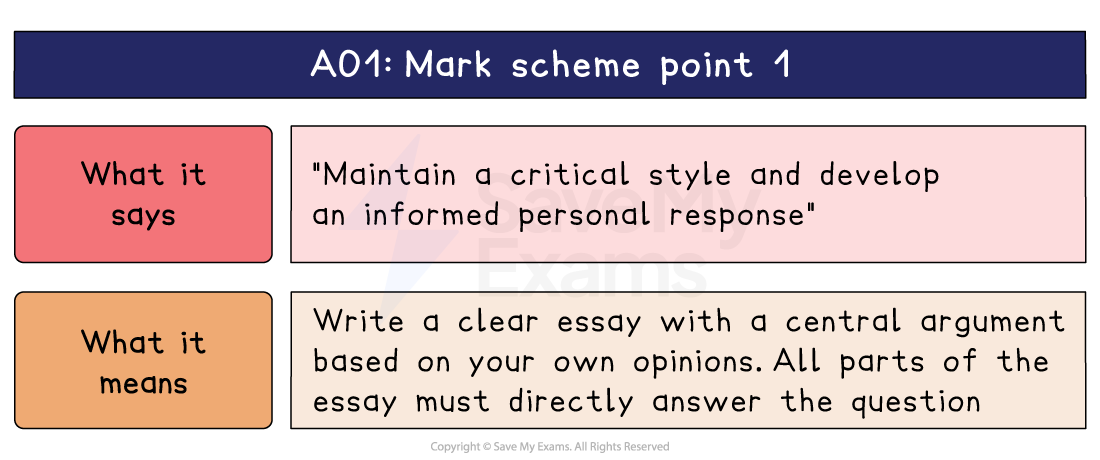
Commentary:
Examiners want to see what they call a “coherent” response: an answer that relates to a central argument in every part of the essay:
This is why it is vital to plan your answer first
This argument should always link directly to the question, so include the key words of the question in your thesis and your topic sentences
Examiners want to see your opinions
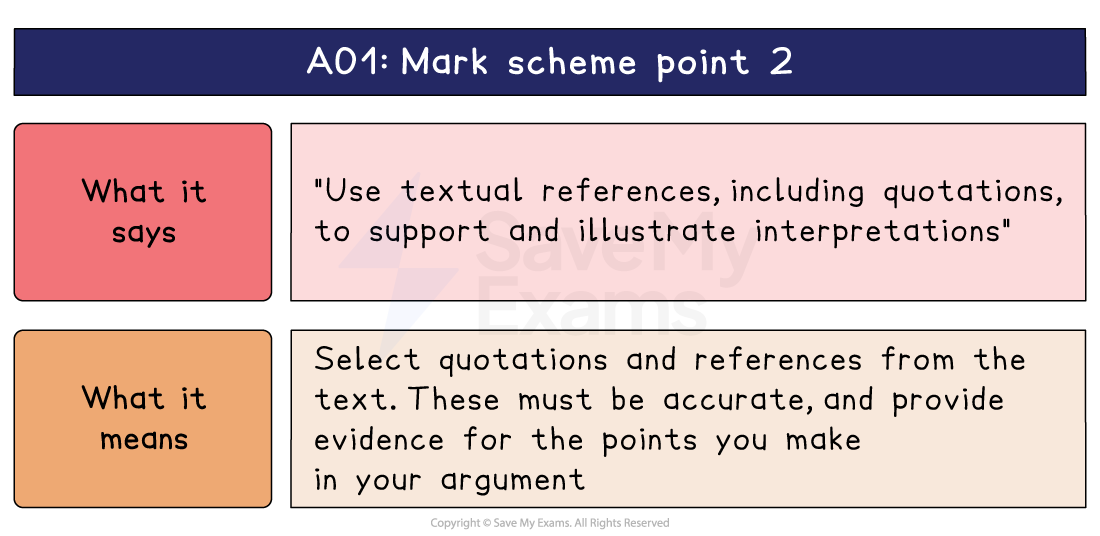
Commentary:
Examiners reward the highest marks to students who relate the ideas and themes to the text:
To link to elsewhere in the text, use phrases like: “Earlier/later in the text”, “Similarly, in Act X, Scene Y”, “the writer also highlights this idea when”
References do not need to be direct quotations
You do not get more marks for more quotations:
All references just need to be accurate and provide evidence for your points and overall argument
All references must be relevant to the points of your essay
Examiners dislike when students include irrelevant quotations
AO2: Analysing the writer's craft
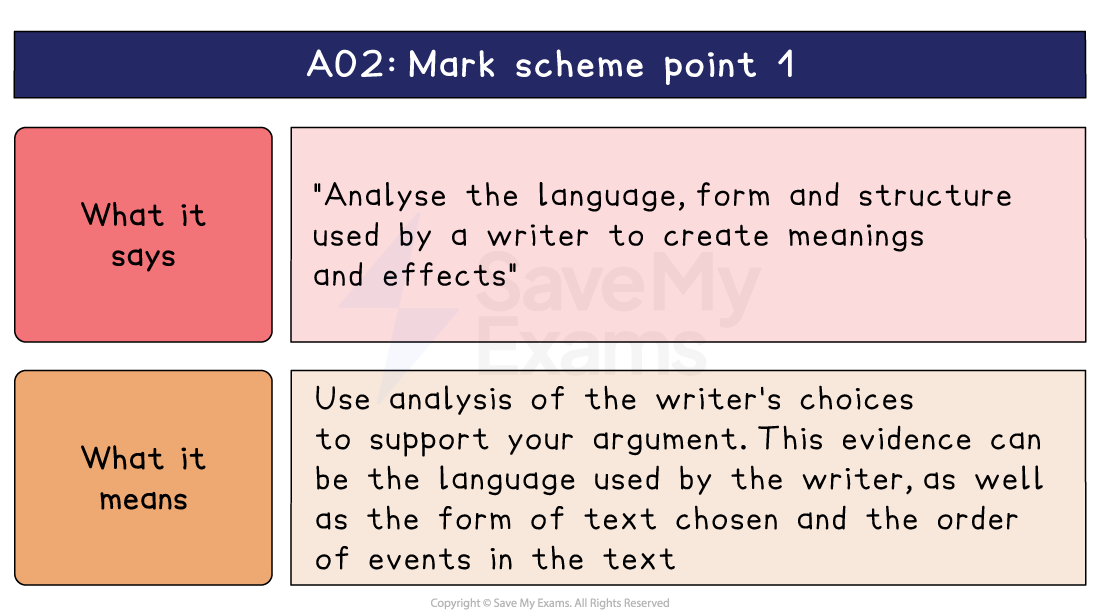
Commentary:
Examiners want students to move away from word-level analysis to whole-text analysis:
This means not just focusing your analysis on the language in the text, or quotations you have memorised
Instead, think about choices the writer has made in terms of form and structure, contrasts and character development
This analysis should move from how the writer uses language, structure and form, to why they do it:
What is the writer using their language/characters to say? What is the writer’s overall message?
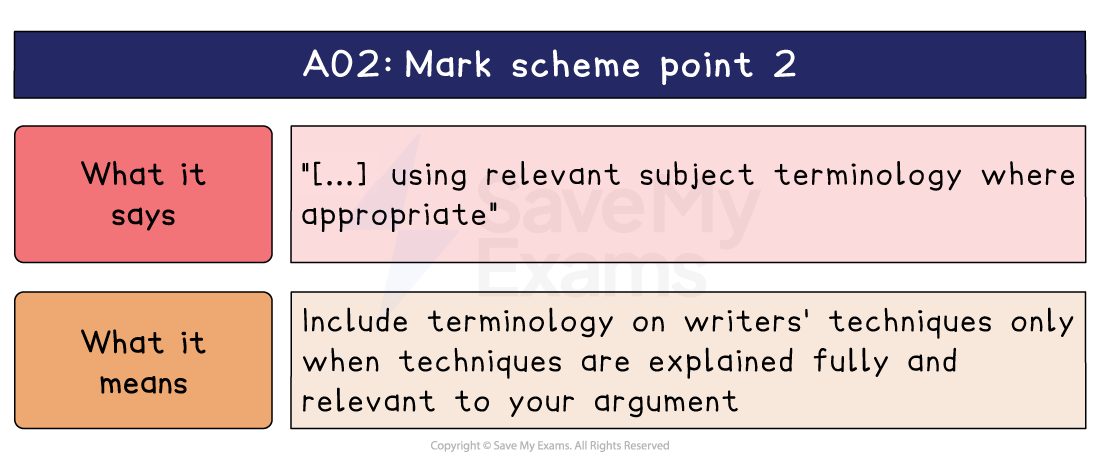
Commentary:
Examiners don’t like what they call “technique-spotting”:
This is where a student uses (sometimes very sophisticated) vocabulary to name the literary techniques the writer uses without explaining them
Equally, they don’t reward analysis that just names a word class (“the noun X”; “the verb Y”):
They think this is “unnecessary and unhelpful”
The writer’s techniques should only be analysed if they provide further evidence to support your argument
Examiners want students to move from what technique the writer uses to how and why they are using them
AO3: Incorporating context and ideas
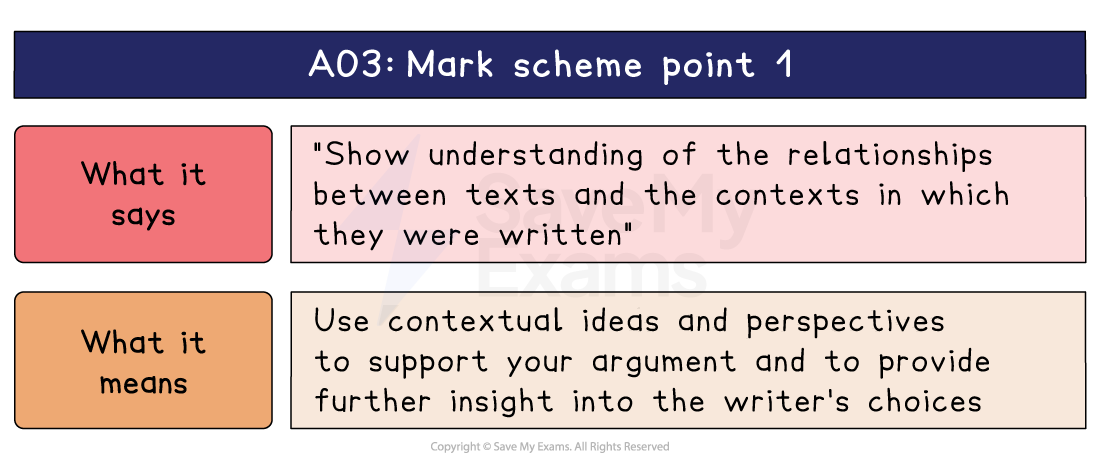
Commentary:
Context is not historical or biographical information that has nothing to do with the ideas presented in the modern text
Instead, context should be seen as the ideas and perspectives of the writer’s time
These ideas and perspectives (views on class, gender, race, etc.) help us understand why the writers present their text and characters in the way they do:
Why do characters behave the way they do?
Why is this scene set in this particular place?
Why is this theme significant in the text?
Examiners want to see context linked to the themes and ideas of the text
All context should also be linked to your overall argument:
What further insight does an understanding of the behaviours and beliefs of the writer’s era provide to my argument?
AO4: Using SPaG effectively
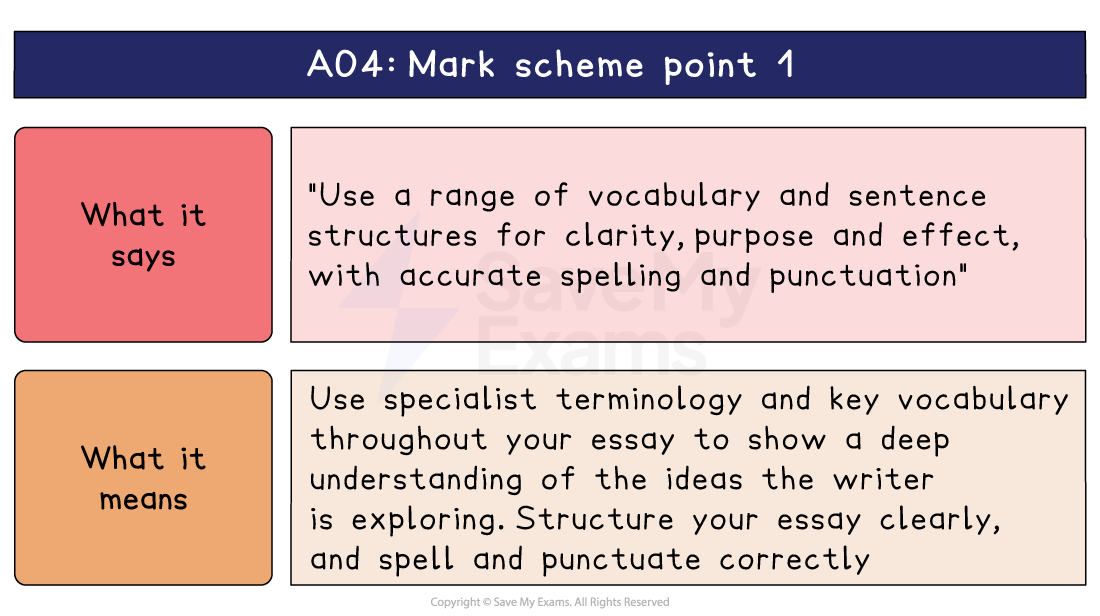
Commentary:
Although AO4 on its own is only worth 4 marks, using key vocabulary and structuring your essay well will also increase your AO1 marks:
Using specialist terminology can help you create a “conceptualised response”, which is rewarded with the highest marks
Structuring your essay into clear paragraphs with clear topic sentences will also help you gain top marks for organisation
Examiner Tips and Tricks
Examiners look for one argument running through the whole essay, not three separate mini-essays under a shared title. Every paragraph should be visibly working on the same claim you made in your opening lines.
For example, you could start each paragraph with a sentence that picks up a word from your opening claim (your thesis), so the link is obvious on the page. Making the connection visible is what turns three good points into a coherent argument.
Understanding the different levels
The mark scheme for English Literature has six levels, with Level 1 at the bottom, and Level 6 at the top. Examiners do not receive a list of points that need to be included for a student’s essay to achieve Level 3, say, or Level 5. Instead, the mark scheme contains different “descriptors” for each level:
“Descriptors” are the:
Features that a response is expected to have to achieve at each level:
This means: How well a student has responded to the question (the overall quality of the answer)
Skills a student is expected to show to achieve each level:
This means: The specific skills needed to explore and analyse a text
For example, the “descriptors” for a Level 1 response are:
An attempt to answer the question (quality of answer)
A narrative or descriptive approach (quality of answer)
A simple analysis of the writer’s methods and context (skills shown)
In contrast, examiners expect a lot more for a Level 6 response. The “descriptors” for Level 6 include:
Responding to the full task with a well-structured argument (quality of answer)
A critical, exploratory and conceptualised approach (quality of answer)
Insightful analysis of the writer’s methods (skills shown)
An integrated and exploratory approach to context (skills shown)
Essentially, when examiners are putting student essays into a particular level, they are just deciding how well the student has displayed the expected features and skills of each assessment objective. So, if you understand each AO, and what is required for each AO, you will know how to improve.
What makes a Level 6 answer?
If you want to achieve a Grade 9, you should be aiming for a Level 6 response. Below you will see a table that explains how to move from a Level 5 response to Level 6.
Question:
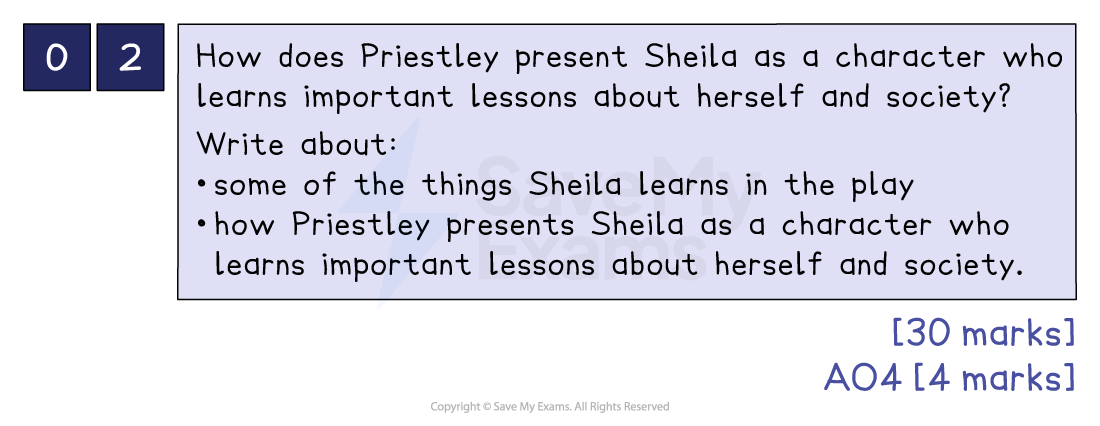
Part of essay | Level 5 | Level 6 | Reason |
|---|---|---|---|
Introduction | Priestley presents Sheila as a character who learns important lessons about herself and society in several ways. Once the Inspector arrives, Sheila begins to change as she quickly learns the important lesson of personal and social responsibility and this will be explored further in this essay. | Priestley demonstrates Sheila’s capacity to learn important lessons about herself and society throughout An Inspector Calls. As her character develops, Priestley uses her to highlight his message about social and collective responsibility suggesting that everyone in the play, including the audience and wider society, also have important lessons to learn. | The Level 6 introduction is in the form of a thesis statement, which presents an overarching argument that includes Priestley as a writer making deliberate choices and conveying a message. |
Topic sentence | As the play progresses, Priestley continues to present Sheila as a character who is learning to change her behaviour and attitudes. | Priestley demonstrates Sheila’s capacity to learn important lessons about herself and society as Act I develops and he uses her character to highlight his message about social and collective responsibility. | The Level 6 response develops the idea within the question much more thoroughly and links it directly to Priestley’s message. |
Analysis of the writer’s methods | Priestley demonstrates Sheila’s capacity to learn through her use of emotional language. When she discovers Eva’s fate, she is inconsolable: “I can't help thinking about this girl - destroying herself so horribly”. Her language reveals her compassion for Eva’s situation and demonstrates the lesson she has learned about social and personal responsibility for her actions. Her language is in sharp contrast to her parents who fail to show any empathy for Eva and who fail to accept any responsibility for the girl’s fate. | Priestley demonstrates Sheila’s capacity to learn through her increasingly emotional language. Her dialogue reveals her sensitive nature and compassion and empathy for others less fortunate than herself. When she discovers Eva’s fate, she is inconsolable: “I can't help thinking about this girl - destroying herself so horribly”. Priestley sharply contrasts with the pompous language of her father and the condescending tone of her mother. Structurally, Priestley creates a strong contrast in the first half of the act compared to the second half in terms of both character and mood: while the first half illustrates the prosperity and smugness of the Birlings, the second half enables the audience to observe its destruction, as unlike Sheila, many of the characters fail to learn from their mistakes. | The Level 5 response presents thoughtful and developed ideas and demonstrates a clear exploration of the writer’s methods to create meanings and uses appropriate references to support their ideas. The Level 6 response takes more of an analytical approach to the text by looking closely at elements of the method and selecting precise references to illustrate their argument. It provides an argument which is much more convincing in its exploration than the Level 5 response. |
Context | During the period in which the play is set, women’s rights were being sought through the suffragette movement which campaigned for gender equality for women. It was an increasing time of political agitation for women’s rights. Priestley uses Sheila to show how women were learning important lessons about their role in society. Priestley’s message that members of society have duties and obligations towards the welfare of others is presented through the character of Sheila. | Priestley uses Sheila to show how women were learning important lessons about their role in the home and society, as this was a period when women’s rights were being sought through the suffragette movement. Sheila belongs to a class where women would never be expected to provide for themselves and although she uses her power and position to suppress another female by having her fired, she does demonstrate a capacity to learn from that mistake: “And I know I'm to blame – and I'm desperately sorry”. Sheila’s acceptance that she is responsible and accountable for her actions underscores Priestley’s message that members of society have duties and obligations toward the welfare of others. | The Level 5 response is starting to demonstrate elements of exploratory thought and begins to convey some tentative ideas as to Priestley’s purpose which is one of the indicators of a Level 5 response. The Level 6 response demonstrates a more integrated engagement with the text as a whole and its context, reflecting on the ideas in a more reflective and insightful way. Contextual information is also explicitly connected to Priestley’s overall message. |
Examiner Tips and Tricks
Examiners reward answers that prove a claim rather than just assert one. The two versions on this page make the same point about Sheila, but only one of them shows the moment in the play where she admits she was wrong.
For example, you could write: “Sheila says ‘I know I’m to blame – and I’m desperately sorry’, which shows she accepts responsibility instead of defending herself as her parents do”. A short quotation turns a claim about a character into a point you can support.
Overall student-friendly mark scheme
The GCSE mark scheme can be confusing as it is written for examiners, not students. Below is a translated mark scheme that breaks the assessment objectives into concise, clear instructions.
Assessment Objective | Number of marks | Meaning |
|---|---|---|
AO1 | 12 |
|
AO2 | 12 |
|
AO3 | 6 |
|
AO4 | 4 |
|
Tick list for success
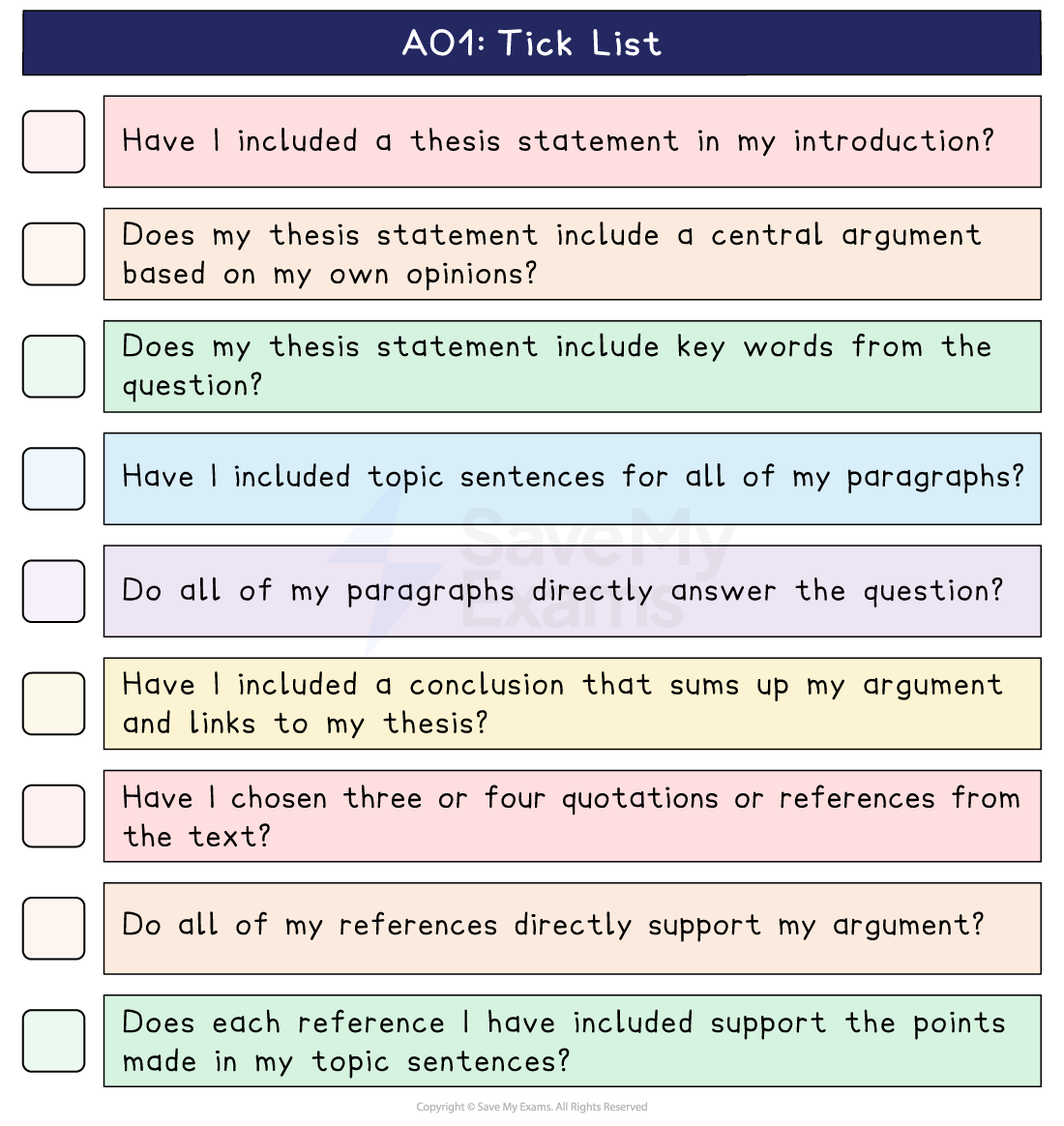
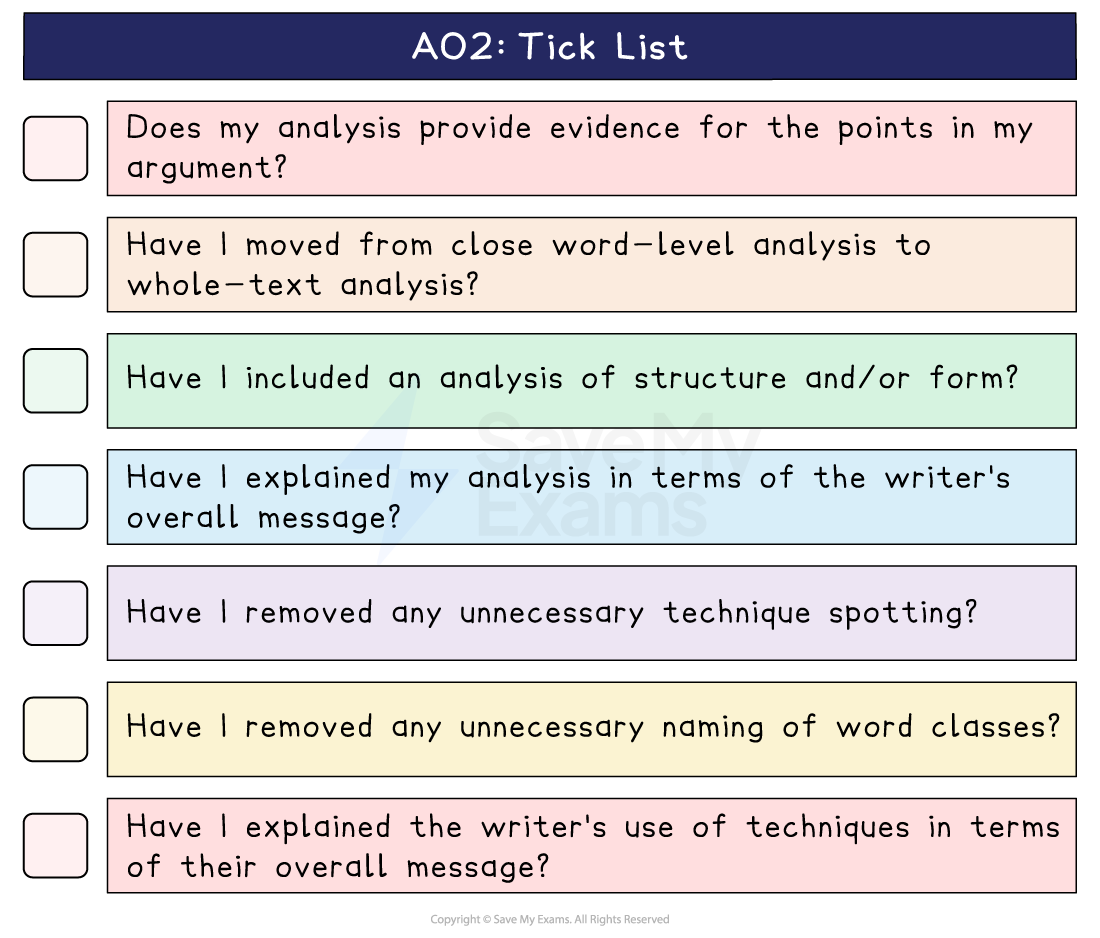
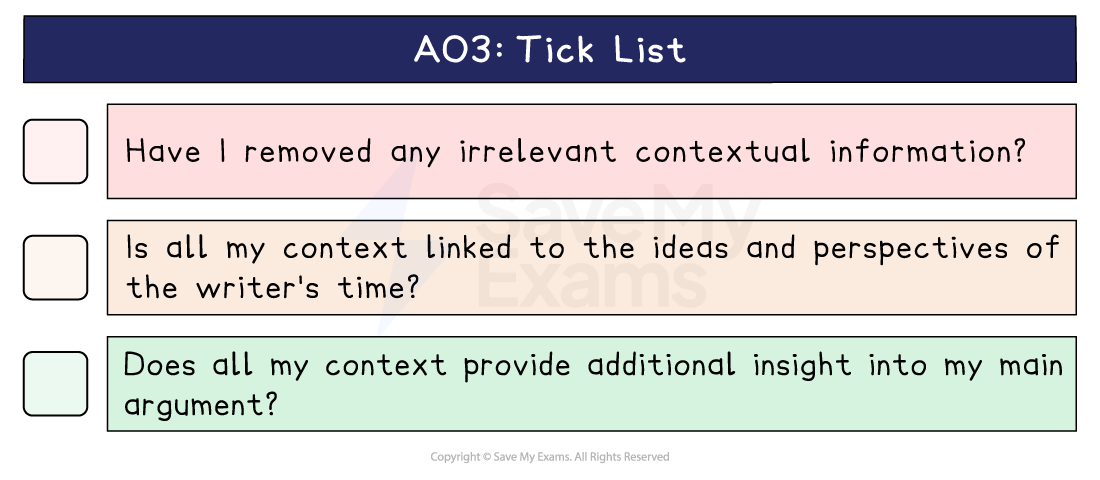
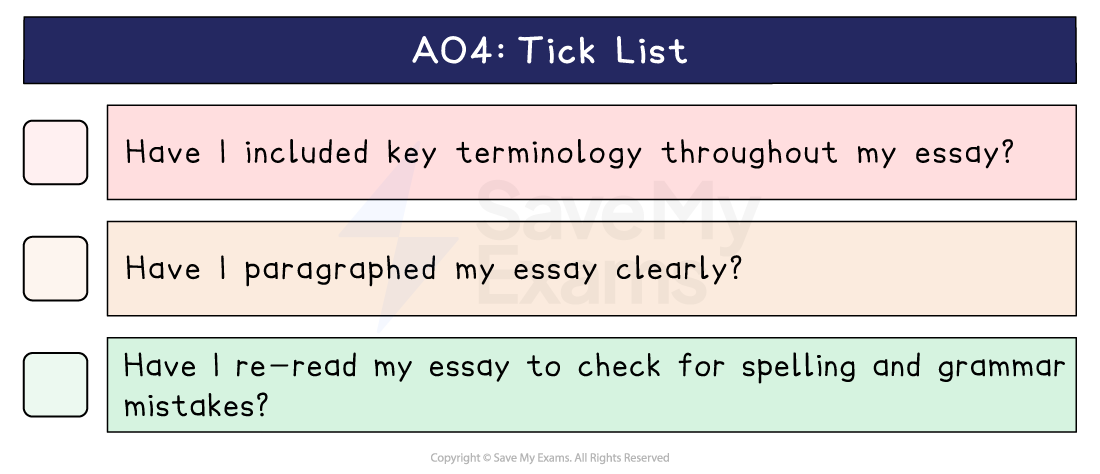
Marking your own essays can be difficult. However, if you use the tick list below, you can see which features and skills you have, and haven’t, included in your answer. If you can say ‘yes’ to all of the questions below, your essay should be heading toward the highest level.
AO1: Answering the question and using evidence
AO2: Analysing the writer's craft
AO3: Incorporating context and ideas
AO4: Using SPaG effectively

Unlock more, it's free!
Join the 100,000+ Students that ❤️ Save My Exams
the (exam) results speak for themselves:

Was this revision note helpful?