Mark Scheme (AQA GCSE English Literature): Revision Note
Exam code: 8702

The mark scheme in English Literature can seem daunting, and difficult to understand. This is because there is no “correct answer” for any essay: the exam board does not provide points that need to be included in any essay, and instead, examiners have to use the mark scheme to place an answer into a level.
It is therefore essential to understand the mark scheme really well yourself: if you understand exactly what you are being assessed on, you understand how to improve. Below you will find sections on:
Translating the mark scheme
Understanding the different levels
How to get a Level 6
Student-friendly mark scheme
Tick list for success
Translating the mark scheme
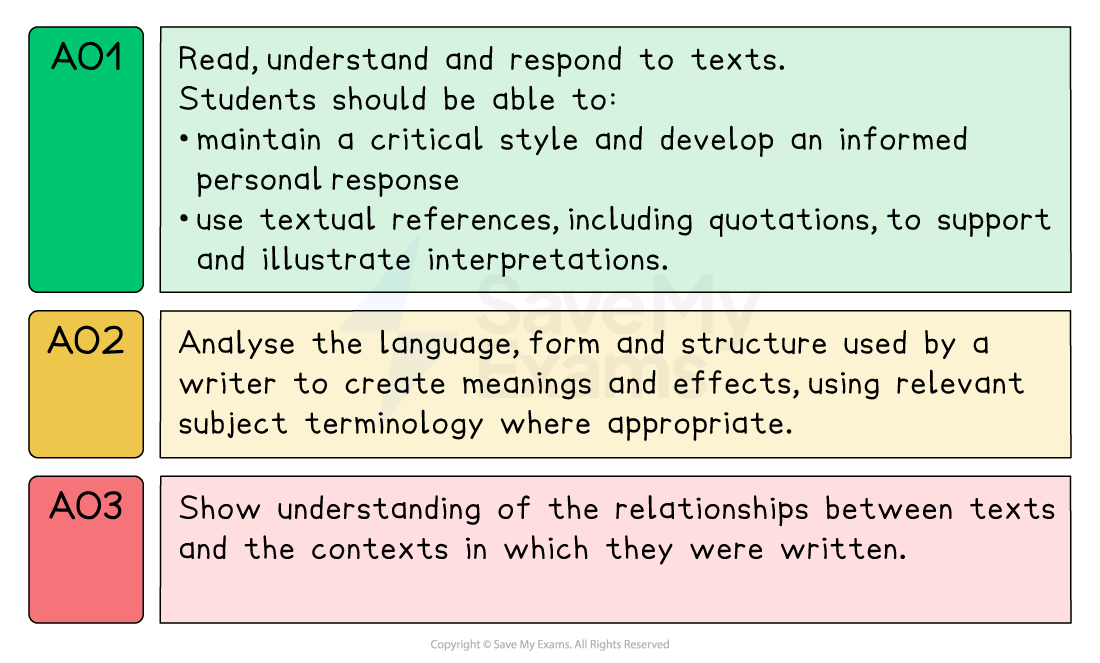
Here is a simple version of the AQA mark scheme for the 19th-century novel question, and below, a student-friendly translation of the mark scheme with expert advice and guidance, broken down into the different assessment objectives.
AO1: Answering the question and using evidence
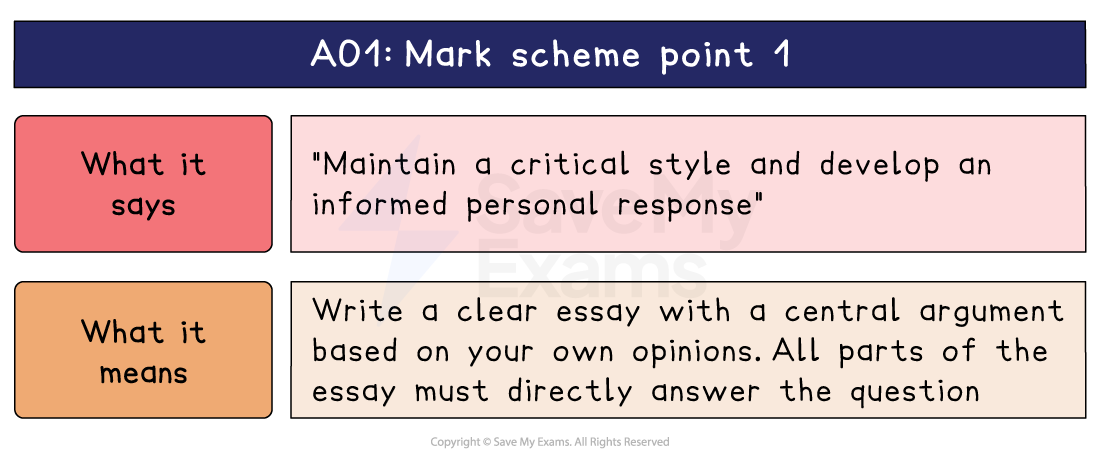
Commentary:
Examiners want to see what they call a “coherent” response: an answer that relates to a central argument in every part of the essay:
This is why it is vital to plan your answer first
This argument should always link directly to the question, so include the keywords of the question in your thesis and your topic sentences
Examiners want to see your opinions, not the opinions of an imagined 19th-century reader
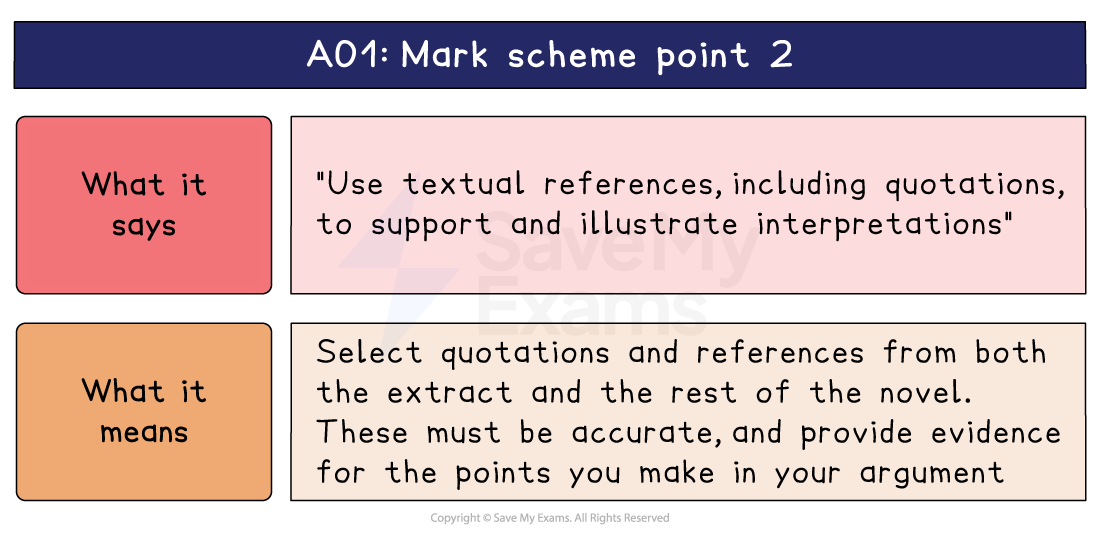
Commentary:
Examiners reward the highest marks to students who relate the ideas and themes of the extract to other parts of the novel:
To link to elsewhere in the novel, use phrases like: “Earlier/later in the novel”, “Similarly, in Chapter X”, “the author also highlights this idea when”
References do not need to be direct quotations
You do not get more marks for more quotations:
All references just need to be accurate and provide evidence for your points and overall argument
All references must be relevant to the points of your essay:
Examiners dislike when students include irrelevant quotations
AO2: Analysing the writer's craft
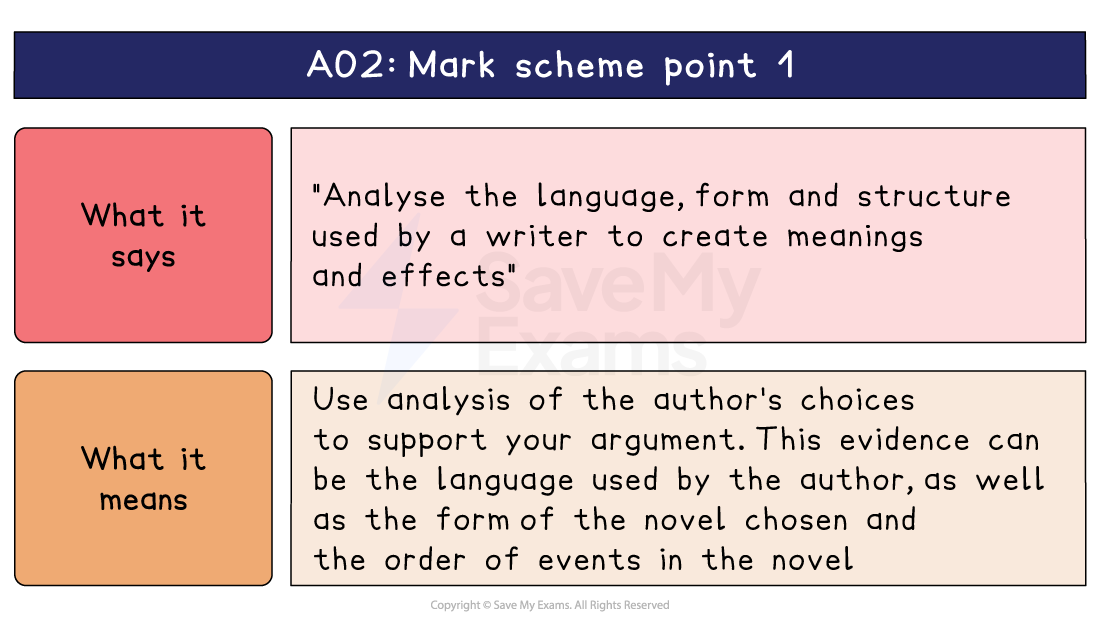
Commentary:
Examiners want students to move away from word-level analysis to whole-text analysis:
This means not just focusing your analysis on the language in the extract, or quotations you have memorised
Instead, think about choices the author has made in terms of form and structure, contrasts and character development
This analysis should move from how the author uses language, structure and form, to why they do it:
What is the author using their language/characters to say? What is the author’s overall message?
Commentary:
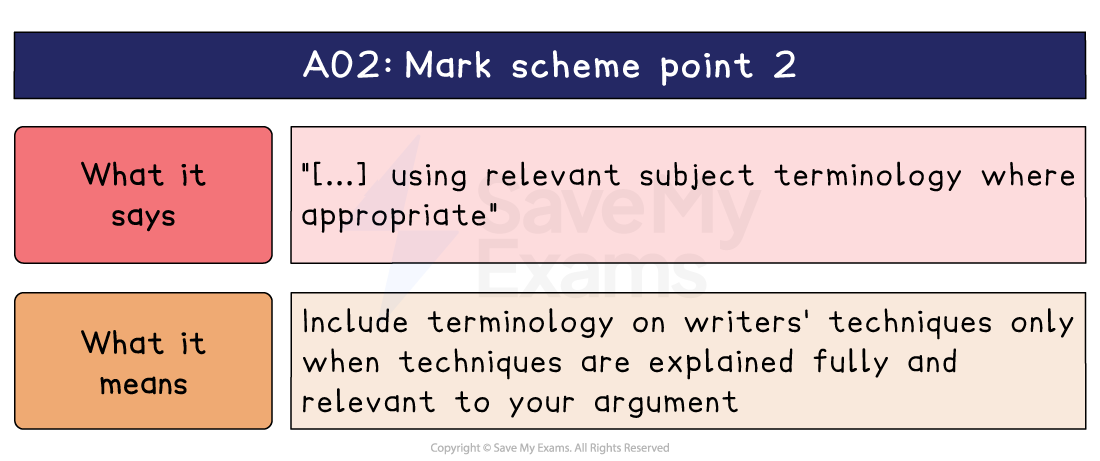
Examiners don’t like what they call “technique-spotting”:
This is where a student uses (sometimes very sophisticated) vocabulary to name the literary techniques the author uses without explaining them
Equally, they don’t reward analysis that just names a word class (“the noun X”; “the verb Y”):
They think this is “unnecessary and unhelpful”
The author’s techniques should only be analysed if they provide further evidence to support your argument
Examiners want students to move from what technique the author uses to how and why they are using them
AO3: Incorporating context and ideas
Commentary:
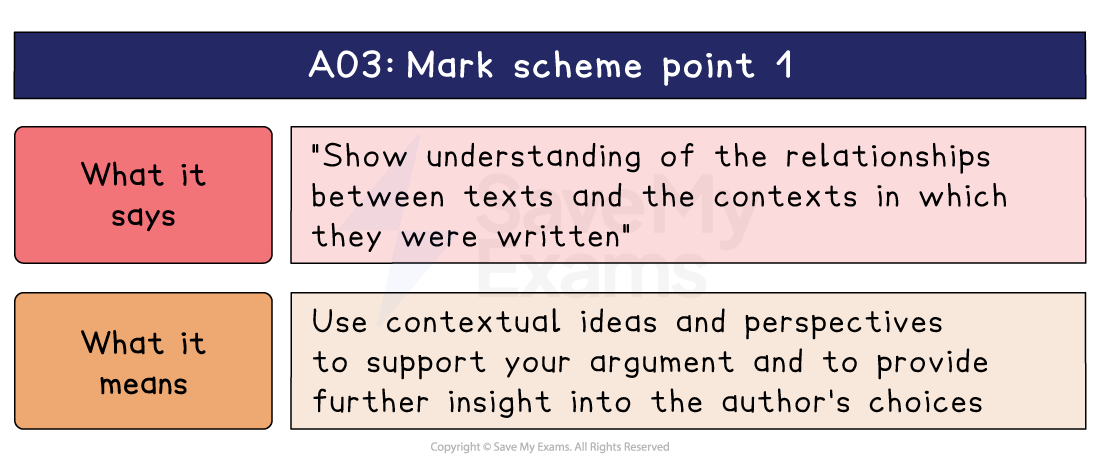
Context is not historical or biographical information that has nothing to do with the ideas presented in the 19th-century novel
Instead, context should be seen as the ideas and perspectives of the author’s time
These ideas and perspectives (19th-century views on religion, gender, the supernatural, etc.) help us understand why the authors present their novels and characters in the way they do:
Why do characters behave the way they do?
Why is this scene set in this particular place?
Why is this theme significant in the text?
Examiners want to see context linked to the themes and ideas of the novel
All context should also be linked to your overall argument:
What further insight does an understanding of the behaviours and beliefs of the novelist’s era provide to my argument?
Examiner Tips and Tricks
Examiners are clear that more quotations do not make a better essay, and that an irrelevant one actively weakens it. What counts is how much you say about each reference you choose, not how many you can fit in.
For example, you could take one short quotation and write three sentences on it: what it shows, how the writer does it, and why it matters to your argument. Three sentences on one quotation shows more than three quotations with a sentence each.
Understanding the different levels
The mark scheme for English Literature has six levels, with Level 1 at the bottom, and Level 6 at the top.
Examiners do not receive a list of points that need to be included for a student’s essay to achieve Level 3, say, or Level 5. Instead, the mark scheme contains different “descriptors” for each level:
“Descriptors” are the:
Features that a response is expected to have to achieve at each level:
This means: How well a student has responded to the question (the overall quality of the answer)
Skills a student is expected to show to achieve each level:
This means: The specific skills needed to explore and analyse a text
For example, the “descriptors” for a Level 1 response are:
An attempt to answer the question (quality of answer)
A narrative or descriptive approach (quality of answer)
A simple analysis of the writer’s methods and context (skills shown)
In contrast, examiners expect a lot more for a Level 6 response. The “descriptors” for Level 6 include:
Responding to the full task with a well-structured argument (quality of answer)
A critical, exploratory and conceptualised approach (quality of answer)
Insightful analysis of the writer’s methods (skills shown)
An integrated and exploratory approach to context (skills shown)
Essentially, when examiners are putting student essays into a particular level, they are just deciding how well the student has displayed the expected features and skills of each assessment objective. So if you understand each AO, and what is required for each AO, you will know how to improve.
What makes a Level 6 answer?
If you want to achieve a Grade 9, you should be aiming for a Level 6 response. Below you will see a table that explains how to move from a Level 5 response to Level 6.
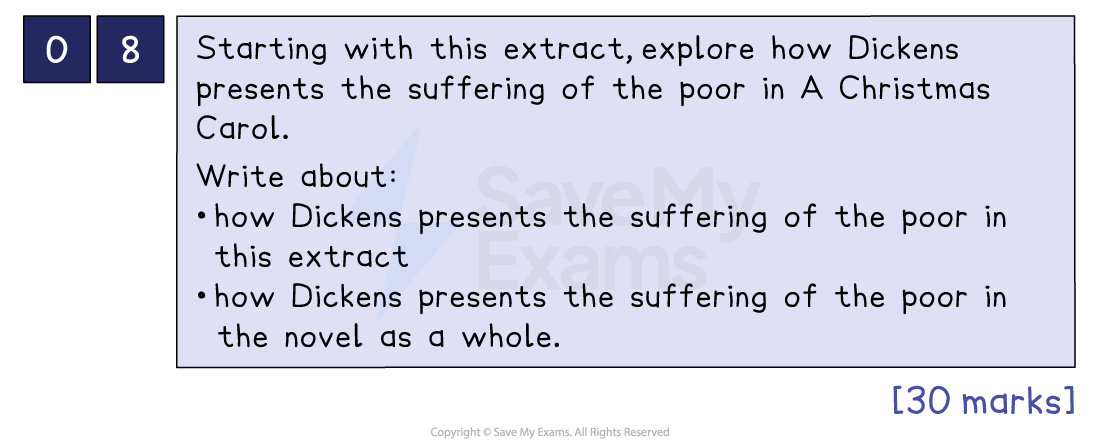
Question:
Part of essay | Level 5 | Level 6 | Reason |
|---|---|---|---|
Introduction | Dickens presents the suffering of the poor in numerous ways throughout the novella. Prevailing Victorian attitudes towards the poor meant they viewed their predicament as entirely of their own making and Dickens conveys their harsh attitudes in the extract. | The suffering of the poor is one of the most prevalent ideas within A Christmas Carol and Dickens presents the poor and destitute to the reader from the outset. Dickens depicts the exploitation and ignorance of the poor through various characters in the novella and he demonstrates how they are trapped in a system through no fault of their own which conveys his message for social change. | The Level 6 introduction is in the form of a thesis statement, which presents an overarching argument that includes Dickens as an author making deliberate choices and conveying a message. |
Topic sentence | Dickens uses Ignorance and Want as an allegory in the extract and uses this device to convey his message. | In this extract, Dickens uses the two characters, Ignorance and Want, as an allegory, as they are symbolic of society’s cruelty towards the suffering of the poor and underscore his moral message. | The Level 6 response develops the idea within the question much more thoroughly and links it directly to Dickens’ message. |
Analysis of writer’s methods | Ignorance and Want convey Dickens’ concerns about the suffering of the poor. They are first described through a range of adjectives: “wretched, abject, frightful, hideous, miserable” which convey a horrifying image to the reader which would invoke sympathy. The repeated use of synonyms adds to the sense that their poverty is unending. Images of decay are also described such as “shrivelled hand” and “stale” which again create horror in the reader and demonstrate how wretched the poor are. | Dickens uses these two characters to highlight the effects of societal avarice and greed. The fact that the children are first shown emerging from the spirit's garment emphasises Dickens’ point that poverty and its devastating effects are mostly concealed, unknown, and disregarded by society. Further, Dickens’ imagery depicts the children as emaciated and wretched which induces both horror and pity from the reader. Further the religious undertones depicted in the phrase: “They knelt down at its feet, and clung upon the outside of its garment” suggests how the poor are not provided with the resources to help themselves and instead must grovel and plead for assistance and are reliant on the charity of others. | The Level 5 response presents thoughtful and developed ideas and demonstrates a clear exploration of the writer’s methods to create meanings and uses appropriate references to support their ideas. The Level 6 response takes more of an analytical approach to the text by looking closely at elements of method and selecting precise references to illustrate their argument. It provides an argument which is much more convincing in its exploration than the Level 5 response. |
Context | The extract demonstrates how the Capitalist system and industrialisation had a detrimental impact on the lives of people during the Victoria era which meant that child labour and the exploitation of children became commonplace. Dickens could be using Ignorance and Want as symbols of the exploitation of poor children, which has therefore left them emaciated and undernourished. Dickens’ message here is one of social change. | In the rest of the novella, Dickens uses the Ghost of Christmas Yet to Come to depict the devastating consequences of a Capitalist system in which Tiny Tim could potentially die. Similar to Ignorance and Want, Tiny Tim’s potential death highlights the poor living conditions and malnourishment experienced by many poor children during this era. Dickens uses these characters to highlight the high levels of child mortality in Victorian England and indicates that many of them were poor through no fault of their own. Dickens uses these characters to highlight to the reader that such tragedies are avoidable if greater equality is achieved within society. | The Level 5 response is starting to demonstrate elements of exploratory thought and begins to convey some tentative ideas as to Dickens’ purpose which is one of the indicators of a Level 5 response. The Level 6 response demonstrates a more integrated engagement with the novel as a whole and its context, reflecting on the ideas in a more reflective and insightful way. Contextual information is also explicitly connected to Dickens’ overall message.
|
Examiner Tips and Tricks
Examiners note that the difference between a good answer and the best one is often nothing to do with knowing more. The strongest responses take the same piece of information and ask what the writer wanted a reader to think or feel about it.
For example, you could write: “Dickens makes Ignorance and Want children so that readers cannot dismiss poverty as something adults bring on themselves”. Explaining what the writer wanted readers to feel, rather than what was true of the period, turns a fact into an interpretation.
Overall student-friendly mark scheme
The GCSE mark scheme can be confusing as it is written for examiners, not students. Below is a translated mark scheme that breaks the assessment objectives into concise, clear instructions.
Assessment Objective | Number of marks | Meaning |
|---|---|---|
AO1 | 12 |
|
AO2 | 12 |
|
AO3 | 6 |
|
Tick list for success
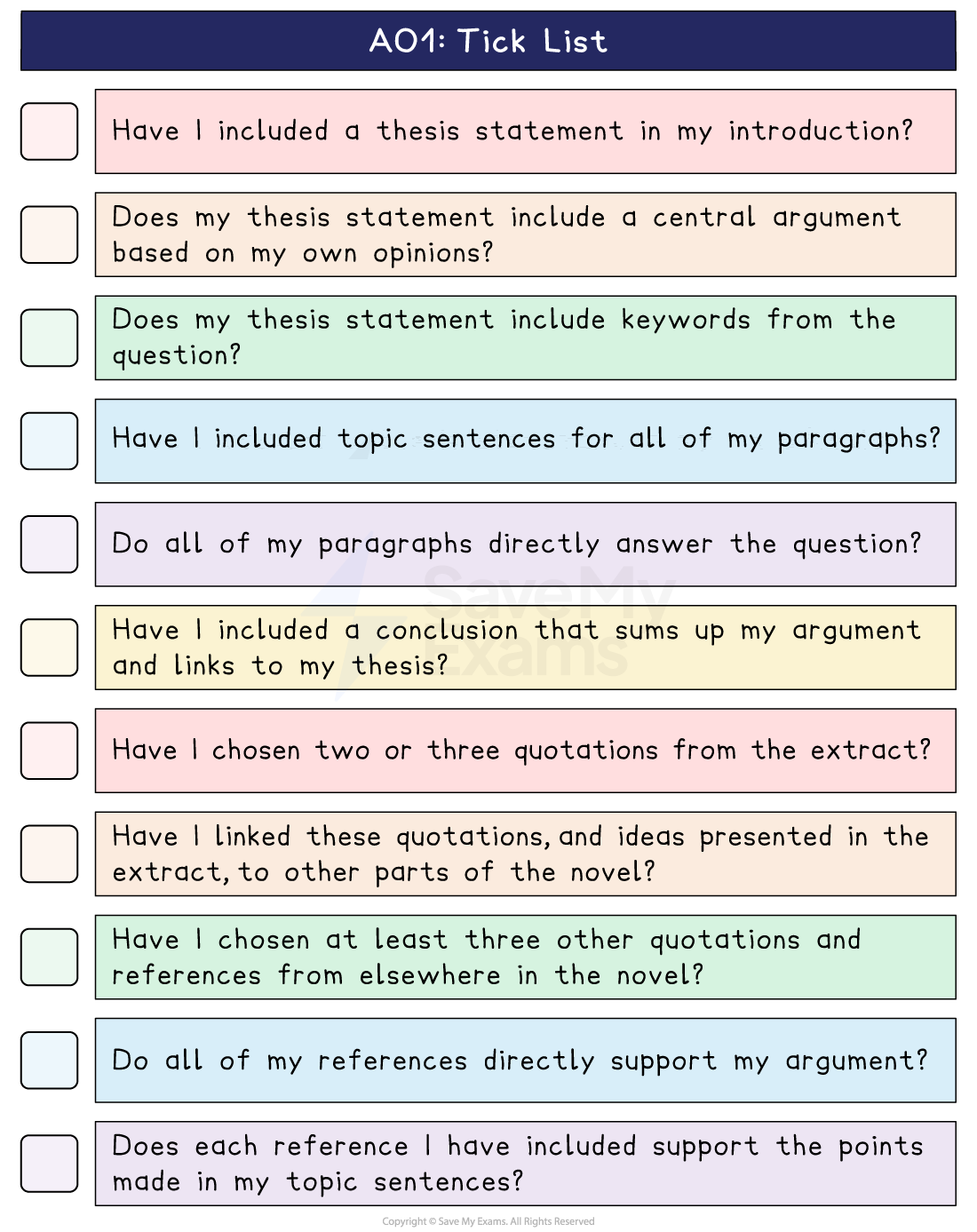
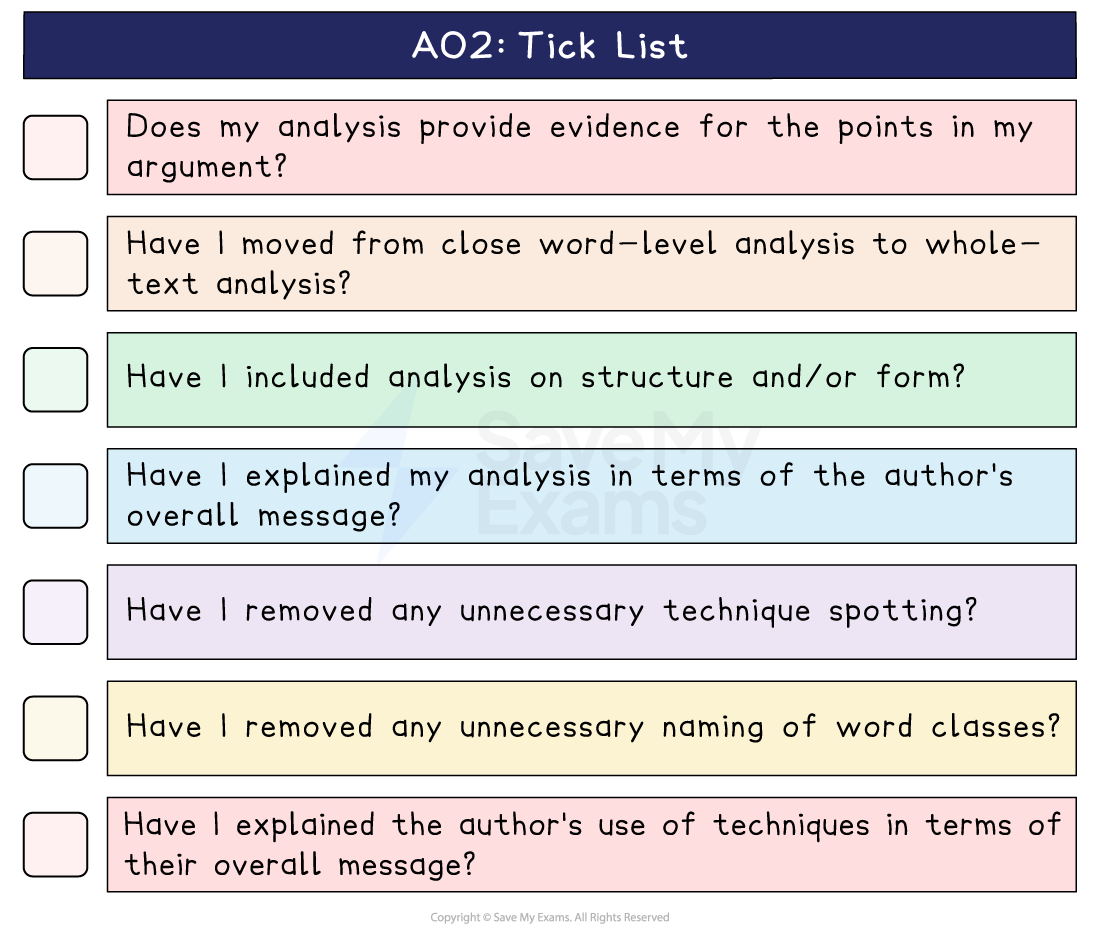
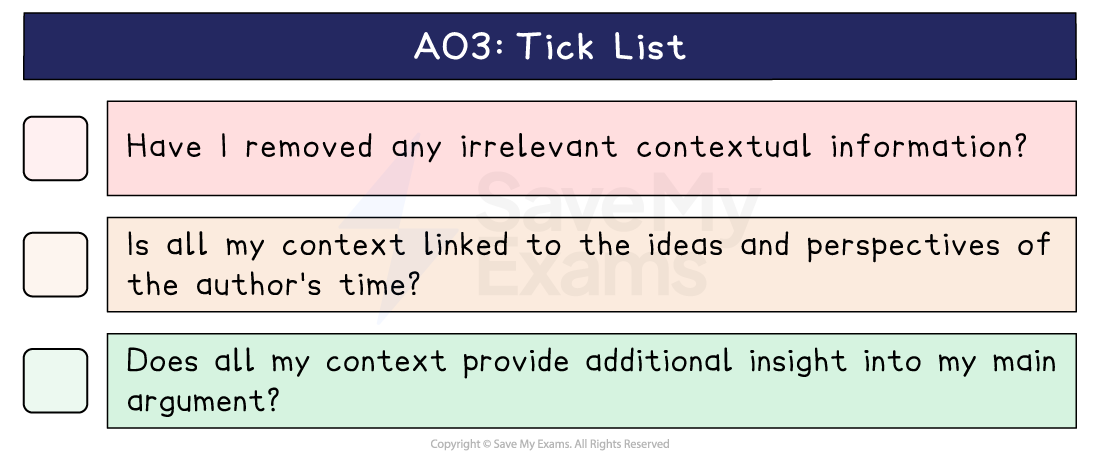
Marking your own essays can be difficult. However, if you use the tick list below, you can see which features and skills you have, and haven’t, included in your answer. If you can say “yes” to all of the questions below, your essay should be heading toward the highest level.
AO1: Answering the question and using evidence
AO2: Analysing the writer's craft
AO3: Incorporating context and ideas

Unlock more, it's free!
Join the 100,000+ Students that ❤️ Save My Exams
the (exam) results speak for themselves:

Was this revision note helpful?