A Taste of Honey: Overview (AQA GCSE English Literature): Revision Note
Exam code: 8702

A Taste of Honey: Overview
The A Taste of Honey question is part of Paper 2, Section A of your GCSE examination. You are expected to write one essay-length answer to one set question and, unlike with the Shakespeare and 19th-century novel questions, you will not be given an extract from the text. This can seem daunting at first, but this page contains some helpful information, and links to more detailed revision note pages, that will enable you to feel confident answering any question on A Taste of Honey. This page includes:
Who was Shelagh Delaney?
A summary of A Taste of Honey
A brief overview of what is required in the exam
A Taste of Honey characters
A Taste of Honey context
A Taste of Honey themes
A Taste of Honey quotes
Top tips for the highest grade
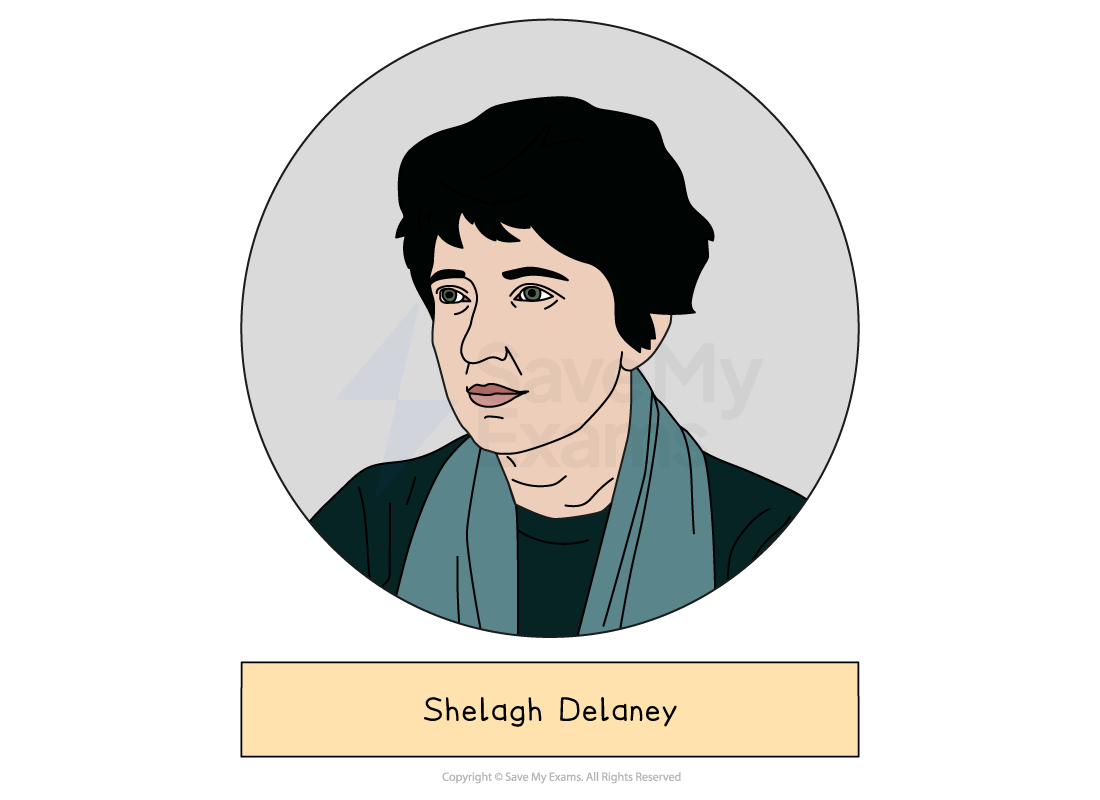
Who was Shelagh Delaney?
Shelagh Delaney was an English playwright and screenwriter. She was born in Salford, near Manchester, in November 1938, and died in Suffolk in November 2011, aged seventy-two.
Delaney wrote A Taste of Honey in 1958, when she was eighteen. She sent the script to Joan Littlewood’s Theatre Workshop in April that year, and it was on stage by May. She wrote it as an answer to the theatre of the time, which she thought had nothing to do with the lives she saw around her in Salford.
The play was controversial. A working-class single mother, a teenage pregnancy, an interracial relationship and a gay character were not the usual material of 1950s drama. What unsettled audiences most was that Delaney refused to condemn any of them. She is now seen as a central figure in kitchen sink drama: realistic plays about ordinary, usually northern, working-class lives. For further ideas about the ideas explored in the play, please see the A Taste of Honey: Context page.
A Taste of Honey summary
A Taste of Honey is a play by Shelagh Delaney, written in 1958 and set in an industrial town near Manchester. It follows two women — a mother and daughter — living in poverty in postwar Britain.
Helen is a woman caught in a cycle of unstable relationships, chasing financial security and male attention. Her daughter Jo is malnourished, neglected and left to fend for herself, moved from flat to flat and travelling miles to school. The two argue and mock each other constantly, each disappointed by her life and by the other.
Helen marries Peter Smith, an untrustworthy car salesman: she marries him for money and he marries her for sex. Left alone, Jo has a relationship with the Boy (Jimmie), a Black sailor in the navy, and becomes pregnant. He goes back to sea and does not return.
Jo is taken in by Geof Ingram, a gay art student, who supports her through her pregnancy, keeps house and gives her advice about motherhood — and who is, in a play full of failing adults, the only person who reliably looks after her.
Helen’s marriage collapses and she returns. She forces Geof out and promises to care for Jo herself, but when she learns that the baby may not be white, she leaves too. The play ends with Jo alone, and with the cycle of poverty and abandonment apparently ready to repeat itself.
For a more detailed summary, please see the A Taste of Honey: Plot Summary page.
How is A Taste of Honey assessed in the exam?
Paper 2 requires you to answer four questions (three on poetry) in 2hrs 15min. That means you have approximately 45 minutes to plan, write and check your A Taste of Honey essay
Paper 2 is worth 96 marks and accounts for 60% of your overall GCSE grade
The A Taste of Honey essay is worth 34 marks in total, because it also includes 4 marks for spelling, punctuation and grammar
Section A of Paper 2 contains the A Taste of Honey question and you are required to answer only one of the two printed questions on the play
Unlike the Shakespeare and 19th-century novel questions, you will not receive an extract of the play in your exam
It is also a closed-book exam, which means you will not have access to a copy of the text in your exam either
You will be asked a question that asks you to analyse and write in detail about an aspect of A Taste of Honey
For a much more detailed guide on answering the A Taste of Honey question, please see our revision notes on How to Answer the Modern Prose and Drama Essay Question.
A Taste of Honey characters
There are only five characters in Delaney’s play, and you should know all of them:
Jo
Helen
Peter Smith
The Boy (Jimmie)
Geof Ingram
It is always vital to remember — when considering A Taste of Honey, or any text — that characters are deliberate constructions created by a playwright for a purpose. These characters often represent ideas, or belief systems, and a writer like Delaney uses them to explore those ideas. For more details, please see the A Taste of Honey: Characters revision notes page.
A Taste of Honey context
Understanding how to include context in a GCSE essay is challenging, so it is first necessary to figure out what examiners really mean when they talk about context. They define context not as historical information, or biographical facts about a writer, but as the ideas and perspectives explored by a writer through their text. Therefore, the A Taste of Honey context you should explore in your essay response is not a history of postwar Salford, or facts about Shelagh Delaney’s own life, but ideas about:
Class and poverty in postwar Britain
Racism
Homophobia
Lots of these ideas and perspectives are still relevant today, so your own opinions on them are valid, and examiners welcome them in an essay. For a detailed breakdown of the contextual topics listed above, see the A Taste of Honey: Context page.
A Taste of Honey themes
Understanding the themes that are prevalent in A Taste of Honey will enable you to reach the highest levels of the GCSE mark scheme. This is because to be rewarded top marks on your essay, you need to take what examiners call a “conceptualised approach”: a detailed and perceptive exploration of Delaney’s ideas and intentions. The main themes explored by Delaney in A Taste of Honey are:
Motherhood and family
Discrimination
Independence and marriage
You are encouraged to explore other themes that Delaney examines in her play, because bringing original ideas when interpreting a text is always rewarded highly at GCSE. However, the above list makes a great place to start, and detailed breakdowns of each of these themes can be found on our A Taste of Honey: Themes page.
A Taste of Honey quotes
It is of course important to learn quotations for your A Taste of Honey exam question, especially since it is a closed-book exam and you will not have a printed extract on your paper. However, it is worth stating here that examiners value “references” to the play just as highly as direct quotations: this is when students pinpoint individual moments in the play, rather than quoting what the characters say. In order to select references really successfully, it is extremely important that you know A Taste of Honey itself very well, including the order of the events that take place. This detailed scene-by-scene breakdown of the plot will help you to revise the chronology of A Taste of Honey.
Of course, it is also useful to revise a few — very well selected — quotations from the play that can be used in a variety of essays on different themes and characters. Luckily, we have made that selection for you! For a detailed analysis of each of these quotations, see our A Taste of Honey: Key Quotations page, and for quotations grouped by character see the A Taste of Honey: Character Quotations page.
Top tips for the highest grade
Please see our revision pages on the Modern Prose and Drama exam for guides on:
Sources
Delaney, Shelagh (2008), A Taste Of Honey (Edited by Glenda Leeming and Elaine Aston), Bloomsbury Academic.

Unlock more, it's free!
Join the 100,000+ Students that ❤️ Save My Exams
the (exam) results speak for themselves:

Was this revision note helpful?
Build on this topic