The AQA GCSE Shakespeare Mark Scheme (AQA GCSE English Literature): Revision Note
Exam code: 8702

The mark scheme in English Literature can seem daunting and difficult to understand. This is because there is no “correct answer” for any essay; the exam board does not provide points that need to be included in any essay and, instead, examiners have to use the mark scheme to place an answer into a level.
It is, therefore, essential to understand the mark scheme really well yourself: if you understand exactly what you are being assessed on, you understand how to improve. Below you will find sections on:
Translating the mark scheme
Understanding the different levels
How to get a Level 6
Student-friendly mark scheme
Tick list for success
Translating the mark scheme
Here is a simple version of the AQA mark scheme for the Shakespeare question and, below, a student-friendly translation of the mark scheme with expert advice and guidance, broken down into the different assessment objectives.
AO1: Answering the question and using evidence
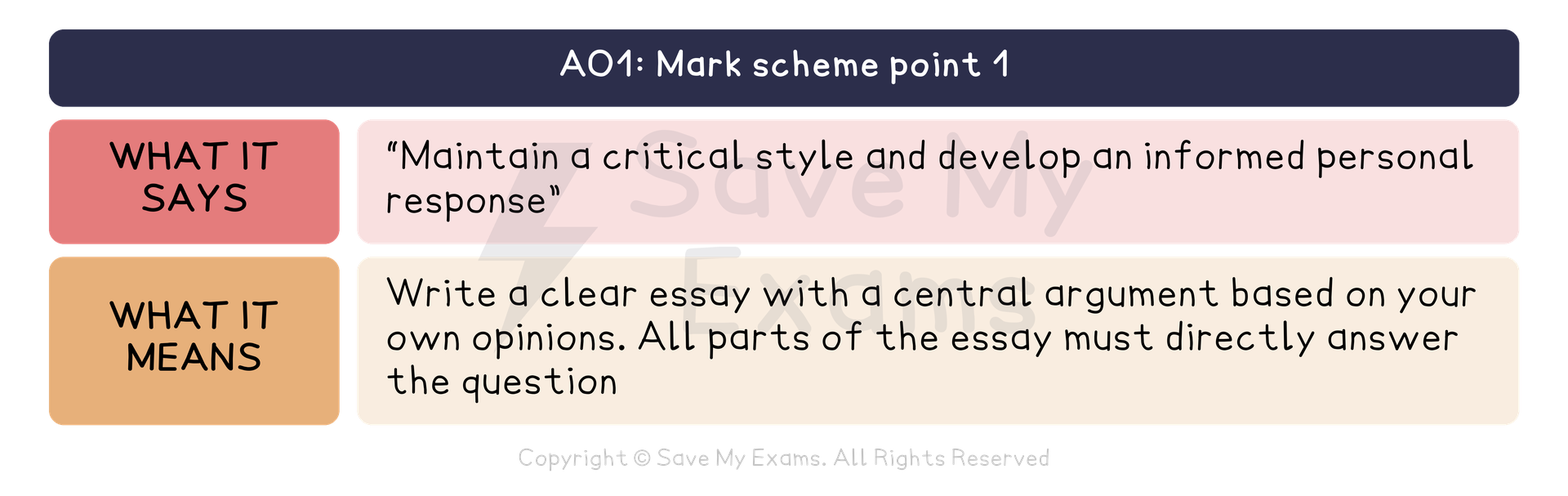
Commentary:
Examiners want to see what they call a “coherent” response: an answer that relates to a central argument in every part of the essay:
This is why it is vital to plan your answer first
This argument should always link directly to the question, so include the keywords of the question in your thesis and your topic sentences
Examiners want to see your opinions, not the opinions of an imagined Elizabethan or Jacobean audience
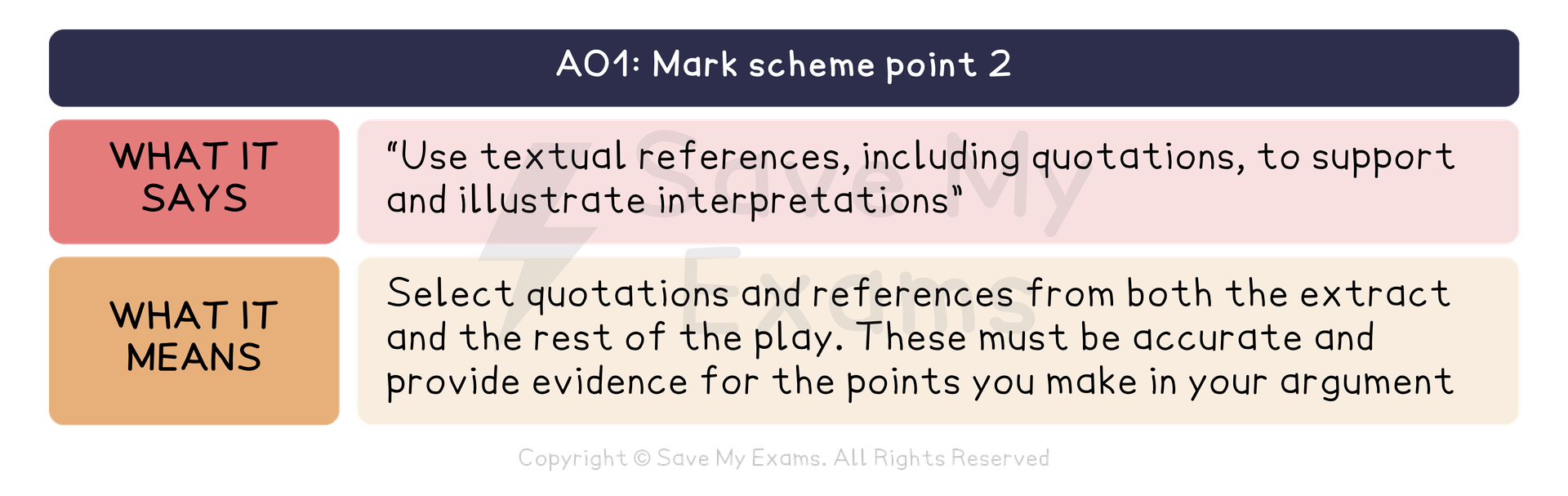
Commentary:
Examiners reward the highest marks to students who relate the ideas and themes of the extract to other parts of the play:
To link to elsewhere in the play, use phrases like: “Earlier/later in the play”, “Similarly, in Act X, Scene Y …”, “Shakespeare also highlights this idea when…”
References do not need to be direct quotations
You do not get more marks for more quotations:
All references just need to be accurate and provide evidence for your points and overall argument
All references must be relevant to the points of your essay:
Examiners dislike when students include irrelevant quotations
AO2: Analysing the writer's craft
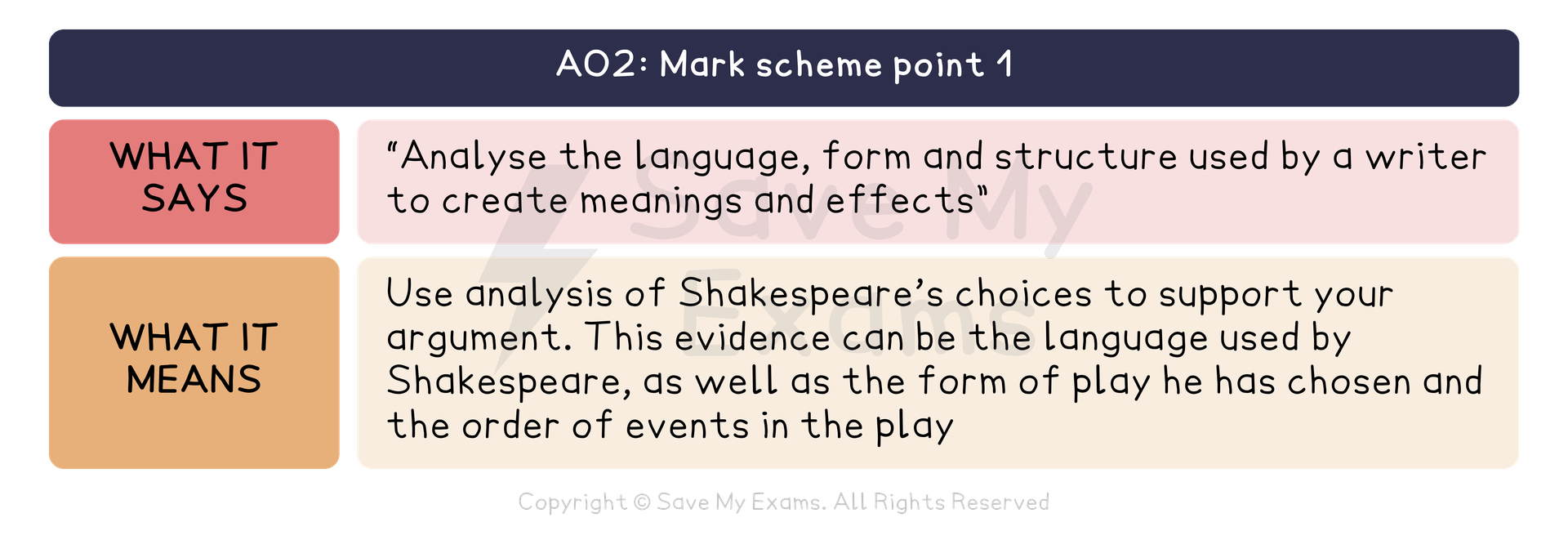
Commentary:
Examiners want students to move away from word-level analysis to whole-text analysis:
This means not just focusing your analysis on the language in the extract or quotations you have memorised
Instead, think about choices Shakespeare has made in terms of form and structure, contrasts and character development
This analysis should move from how Shakespeare uses language, structure and form, to why he does it:
What is Shakespeare using his language/characters to say? What is his overall message?
![AO2 of the AQA GCSE English Literature mark scheme, point 2, translated. What it says: “[…] using relevant subject terminology where appropriate” What it means: Include terminology on writers’ techniques only when techniques are explained fully and relevant to your argument](https://cdn.savemyexams.com/cdn-cgi/image/f=auto,width=3840/https://cdn.savemyexams.com/uploads/2026/08/24740-the-aqa-gcse-shakespeare-mark-scheme-ao2-translation-2-v2.png)
Commentary:
Examiners don’t like what they call “technique-spotting”:
This is where a student uses (sometimes very sophisticated) vocabulary to name the literary techniques Shakespeare uses without explaining them
Equally, they don’t reward analysis that just names a word class (“the noun X”; “the verb Y”):
They think this is “unnecessary and unhelpful”
Shakespeare’s techniques should only be analysed if they provide further evidence to support your argument
Examiners want students to move from what technique Shakespeare uses to how and why he is using it
AO3: Incorporating context and ideas
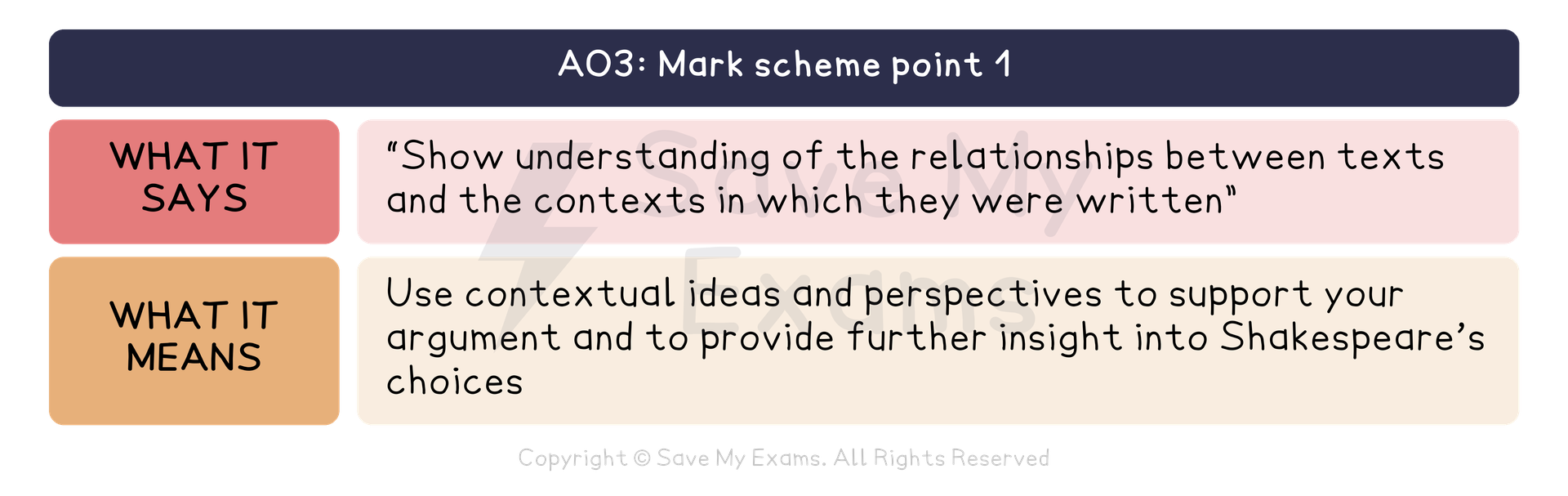
Commentary:
Context is not historical or biographical information that has nothing to do with the ideas presented in a Shakespeare play
Instead, context should be seen as the ideas and perspectives of Shakespeare’s time
These ideas and perspectives (Elizabethan or Jacobean views on religion, gender, race, etc.) help us understand why Shakespeare presents his play and characters in the way he does:
Why do characters behave the way they do?
Why is this scene set in this particular place?
Why is this theme significant in the text?
Examiners want to see context linked to the themes and ideas of the play
All context should also be linked to your overall argument:
What further insight does an understanding of the behaviours and beliefs of Shakespeare’s era provide for my argument?
AO4: Using SPaG effectively
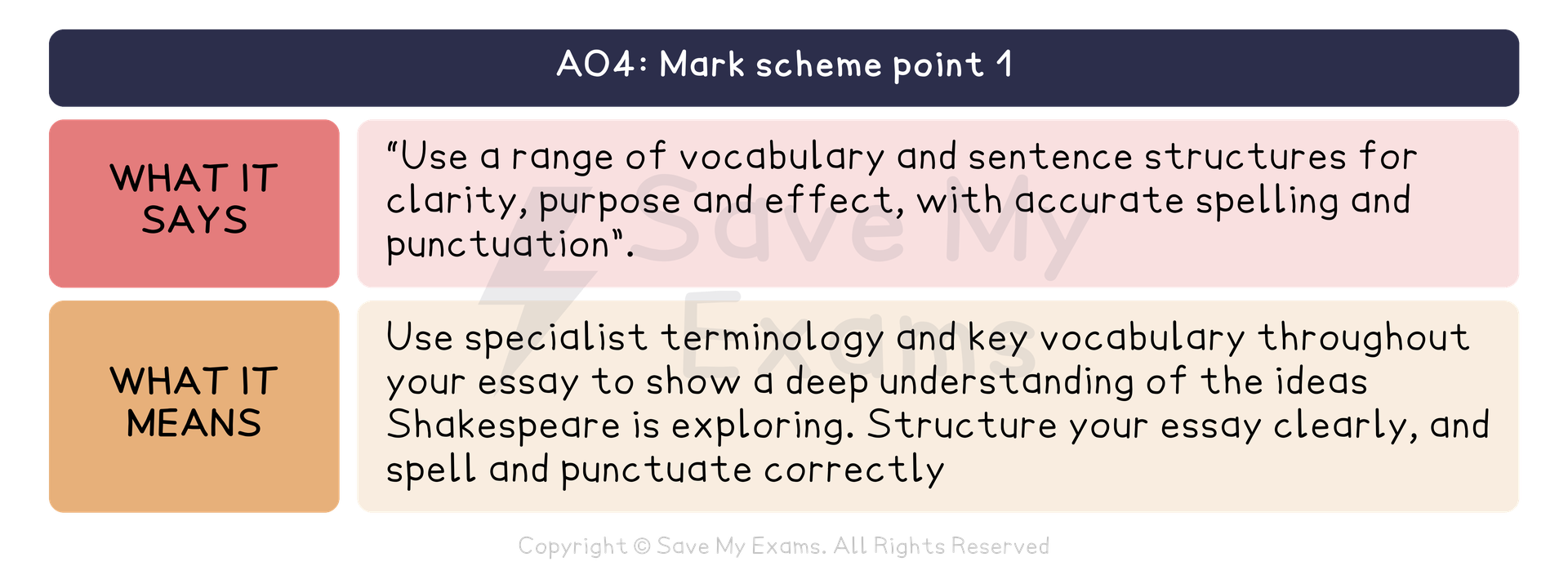
Commentary:
Although AO4 on its own is only worth 4 marks, using key vocabulary and structuring your essay well will also increase your AO1 marks:
Using specialist terminology can help you create a “conceptualised response”, which is rewarded with the highest marks
Structuring your essay into clear paragraphs with clear topic sentences will also help you gain top marks for organisation
Examiner Tips and Tricks
Examiners warn against “technique-spotting” — naming a device and moving on without saying what it does. In fact, sometimes avoiding naming the technique helps you explain what Shakespeare is actually doing with his language.
For example, instead of just pointing out the metaphor, you could write: “Shakespeare has Macbeth describe his mind as ‘full of scorpions’ rather than a plain statement of fear, which suggests his mind has turned on itself”. Naming a technique and then explaining why the writer chose it is the difference between spotting and analysis.
Understanding the different levels
The mark scheme for English Literature has six levels, with Level 1 at the bottom, and Level 6 at the top. Examiners do not receive a list of points that need to be included for a student’s essay to achieve Level 3, say, or Level 5. Instead, the mark scheme contains different “descriptors” for each level.
“Descriptors” are the:
Features that a response is expected to have to achieve at each level:
This means: How well a student has responded to the question (the overall quality of the answer)
Skills a student is expected to show to achieve each level:
This means: The specific skills needed to explore and analyse a text
For example, the “descriptors” for a Level 1 response are:
An attempt to answer the question (quality of answer)
A narrative or descriptive approach (quality of answer)
A simple analysis of the writer’s methods and context (skills shown)
In contrast, examiners expect a lot more for a Level 6 response. The “descriptors” for Level 6 include:
Responding to the full task with a well-structured argument (quality of answer)
A critical, exploratory and conceptualised approach (quality of answer)
Insightful analysis of the writer’s methods (skills shown)
An integrated and exploratory approach to context (skills shown)
Essentially, when examiners are putting student essays into a particular level, they are just deciding how well the student has displayed the expected features and skills of each assessment objective. So if you understand each AO, and what is required for each AO, you will know how to improve.
Examiner Tips and Tricks
Examiners are not working through a checklist of points your essay has to contain. They are judging how well you have shown a small set of skills, which is why two very different essays on the same question can both do well.
To ensure you display each of these skills, a great idea is to plan what each paragraph will show — an argument (your topic sentence), which evidence you’ll select, and how you’ll analyse that evidence. Planning like this also helps you stop writing down everything you know, so your answer is focused on the question.
What makes a Level 6 answer?
If you want to achieve a Grade 9, you should be aiming for a Level 6 response. Below you will see a table that explains how to move from a Level 5 response to Level 6.
Question:
![Essay prompt asks to explore Lady Macbeth's character development in the play, discussing Shakespeare's presentation and her changes. [30 marks]](https://cdn.savemyexams.com/cdn-cgi/image/f=auto,width=3840/https://cdn.savemyexams.com/uploads/2026/08/40829-aqa-lit-q-macbeth-lady-macbeth-change.png)
Part of essay | Level 5 | Level 6 | Reason |
|---|---|---|---|
Introduction | Lady Macbeth is a character who changes dramatically over the course of the play. Initially, she is presented as ruthless and remorseless but is later presented as weak and totally consumed by guilt. In the Elizabethan era, regicide was considered a mortal sin, so Lady Macbeth’s downfall could be related to her sinful nature. | Shakespeare presents Lady Macbeth as a female character who changes dramatically over the course of the play: she changes from a ruthless, remorseless woman who is able to manipulate her husband, to one that is side-lined by Macbeth and ultimately totally consumed by guilt. Shakespeare is perhaps suggesting that unchecked ambition and hubris, particularly for women, have fatal consequences. | The Level 6 introduction is in the form of a thesis statement, which presents an overarching argument that includes Shakespeare as an author making deliberate choices and conveying a message. It is also a response to the full task, because it addresses the word “female” in the question, which the Level 5 introduction does not. |
Topic sentence | Lady Macbeth becomes weaker as the play progresses, and is no longer able to control Macbeth. | Lady Macbeth’s strength, and ability to command and manipulate those around her, dramatically diminishes from the first time the audience sees her, in Act 1, Scene 5, to the last time, here in Act 5, Scene 1. | The Level 6 response is more specific. Her “strength” is detailed as an “ability to command and manipulate those around her”, which is more precise. It also gives a more specific timeframe for her character development, with the inclusion of specific scenes. |
Analysis of the writer’s methods | Shakespeare shows Lady Macbeth’s loss of control by showing her desperation in this scene. She uses imperatives — “wash”, “put”, “look” — but instead of her using these to command people around her, she directs these at herself, perhaps showing that she has lost authority over other characters, and even over herself. Furthermore, her fragmented speech (“O, O, O”) also may reflect her loss of power over herself, and that she is losing her mind. | Shakespeare emphasises Lady Macbeth’s loss of control by using contrasting verses forms as the play progresses. Initially, she uses the order and authority of blank verse, which reflects her own power and control. However, in this scene, Lady Macbeth does not use the regular or ordered language of blank verse, but rather the disordered form of prose. This reflects both her loss of status and power (prose is often used by commoners in Shakespeare’s plays), but also her own mental illness. | The Level 6 response does not only rely on quotations from the extract for its analysis. Instead, it takes a whole-text approach to the question and focuses on character development: how Lady Macbeth changes over the course of the play. It also analyses verse form, instead of just language, which shows a sophisticated understanding of Shakespeare’s methods and intentions. |
Context | In Act 1, Scene 5, Lady Macbeth is presented as commanding, ruthless and strong. In the Jacobean era, women were expected to be nurturing, compassionate and obedient to their husbands, so Lady Macbeth is very unusual for a woman at this time. | The first time she is presented to the audience, Lady Macbeth is presented as a very untypical woman: far from being a dutiful and subservient wife, she is shown to be plotting on Macbeth’s behalf, speaks of him disparagingly (she worries he is too kind to carry out her plan), and is presented as having power over both Macbeth and her surroundings. | The context in the Level 6 response is interwoven into the analysis and linked directly to the theme and question. The idea of an “untypical woman” is enough context to add here, as it focuses on perspectives and ideas, rather than the bolt-on historical information in the Level 5 response. The Level 5 response is less focused on the question as a result. |
Overall student-friendly mark scheme
The GCSE mark scheme can be confusing as it is written for examiners, not students. Below is a translated mark scheme that breaks the assessment objectives into concise, clear instructions.
Assessment objective | Number of marks | Meaning |
|---|---|---|
AO1 | 12 |
|
AO2 | 12 |
|
AO3 | 6 |
|
AO4 | 4 |
|
Tick list for success
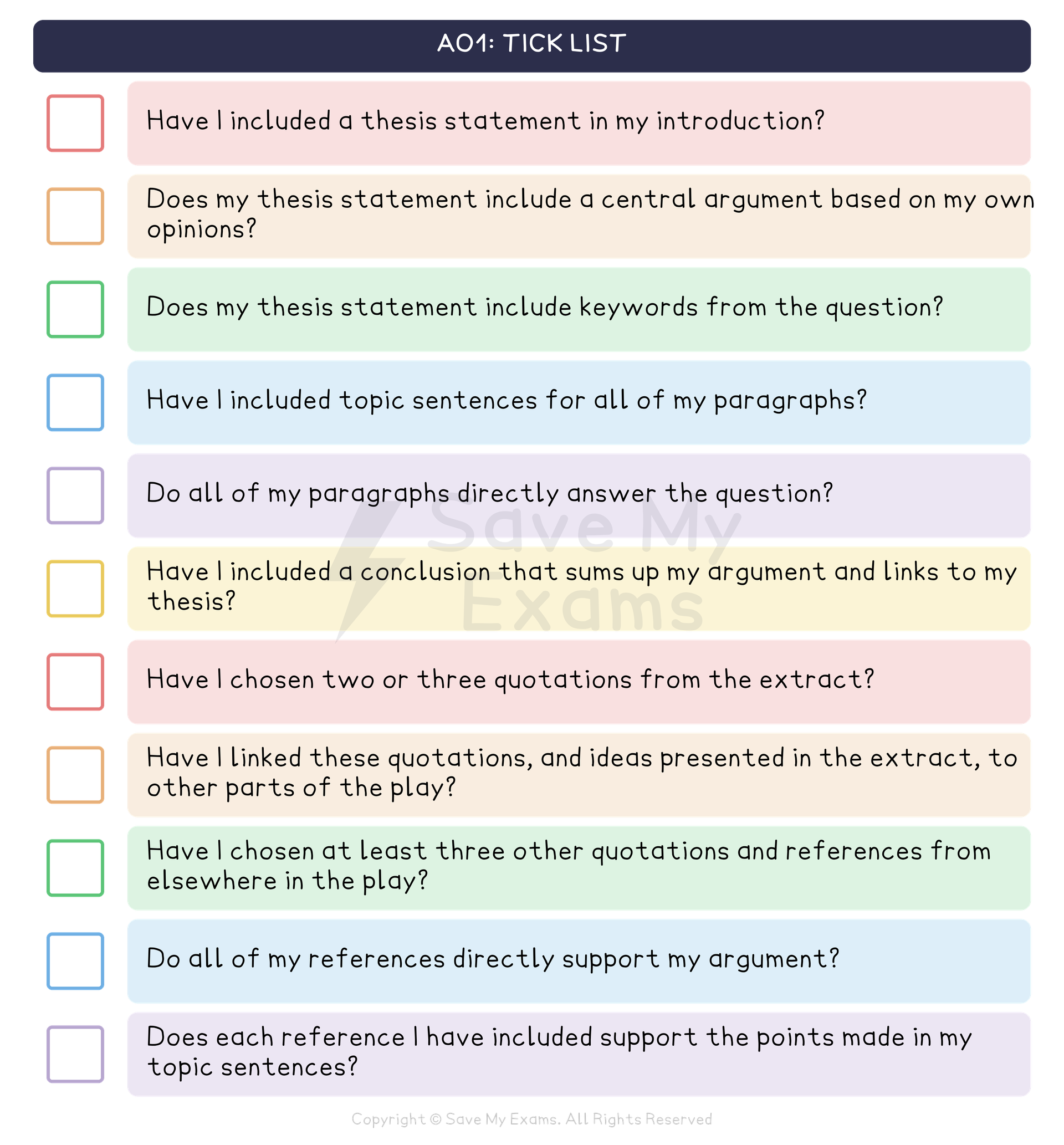
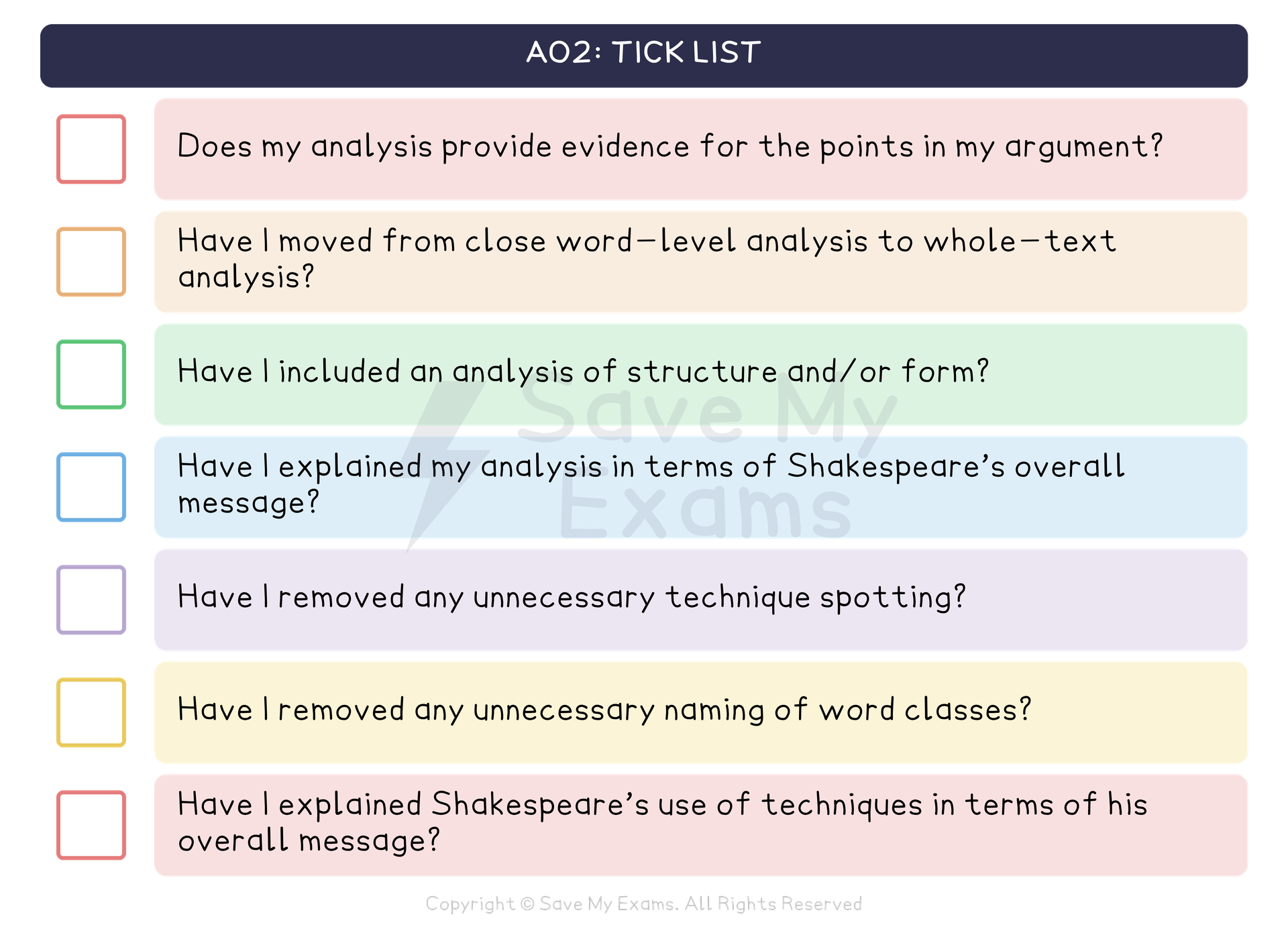
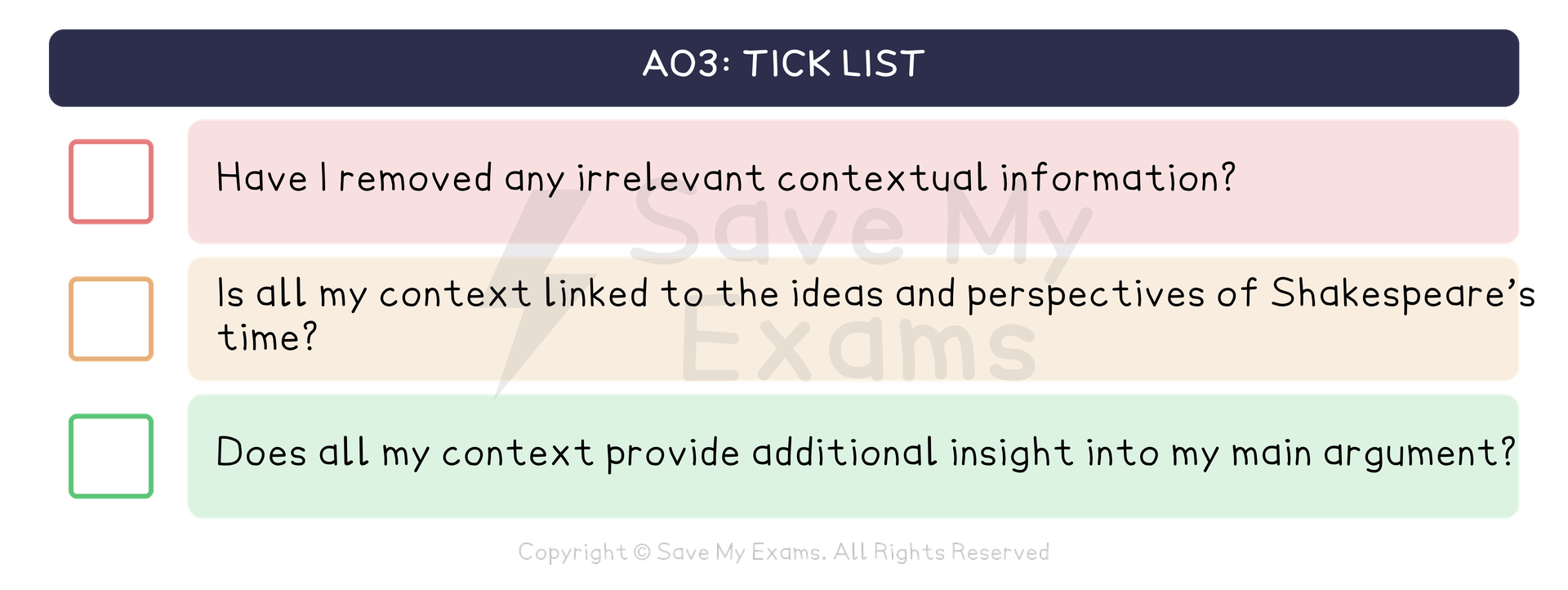
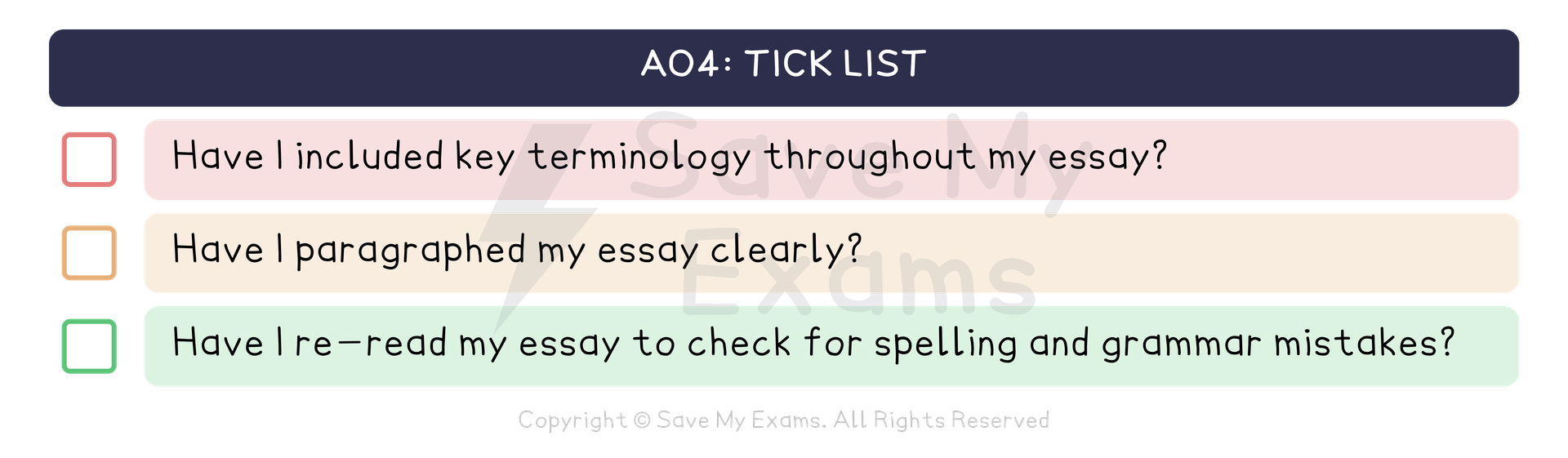
Marking your own essays can be difficult. However, if you use the tick list below, you can see which features and skills you have, and haven’t, included in your answer. If you can say ‘yes’ to all of the questions below, your essay should be heading toward the highest level.
AO1: Answering the question and using evidence
AO2: Analysing the writer's craft
AO3: Incorporating context and ideas
AO4: Using SPaG effectively

Unlock more, it's free!
Join the 100,000+ Students that ❤️ Save My Exams
the (exam) results speak for themselves:

Was this revision note helpful?