Frankenstein: Overview (AQA GCSE English Literature): Revision Note
Exam code: 8702
Frankenstein: Overview
The Frankenstein question is part of Paper 1, Section B of your GCSE. For this, you are required to write one essay-length answer to one set question. This can seem daunting at first, but this page contains some helpful information and links to more detailed revision note pages that will enable you to aim for the highest grade. This page includes:
Who was Mary Shelley?
A summary of Frankenstein
A brief overview of what is required in the exam
Frankenstein characters
Frankenstein context
Frankenstein themes
Frankenstein quotes
Top tips for the highest grade
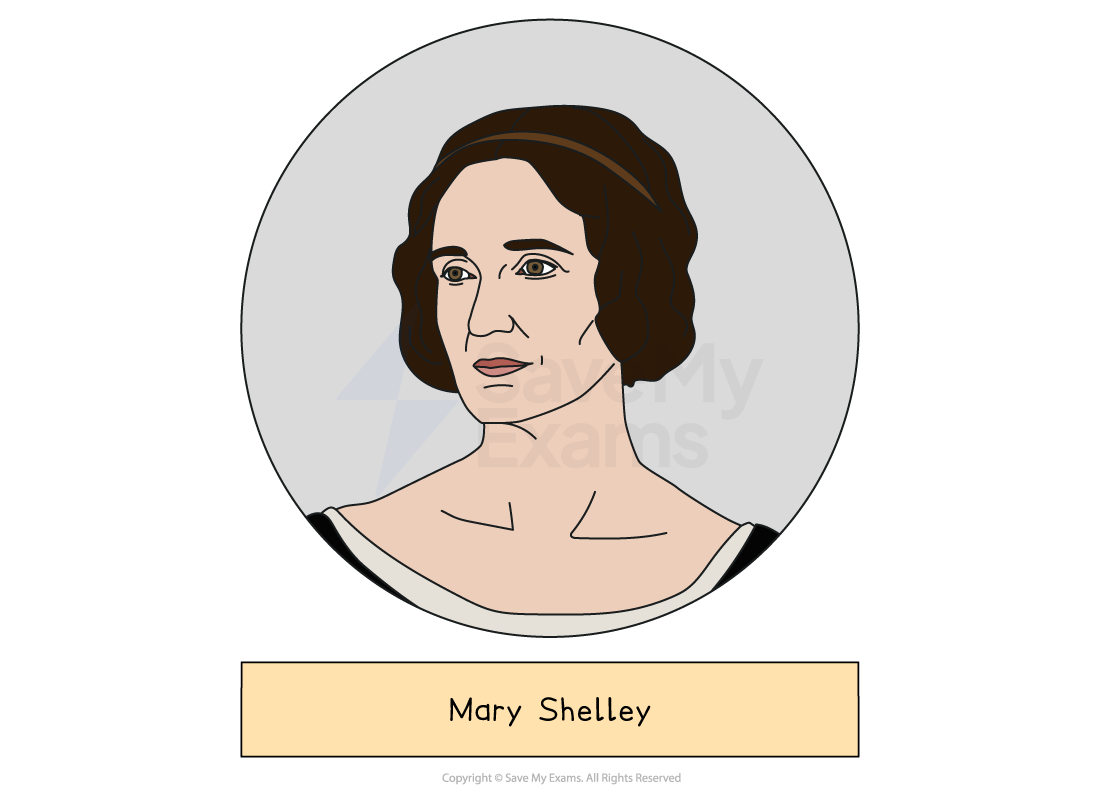
Who was Mary Shelley?
Mary Shelley was an English novelist, short-story writer and essayist, and the author of what many consider the first work of science fiction. She was born Mary Wollstonecraft Godwin in London on 30 August 1797 and died there on 1 February 1851. Her parents were both radical thinkers: her mother, Mary Wollstonecraft, wrote A Vindication of the Rights of Woman and died days after giving birth to her, and her father, William Godwin, was a political philosopher.
Shelley began Frankenstein in 1816, when she was eighteen. She was staying by Lake Geneva with her future husband Percy Bysshe Shelley and Lord Byron, who challenged the group to write a ghost story. The novel was published anonymously in 1818, and the revised edition most students study appeared in 1831.
Shelley was part of the Romantic movement, and the novel deals with the ideas the Romantics cared about: the power of the natural world, the danger of unchecked ambition, and the doubt that scientific progress is always progress. Loss shaped the book too. Shelley never knew her own mother, and she had lost a baby daughter of her own before she began writing. For further ideas about the themes explored in the novel, please see the Frankenstein: Themes page.
Frankenstein summary
Frankenstein is a Gothic novel written by Mary Shelley and published in 1818. It is told through a series of nested narratives, so the reader hears the same events from more than one point of view.
The novel opens with letters from Captain Robert Walton, on a voyage to the North Pole, who rescues a desperately ill man from the ice. That man is Victor Frankenstein, and he tells Walton his story as a cautionary tale.
Victor recounts a comfortable Swiss childhood, the death of his mother from scarlet fever, and a growing obsession with natural philosophy and the reanimation of the dead. He succeeds in creating a living being — and is so horrified by its appearance that he abandons it. Soon afterwards Victor’s young brother William is murdered, and the family servant Justine is executed for the crime after the creature plants William’s locket on her. Victor knows she is innocent and says nothing.
Confronting Victor in the Alps, the creature tells his own story: rejected everywhere he goes, he taught himself to speak and read by watching the De Lacey family, and turned to violence only after they too drove him out. He demands that Victor make him a female companion. Victor agrees, then destroys the second creature, and the creature threateningly promises to be with him on his wedding night.
The creature kills Victor’s friend Henry Clerval and, on the wedding night, his bride Elizabeth. Victor pursues him across Europe and into the Arctic, where Walton finds him. Victor dies on board the ship, and the creature — grieving rather than triumphant — departs across the ice to end his own life.
For a more detailed summary, please see the Frankenstein: Plot Summary page.
How is Frankenstein assessed in the exam?
Your GCSE Paper 1 requires you to answer two questions in 1hr 45min. That means you have approximately 52 minutes to plan, write and check your Frankenstein essay
Paper 1 is worth 64 marks and accounts for 40% of your overall GCSE grade
The Frankenstein essay is worth 30 marks in total — unlike the Shakespeare question, there are no AO4 marks for spelling, punctuation and grammar in this section
The Frankenstein question is in Section B of Paper 1 and you are required to answer the one available question on the novel
Your question will also include a printed extract of about 35 lines from the novel
It is a closed-book exam, which means you will not have access to a copy of the text (other than the printed extract) in your exam
The question will require you to analyse and write in detail about an aspect of Frankenstein
Your answer will need to address both the extract from the novel that you will be given, and the novel as a whole
For a much more detailed guide on answering the Frankenstein question, please see our revision notes on How to Answer the 19th-Century Novel Essay Question.
Frankenstein characters
The characters you should focus on when revising Frankenstein are:
Victor Frankenstein
The creature
Captain Robert Walton
Elizabeth
Henry Clerval
Justine
When considering Frankenstein or any other text, it is crucial to remember that characters are intentionally crafted by the writer to serve a specific purpose. In many cases, these characters embody certain concepts or beliefs, and the writer, such as Shelley, uses them to reflect on and examine these ideas. For more details, please see the Frankenstein: Characters page. There are also full character analyses of Victor Frankenstein, the creature and Captain Robert Walton.
Frankenstein context
Understanding what context actually is can be tricky at GCSE. Examiners understand context not as historical information or biographical facts about a writer, but as the ideas and perspectives explored by a writer through their text. Therefore, the Frankenstein context you should explore in your essay response is not information about Geneva, or facts about Mary Shelley’s life, but ideas about:
Science and religion
Society and inequality
The Romantic movement
The Gothic genre
Lots of these ideas and perspectives are universal, so your own opinions of them are valid and will be rewarded in an exam. For a detailed breakdown of the contextual topics listed above, see the Frankenstein: Context page.
Frankenstein themes
Understanding the themes that Shelley explores in Frankenstein is one of the best approaches any student can take when revising the novel. This is because to get the highest mark on your exam, you need to take what examiners call a “conceptualised approach”: a detailed and perceptive exploration of Shelley’s ideas and intentions. The main themes explored by Shelley in Frankenstein are:
Shelley explores numerous other themes in Frankenstein beyond those mentioned above and you are encouraged to examine these themes as well. However, the above list makes a great place to start, and each theme above has its own dedicated page as well as a summary on the Frankenstein: Themes page.
Frankenstein quotes
Although you are given credit for including quotations from Frankenstein in your answer, it is not a requirement of the exam. In fact, examiners say that “references” to the rest of the novel are just as valid as direct quotations: this is when students pinpoint individual moments in the novel, rather than quoting what the characters say. In order to select references really successfully, it is extremely important that you know the novel itself very well, including the order of the events that take place. This detailed chapter-by-chapter breakdown of the plot will help you to revise the chronology of Frankenstein.
However, it can also be useful to revise a few — very well selected — quotations from the novel that can be used in a variety of essays on different themes and characters. Luckily, we have made that selection for you! For a detailed analysis of each of these quotations, see the Frankenstein: Key Quotations page. If you are revising a particular character, the Frankenstein: Character Quotations page groups the most useful quotations by character.
Top tips for the highest grade
Please see our revision pages on the 19th-century novel exam for guides on:
Sources
Shelley, Mary. (2013). Frankenstein. In Delphi Complete Works of Mary Shelley (Illustrated). Delphi Classics.

Unlock more, it's free!
Join the 100,000+ Students that ❤️ Save My Exams
the (exam) results speak for themselves:

Was this revision note helpful?
Build on this topic