The Tempest: Writer's Methods and Techniques (AQA GCSE English Literature): Revision Note
Exam code: 8702

Writer’s Methods and Techniques
The best responses don’t limit their analysis to individual words and phrases. Examiners are really looking for an analysis of Shakespeare’s overall aims, so try to take a “whole-text” approach to the writer’s methods and techniques. Each of the below topics do just that:
Form and structure
Stagecraft
Language
Imagery and symbolism
Shakespeare employs various dramatic devices and literary techniques to convey meaning, and your exam question on The Tempest requires you to analyse the methods that achieve Shakespeare’s overall aims.
Here we will explore the way Shakespeare uses:
Form and structure

The Tempest is a Shakespearean romantic comedy. This means that Shakespeare has chosen to use comic conventions to deliver themes or convey meaning. It is useful to consider the genre of the play in your analysis, as this is a writer’s method. You should therefore analyse the way the play uses comic conventions or patterns to deliver ideas.
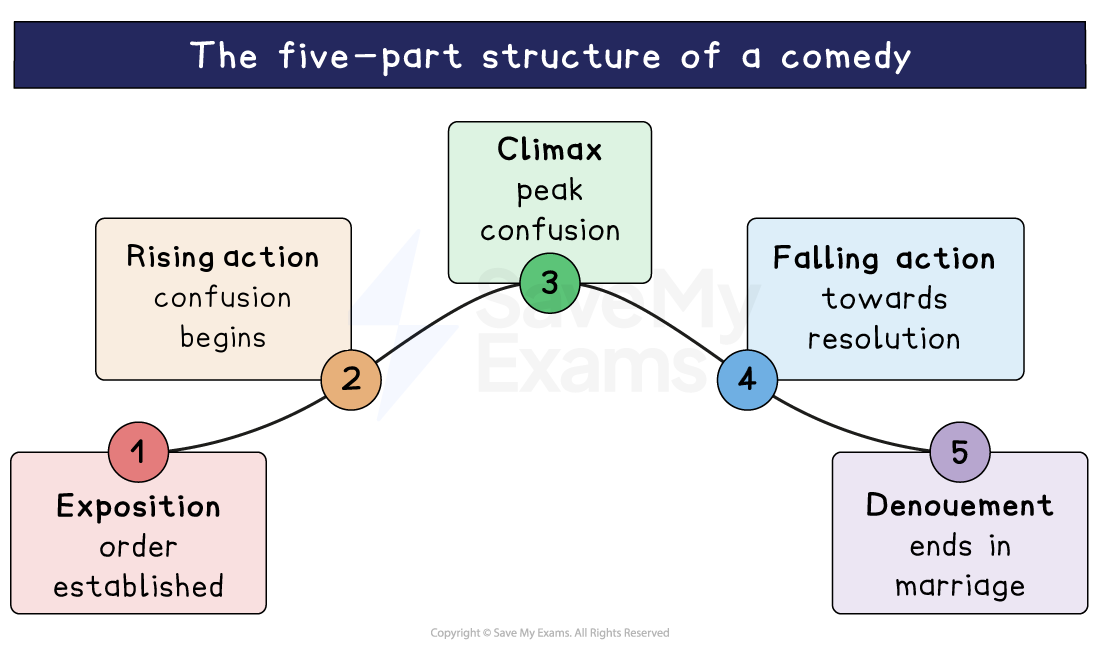
Shakespearean comedies generally follow a five-part structure:
In the exposition and rising action of a comedy, the playwright generally uses deception to foreshadow the play’s main conflict:
In The Tempest, Shakespeare depicts a magician, Prospero, tricking the king’s men by creating a storm
Ariel is a similarly magical character who serves to mock, warn, and trick the characters from the very start, and this causes confusion:
For example, Ferdinand hears invisible songs before he is trapped, and Gonzalo is given a secret warning from an invisible voice
Comedies usually introduce a love dilemma that involves silly misunderstandings:
The Tempest’s romantic dilemma involves Miranda, Ferdinand and Prospero
Humour is created with dramatic irony as audiences hear Prospero’s asides and soliloquies detailing his plots
The audience are complicit in Prospero’s plans and tricks, such as when he makes Ferdinand suffer to prove he is worthy enough for his daughter Miranda
As usual for comedies, there is a comic villain, a character who schemes and plans:
Caliban is the vengeful villain in The Tempest, a typically abused, mad character who is inevitably unsuccessful in his treacherous plans
The play ends like most comedies, with a wedding and a peaceful resolution:
Ferdinand and Miranda’s wedding is typically surreal, with spirits and songs
Prospero forgives Antonio and, with his dukedom returned, sets sail for Milan
Examiner Tips and Tricks
It is a good idea to explore the development of the plot in terms of how certain scenes create tension, create comedy, or resolve conflicts. In your response to the exam question on The Tempest, try to refer to the section of the play as a point of analysis.
For example, you could write “In the rising action, Shakespeare employs disguise to cause confusion. Typical of comedy, the dramatic irony in the scene creates humour, as audiences see the characters behaving foolishly…”
Stagecraft

The Tempest, like many of Shakespeare’s plays, has a dramatic opening scene to engage the audience and, often, to illustrate how nature can unsettle humans:
Stage directions ask for “tempestuous noise” to accompany a ship at sea
Through the play, bells and songs unsettle and confuse the newcomers to the island:
Ferdinand, for instance, says he has been “drawn” by sounds, and attributes supernatural qualities to the island
He shows his confusion in the coupled rhetorical question, “Where should this music be? i' the air or the earth?”
In a comedy like The Tempest, deception and disguise create humour:
Audiences are prompted to laugh at and mock characters, like when an invisible Ariel creates confusion between Caliban, Stephano and Trinculo
Characters in disguise create humour: Prospero has a magic cloak that can make him invisible and allows him to play tricks on others
The Tempest makes use of the comic convention of slapstick humour to present characters who are either misguided or foolish, sometimes both:
For example, in the scene in which Caliban, Trinculo and Stephano get drunk, they misunderstand one another, and fight
Language

Shakespeare’s plays are particular in that they use both dramatic and literary techniques, meaning the characters speak in sophisticated, poetic language:
The characters either speak in blank verse, formal verse, or prose, depending on the scene and the status of the character
Verse which does not rhyme but uses the rhythm of iambic pentameter is used to heighten the mood or present a character as intelligent or noble:
It is often used in a soliloquy, such as Caliban’s in Act 1, Scene 2, to emphasise extreme, imbalanced emotions
For example, Caliban bitterly complains, “In this hard rock, whiles you do keep from me/The rest o' the island”
However, a rhyming couplet depicts a sophisticated character concluding key ideas:
In Prospero’s soliloquy in the epilogue the lines rhyme. For example: “As you from crimes would pardoned be,/Let your indulgence set me free”
Ariel and the other spirits use rhyming couplets in songs, such as “Sea-nymphs hourly ring his knell./Hark, now I hear them, ding dong bell”
This sounds like a magic spell, and contributes to a surreal mood
Prose (lines without rhyme or steady rhythm) present less serious scenes, such as when the drunk Caliban, Trinculo and Stephano argue with each other
Imagery and symbolism

The play is titled after a storm and is set on an island, so weather is a useful symbol for representing the strange and unsettling human experiences:
In the exposition, Miranda describes “wild waters” and a sky that seems to “pour down stinking pitch”, using personification to show nature as violent
Caliban uses the weather to insult Prospero and Miranda, calling for “A south-west blow on ye/And blister you all o’er”
Another example is in Act 3, Scene 3, when stage directions ask for “Thunder and lightning” alongside Ariel’s frightening appearance as a mythical “harpy”
In Act 5, a reformed Prospero promises “calm seas, auspicious gales”
Shakespeare explores the advantages and disadvantages of knowledge and power via the symbolism of books that allow his protagonist to perform magic:
Prospero suggests knowledge brings power by comparing his “library” to a “dukedom”
The motif of “charms” and “arts” connote to both trickery and learning
In the denouement, Shakespeare suggests knowledge (and the power it affords) is a blessing and a curse: Prospero pleads to be free from his “arts”
Prospero’s frustration with his knowledge is conveyed with alliteration and imagery: “deeper than did ever plummet sound/I'll drown my book”
The symbolism of books and the power they bring is illustrated in Caliban’s dialogue:
Arguably, because of his experience under Prospero’s harsh rule, he appears certain that knowledge brings autonomy
When scheming to kill Prospero he tells Stephano and Trinculo, “Remember first to possess his books”, adding, “without them he’s but a sot” (a drunk fool)
While knowledge is symbolised by books, deception may be symbolised by chess:
In Act 5, Scene 1 Miranda, playing chess with Ferdinand, tells him, “you play me false”
This is ironic as the audience knows it was Prospero who deceived her
In this scene, Prospero’s power is illustrated by his superior knowledge, alluding perhaps to his cunning manoeuvres, much like a chess game
Prospero reunites Ferdinand and Alonso as if he has not been orchestrating events since the shipwreck
Sources
https://shakespeare.mit.edu/tempest/full.html

Unlock more, it's free!
Join the 100,000+ Students that ❤️ Save My Exams
the (exam) results speak for themselves:

Was this revision note helpful?
Build on this topic