Mark Scheme (AQA GCSE English Literature): Revision Note
Exam code: 8702

The mark scheme in English Literature can seem daunting, and difficult to understand. This is because there is no “correct answer” for any essay: the exam board does not provide points that need to be included in any essay, and instead, examiners have to use the mark scheme to place an answer into a level.
It is therefore essential to understand the mark scheme really well yourself: if you understand exactly what you are being assessed on, you understand how to improve. Below you will find sections on:
Translating the mark scheme
Understanding the different levels
How to get a Level 6
Student-friendly mark scheme
Tick list for success
Translating the mark scheme
Here is a simple version of the AQA mark scheme for the poetry anthology question, and below, a student-friendly translation of the mark scheme with expert advice and guidance, broken down into the different assessment objectives.
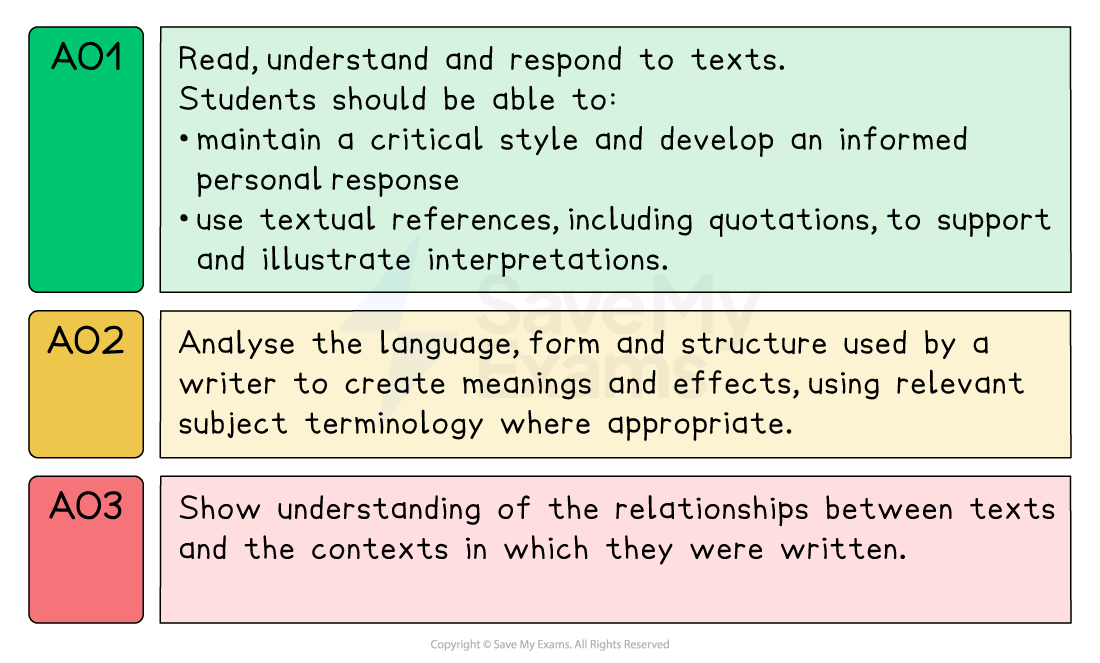
AO1: Answering the question and using evidence
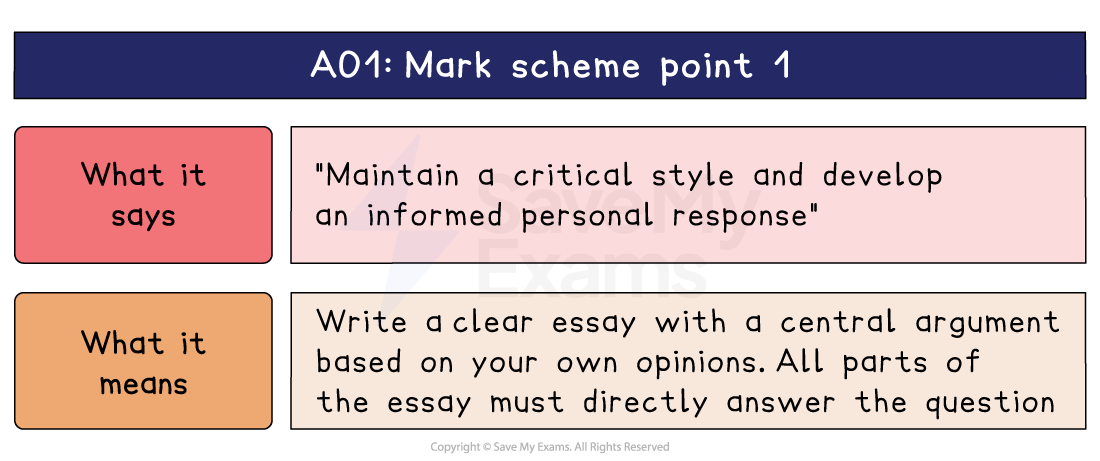
Commentary:
Examiners want to see what they call a “coherent” response: an answer that relates to a central argument in every part of the essay:
This is why it is vital to plan your answer first
It is also vital that you analyse both poems in terms of the question set
This argument should always link directly to the question, so include the key words of the question in your thesis and your topic sentences
Examiners want to see your opinions, not the opinions of an imagined ’reader’
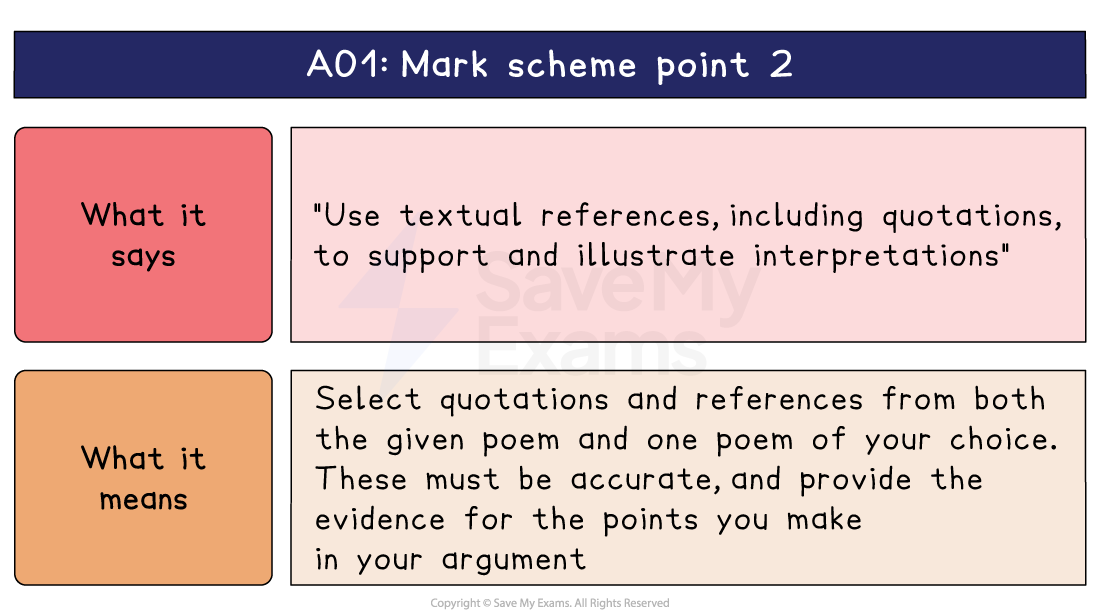
Commentary:
Examiners reward highest marks to students who relate the ideas and themes of both poems in terms of the exam question:
Examiners are looking for students to find thematic “connections” between the two poems
To link poems in your analysis, use phrases like: “Poet X also explores ideas about Y”, “Similarly, in Poem Z”, “Poet A also seeks to highlight Idea B in their poem when…”
References do not need to be direct quotations:
Examiners are equally happy when students just “pinpoint specific moments” in poems
You do not get more marks for more quotations
All references just need to be accurate and provide evidence for your points and overall argument
All references must be relevant to the points of your essay:
Examiners dislike when students include irrelevant quotations
AO2: Analysing the writer's craft
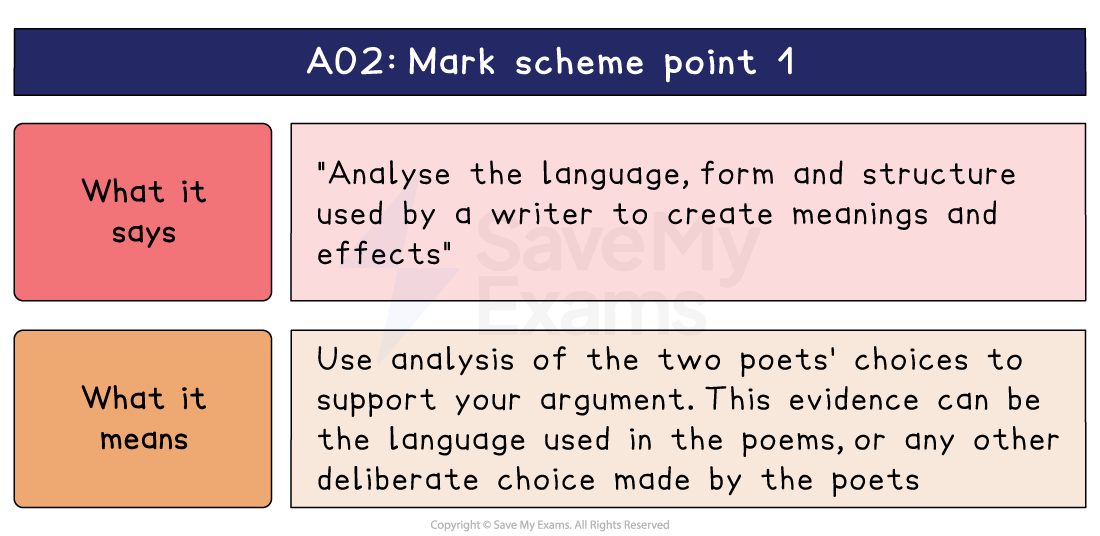
Commentary:
Examiners want students to move away from word-level analysis to whole-text analysis based on a poet’s ideas and message:
This means not just focusing your analysis on the language or poetic techniques in the poems, or quotations you have memorised
Instead, think about the ideas they are trying to present:
What themes are they exploring? Are they challenging or criticising certain viewpoints?
This analysis should move from how the poets use language, structure and form, to why they do it:
What are the poets using their poems to say? What are their overall messages?
Commentary:
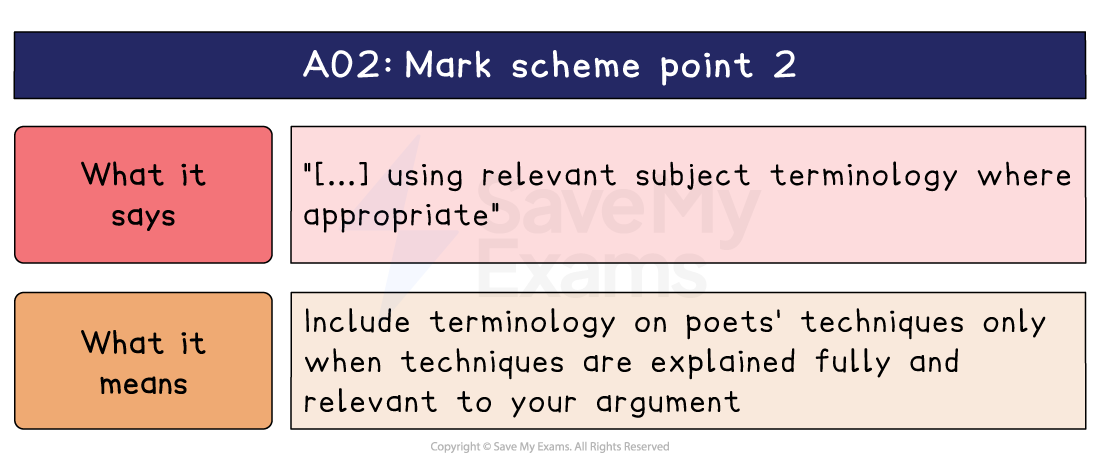
Examiners don’t like what they call “technique-spotting”:
This is where a student uses (sometimes very sophisticated) vocabulary to name the literary techniques poets use without explaining them
Equally, they don’t reward analysis that just names a word class (“the noun X”; “the verb Y”):
They think this is “unnecessary and unhelpful”
A poet’s techniques should only be analysed if they provide further evidence to support your argument
Examiners want students to move from what technique a poet uses to how and why they are using them
AO3: Incorporating context and ideas
Commentary:
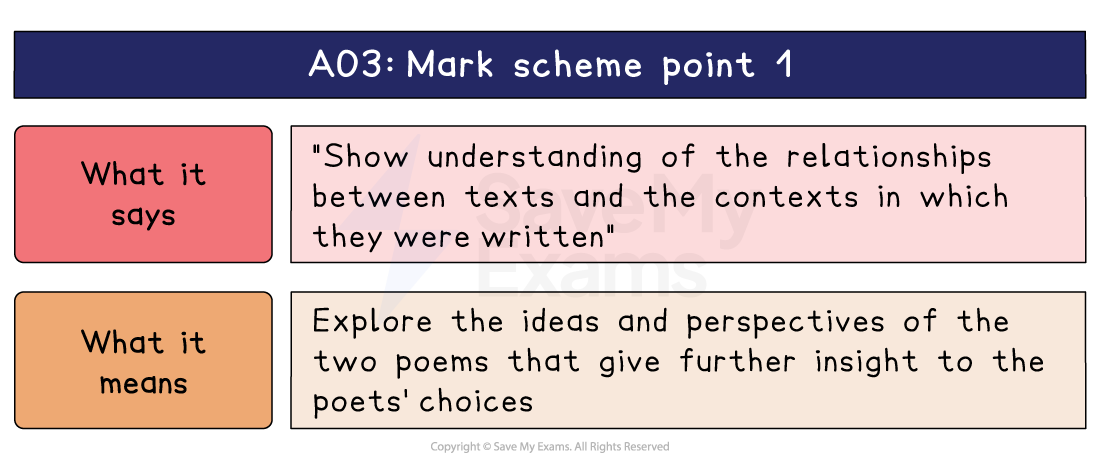
Context is not historical or biographical information that has nothing to do with the ideas presented in a poem
Instead, context should be seen as the ideas and perspectives that a poet is exploring in their poem
These ideas and perspectives (society’s ideas about love, relationships, the nature of power or warfare) help us understand why the poets present their poems in the way they do:
Why do a poem’s characters behave the way they do?
Why is the poem set in this particular place?
Why is this theme significant in the poem?
Examiners want to see context linked to the themes and ideas of the two poems:
Context can be “implicit”
This means no direct exploration of Edwardian attitudes to love or contemporary thinking about the horrors of war
Rather, an exploration of universal attitudes to love, or the negative effects of war, is rewarded by examiners
All context should also be linked to your overall argument
Examiner Tips and Tricks
Examiners look for connections between the two poems at the level of ideas, not at the level of technique. Two poems that both use enjambment have nothing in common worth writing about; two poems that both treat power as something inherited do.
For example, you could write: “Blake and Browning both present power as something inherited rather than earned, which lets each of them criticise the people who have it”. A connection between ideas gives you something to develop in every comparison you make.
Understanding the different levels
The mark scheme for English Literature has six levels, with Level 1 at the bottom, and Level 6 at the top. Examiners do not receive a list of points that need to be included for a student’s essay to achieve Level 3, say, or Level 5. Instead, the mark scheme contains different “descriptors” for each level:
“Descriptors” are the:
Features that a response is expected to have to achieve each level:
This means: How well a student has responded to the question (the overall quality of the answer)
Skills a student is expected to show to achieve each level:
This means: The specific skills needed to explore and analyse a text
For example, the “descriptors” for a Level 1 response are:
An attempt to answer the question (quality of answer)
A narrative or descriptive approach (quality of answer)
Simple analysis of the writer’s methods and context (skills shown)
In contrast, examiners expect a lot more for a Level 6 response. The “descriptors” for Level 6 include:
Responding to the full task with a well-structured argument (quality of answer)
A critical, exploratory and conceptualised approach (quality of answer)
Insightful analysis of the writer’s methods (skills shown)
Integrated and exploratory approach to context (skills shown)
Essentially, when examiners are putting student essays into a particular level, they are just deciding how well the student has displayed the expected features and skills of each assessment objective. So if you understand each AO, and what is required for each AO, you will know how to improve.
What makes a Level 6 answer?
If you want to achieve a Grade 9, you should be aiming for a Level 6 response. Below you will see a table that explains how to move from a Level 5 response to Level 6.
Question:

Part of essay | Level 5 | Level 6 | Reason |
|---|---|---|---|
Introduction | In 'London', William Blake presents ideas about power and control through the use of dramatic monologue to personally criticise the institutions that oppressed the people of London during his time. Robert Browning uses his poem, 'My Last Duchess', to criticise the control powerful people — who often inherited their power — had over women. | In 'London', William Blake is concerned with how human power can be used to control and oppress both people and the natural world, whereas Robert Browning in 'My Last Duchess' presents power through the individual character of the Duke, who uses his position of authority to control women. Both poets do this to criticise inherited or institutional power over ordinary people. | The Level 6 introduction is in the form of a thesis statement, which presents an overarching argument that encompasses ideas in both poems and crucially, already begins to compare and contrast them. The Level 5 response, while sophisticated, treats the two poems as separate entities. |
Topic sentence | William Blake in 'London' presents powerful institutions oppressing women, which leads to unintended violence. | Both William Blake and Robert Browning present the control institutions or figures hold over women as leading to violence (either committed against, or by these women) to highlight the disastrous effects of female oppression in their respective societies. | The Level 6 response is more specific: it explains more clearly that the violence experienced is a direct effect of the oppression (or control) of women. The Level 6 topic sentence also refers to both poems and the poets’ shared ideas, and includes the direct words of the question (“control”) which the Level 5 response does not. |
Analysis of writer’s methods | Blake shows the effect of women’s oppression in the violence that is a consequence of the desperate situation young women found themselves in 19th-century London: having to become sex workers to feed and clothe their children. The “youthful harlot” is presented by Blake as both “curs[ing]” and “blast[ing]” her “new-born infant”, showing a shocking and violent reaction to a new-born baby: the ultimate symbol of innocence. This is perhaps reflective of Blake’s message that in a system that punishes the poor, it is only the innocent who suffer. | Both Blake and Browning hint at the destructive and violent consequences of the oppression of women through the use of (voiceless) female characters in their poems. While Blake’s “youthful harlot” takes out her desperation on her own “new-born infant” (a symbol of perfect innocence) by blasting it with curses, Browning implies a more direct violence against women through the sinister presentation of his persona, the Duke, who seems to wield ultimate control over his wife: the ability to take her life if he so chooses. | Although it is not a requirement of a Level 6 response, here both poems are contrasted in terms of the topic sentence above. Crucially, the connections drawn are based on the poets’ ideas, or overarching messages, rather than comparing them based on poetic techniques, form or structure. The Level 5 response could easily become a Level 6 response if it makes valid connections between the ideas presented and Browning’s presentation of the same theme. |
Context | William Blake was a Romantic poet and so would have been opposed to the dominance of institutions, or monarchical systems, over the ‘ordinary’ people of the 19th-century. | Blake’s presentation of a seemingly immoral “harlot” presents readers with a moral dilemma: it is clear that her behaviour towards her infant is wrong, but, given the oppression and control the institutions of power have over her (and thus her limited freedom), perhaps Blake is asking the reader to apportion blame instead to the systemic failures of a society that leads women to be in such desperate, impoverished, situations. | The context in the Level 6 response is interwoven into the analysis and linked directly to theme and question (power and control). The ideas explored around women and morality certainly constitutes implicit context here, as it focuses on perspectives and ideas, rather than the bolt-on historical information in the Level 5 response. The Level 5 response is less focused on the question as a result. |
Overall student-friendly mark scheme
The GCSE mark scheme can be confusing as it is written for examiners, not students. Below is a translated mark scheme that breaks the assessment objectives into concise, clear instructions.
Assessment Objective | Number of marks | Meaning |
|---|---|---|
AO1 | 12 |
|
AO2 | 12 |
|
AO3 | 6 |
|
Tick list for success
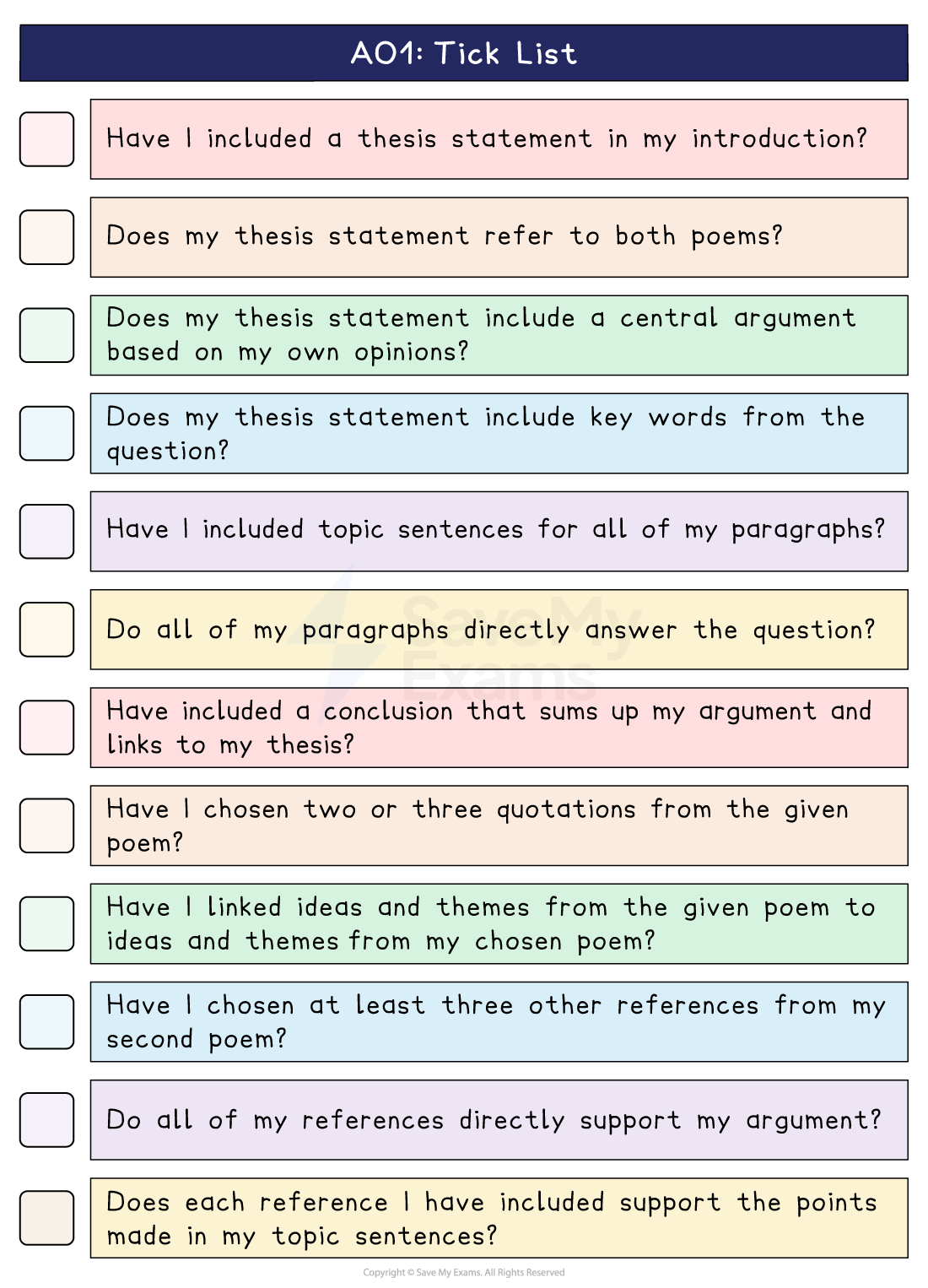
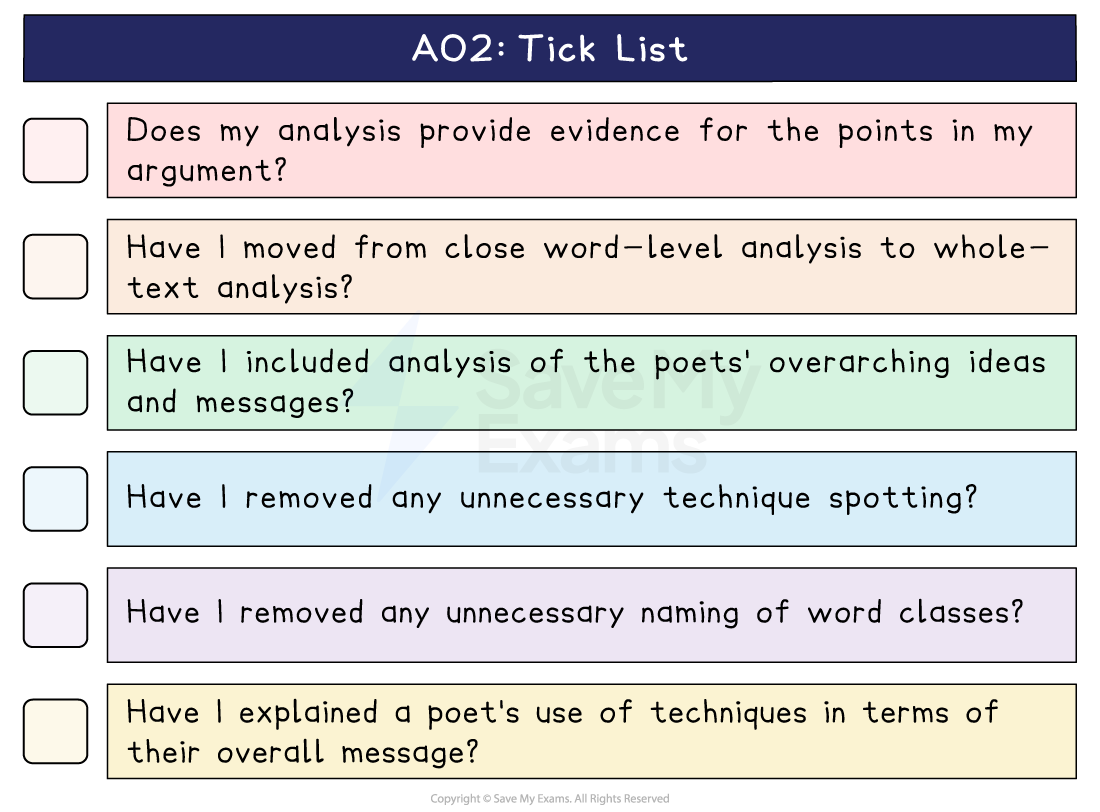
Marking your own essays can be difficult. However, if you use the tick list below, you can see which features and skills you have, and haven’t, included in your answer. If you can say ‘yes’ to all of the questions below, your essay should be heading towards the highest level.
AO1: Answering the question and using evidence
AO2: Analysing the writer's craft
AO3: Incorporating context and ideas
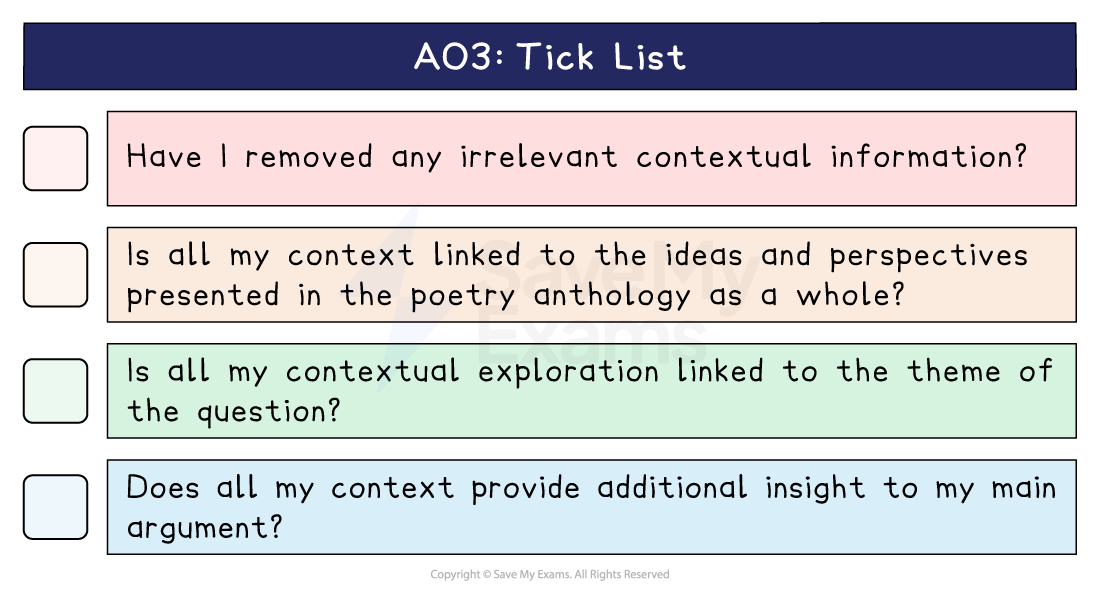
Examiner Tips and Tricks
Students improve fastest when they mark their own work. A tick list is far more useful applied to an essay you have already written than read through before you start, because it shows what you actually leave out when you are in exam conditions.
For example, you could write one timed answer, put it away for a day, then go through it with the list and mark every question you cannot answer yes to. The gaps that appear more often are the ones your revision should target.

Unlock more, it's free!
Join the 100,000+ Students that ❤️ Save My Exams
the (exam) results speak for themselves:

Was this revision note helpful?