Jane Eyre: Overview (AQA GCSE English Literature): Revision Note
Exam code: 8702

Jane Eyre: Overview
The Jane Eyre question is part of Paper 1, Section B of your GCSE. For this, you are required to write one essay-length answer to one set question. This can seem daunting at first, but this page contains some helpful information and links to more detailed revision note pages that will enable you to aim for the highest grade. This page includes:
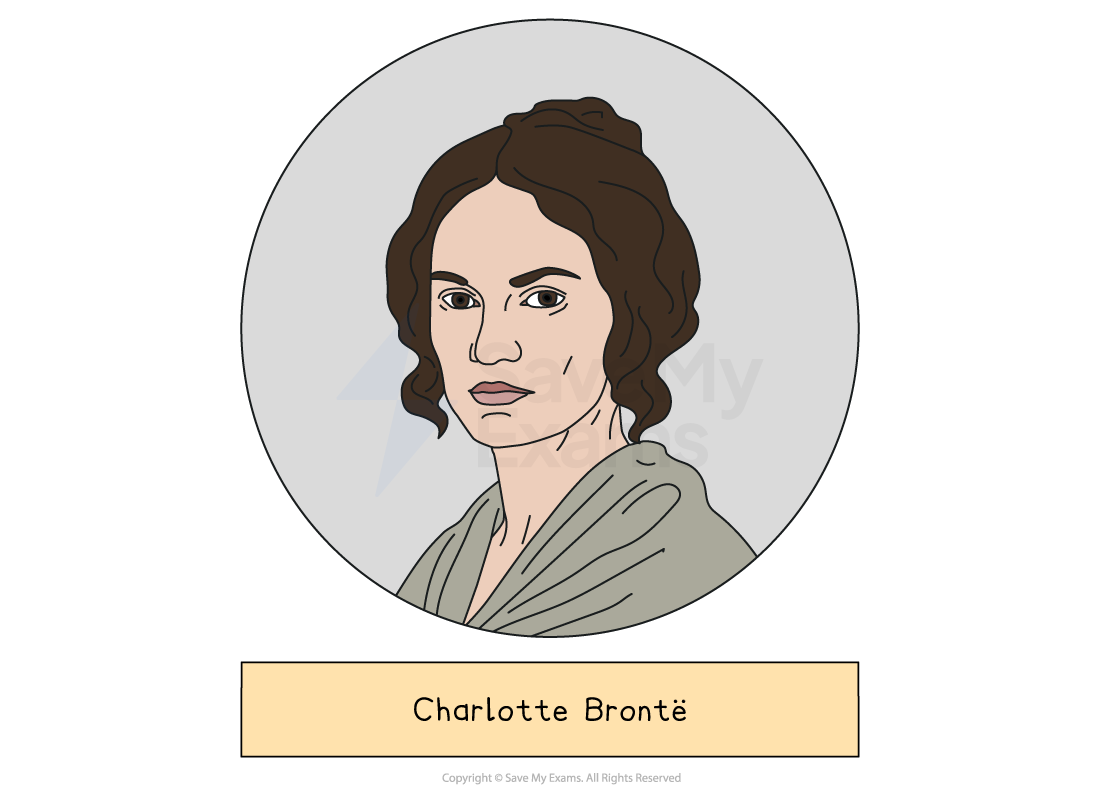
Who was Charlotte Brontë?
A summary of Jane Eyre
A brief overview of what is required in the exam
Jane Eyre characters
Jane Eyre context
Jane Eyre themes
Jane Eyre quotes
Top tips for the highest grade
Who was Charlotte Brontë?
Charlotte Brontë was an English novelist and poet, and the eldest of the three Brontë sisters. She was born in Thornton in Yorkshire on 21 April 1816, the daughter of a clergyman, and died in Haworth on 31 March 1855, aged thirty-eight. Her mother and her two eldest sisters died when she was a child. She and her surviving siblings, Emily, Anne and Branwell, grew up writing elaborate imaginary worlds together.
Brontë worked as a teacher and as a governess before becoming a writer, and both experiences feed directly into Jane Eyre. When the novel was published in 1847 it appeared under the pen name Currer Bell, because a woman writing frankly about a woman’s desires and resentments was likely to be judged more harshly than a man would have been.
Jane Eyre was an immediate success and remains her best-known work. Brontë wrote it as a fictional autobiography and as a Bildungsroman: a novel that follows its protagonist from childhood to adulthood. She combined that realism with Gothic material — a haunted room, a madwoman in the attic, a voice heard across the moors. For further ideas about the themes explored in the novel, please see the Jane Eyre: Themes page.
Jane Eyre summary
Jane Eyre is an 1847 novel by Charlotte Brontë, written in the form of a fictional autobiography. It tells the life story of its protagonist, Jane, over a period of about ten years.
The novel begins at Gateshead Hall, where Jane, an orphan, lives with her aunt Mrs Reed and her cousins John, Georgiana and Eliza. After a violent fight with John, Jane is locked in the red-room as a punishment and then sent away to Lowood, a charity school run by the harsh Mr Brocklehurst. She suffers there, but her friendships with Helen Burns and Miss Temple help her endure it, and she stays on for two years as a teacher.
Jane then takes a post as governess at Thornfield Hall, home of Edward Rochester. The two fall in love and Rochester proposes — but on their wedding day Jane discovers that he is already married to Bertha Mason, who has been kept confined in the attic.
Jane flees, homeless and penniless, and is taken in by the Rivers family. St John Rivers, a devout clergyman, finds her work as a village schoolteacher, and she learns that an uncle has died and left her a fortune. St John asks her to marry him and join him as a missionary in India; she refuses, because she still loves Rochester.
Returning to Thornfield, Jane finds it destroyed by fire. Bertha has died and Rochester has been blinded. Jane is reunited with him at Ferndean, and marries him — on her own terms, and as his equal.
For a more detailed summary, please see the Jane Eyre: Plot Summary page.
How is Jane Eyre assessed in the exam?
Your GCSE Paper 1 requires you to answer two questions in 1hr 45min. That means you have approximately 52 minutes to plan, write and check your Jane Eyre essay
Paper 1 is worth 64 marks and accounts for 40% of your overall GCSE grade
The Jane Eyre essay is worth 30 marks in total — unlike the Shakespeare question, there are no AO4 marks for spelling, punctuation and grammar in this section
The Jane Eyre question is in Section B of Paper 1 and you are required to answer the one available question on the novel
Your question will also include a printed extract of about 35 lines from the novel
It is a closed-book exam, which means you will not have access to a copy of the text (other than the printed extract) in your exam
The question will require you to analyse and write in detail about an aspect of Jane Eyre
Your answer will need to address both the extract from the novel that you will be given, and the novel as a whole
For a much more detailed guide on answering the Jane Eyre question, please see our revision notes on How to Answer the 19th-Century Novel Essay Question.
Jane Eyre characters
The characters you should focus on when revising Jane Eyre are:
Jane Eyre
Edward Fairfax Rochester
Mrs Reed
Mr Brocklehurst
Helen Burns
Bertha Mason Rochester
St John Rivers
When considering Jane Eyre or any other text, it is crucial to remember that characters are intentionally crafted by the writer to serve a specific purpose. In many cases, these characters embody certain concepts or beliefs, and the writer, such as Brontë, uses them to reflect on and examine these ideas. For more details, please see the Jane Eyre: Characters page.
Jane Eyre context
Understanding what context actually is can be tricky at GCSE. Examiners understand context not as historical information or biographical facts about a writer, but as the ideas and perspectives explored by a writer through their text. Therefore, the Jane Eyre context you should explore in your essay response is not information about Victorian Yorkshire, or facts about Charlotte Brontë’s life, but ideas about:
Gender
Social class
Christianity
Colonialism
Lots of these ideas and perspectives are universal, so your own opinions of them are valid and will be rewarded in an exam. For a detailed breakdown of the contextual topics listed above, see the Jane Eyre: Context page.
Jane Eyre themes
Understanding the themes that Brontë explores in Jane Eyre is one of the best approaches any student can take when revising the novel. This is because to get the highest mark on your exam, you need to take what examiners call a “conceptualised approach”: a detailed and perceptive exploration of Brontë’s ideas and intentions. The main themes explored by Brontë in Jane Eyre are:
Justice and injustice
Social class
Love and romance
Personal growth
Brontë explores numerous other themes in Jane Eyre beyond those mentioned above and you are encouraged to examine these themes as well. However, the above list makes a great place to start and detailed breakdowns of each of these themes can be found on the Jane Eyre: Themes page.
Jane Eyre quotes
Although you are given credit for including quotations from Jane Eyre in your answer, it is not a requirement of the exam. In fact, examiners say that “references” to the rest of the novel are just as valid as direct quotations: this is when students pinpoint individual moments in the novel, rather than quoting what the characters say. In order to select references really successfully, it is extremely important that you know the novel itself very well, including the order of the events that take place. This detailed chapter-by-chapter breakdown of the plot will help you to revise the chronology of Jane Eyre.
However, it can also be useful to revise a few — very well selected — quotations from the novel that can be used in a variety of essays on different themes and characters. Luckily, we have made that selection for you! For a detailed analysis of each of these quotations, see the Jane Eyre: Key Quotations page. If you are revising a particular character, the Jane Eyre: Character Quotations page groups the most useful quotations by character.
Top tips for the highest grade
Please see our revision pages on the 19th-century novel exam for guides on:
Sources
Brontë, Charlotte. (2003). Jane Eyre. Pennsylvania State University, Electronic Classics Series.

Unlock more, it's free!
Join the 100,000+ Students that ❤️ Save My Exams
the (exam) results speak for themselves:

Was this revision note helpful?
Build on this topic