11 mark
Which one of these is an immediate effect of exercise?
Improvement in muscular endurance
Improvement in stamina
Increase in aerobic fitness
Increase in heart rate
Was this exam question helpful?
Exam code: 8582
Which one of these is an immediate effect of exercise?
Improvement in muscular endurance
Improvement in stamina
Increase in aerobic fitness
Increase in heart rate
Was this exam question helpful?
Tom has just finished a 10-minute run.
State one immediate effect of exercise on Tom's heart rate
State one immediate effect of exercise on Tom's breathing.
Tom notices he is sweating.
State why the body sweats during exercise.
Was this exam question helpful?
Which one of these correctly distinguishes between an immediate effect and a long-term effect of exercise?
Immediate effects are permanent changes; long-term effects disappear after each session
Immediate effects occur during or straight after a single session; long-term effects develop after months of regular training
Immediate effects only affect the cardiovascular system; long-term effects only affect the musculoskeletal system
Immediate effects are caused by adrenaline only; long-term effects are caused by lactic acid only
Was this exam question helpful?
Marcus has been weight training for eight months.
State the term used to describe the increase in muscle size that Marcus will experience.
Marcus notices his resting heart rate has dropped from 72 to 58 bpm.
State the term used to describe this long-term adaptation
State one other long-term effect Marcus is likely to experience after eight months of weight training
Was this exam question helpful?
Zack is a 16-year-old GCSE PE student. He is just about to play a game of basketball for his school team.
Outline what will happen to Zack’s tidal volume and residual volume once exercise starts.
Was this exam question helpful?
Mich box ael is starting a 12-week training programme.
Identify four long-term effects of exercise.
Was this exam question helpful?
Figure 4 shows a gymnast performing a cartwheel
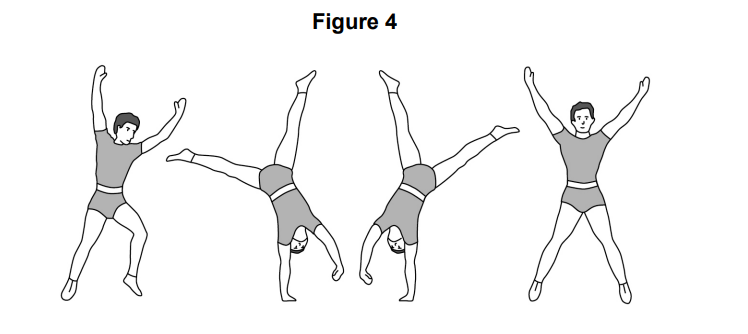
Identify the plane and axis when the gymnast in Figure 4 is performing a cartwheel.
Was this exam question helpful?
Identify three short term effects of exercise.
Was this exam question helpful?
Chris is an experienced 25-year-old 800m runner.
Table 1 shows Chris’s heart rate in beats per minute (bpm) at the start and during an 800m race.
Distance (m) | Heart rate (bpm) |
0 | 80 |
200 | 130 |
400 | 140 |
600 | 160 |
800 | 200 |
Chris has a resting heart rate of 50 beats per minute (bpm).
Explain why Chris’s heart rate is higher at the start of the race than his resting heart rate.
Was this exam question helpful?
Maya completes a vigorous high-intensity interval training session. When she wakes up the next morning, she feels unwell and her muscles hurt.
State two short-term effects of exercise Maya is experiencing
Six months later, Maya's body has adapted to her regular training programme. She notices her resting heart rate has dropped to 56 beats per minute.
Explain the physiological reasons why Maya's resting heart rate has decreased after six months of training.
State one other long-term effect of exercise. Explain how this long-term effect will improve Maya's performance in future high-intensity interval training sessions.
Was this exam question helpful?
A trained marathon runner and an untrained person of the same age both complete a 5km run at the same pace.
Explain two reasons why the trained runner would find the run less demanding than the untrained person. Refer to long-term effects of training in your answer.
Was this exam question helpful?
Sarah is a midfielder for her local hockey team. During a highly intensive match, she experiences cramp and fatigue.
Explain how suffering from a cramp will negatively impact Sarah's performance during the hockey match.
To improve her fitness for next season, Sarah completes a six-month continuous training programme. One long-term effect of this is cardiac hypertrophy.
Explain how cardiac hypertrophy will benefit Sarah's performance in the second half of her future hockey matches.
Explain how suffering from fatigue will negatively impact Sarah's decision-making and skill execution in the final ten minutes of the match.
Was this exam question helpful?
A coach advises an elite marathon runner to replace half of their weekly continuous running sessions with heavy, maximal weight training. The coach claims this will improve their performance.
Evaluate the appropriateness of this advice for a marathon runner, using your knowledge of both the short-term and long-term effects of exercise.
Was this exam question helpful?
A professional footballer suffers a serious leg injury and is unable to train for six months.
Using your knowledge of the principle of reversibility and the long-term effects of exercise, analyse the impact this period of inactivity will have on the footballer's physical performance when they return to match play.
Was this exam question helpful?
Chloe is a central midfielder for a professional football team. She has just completed a highly demanding 90-minute match.
Identify two specific short-term effects of exercise Chloe may experience in the 36 hours following her match, and explain how each effect could negatively impact her ability to train the next day.
Following her recovery, Chloe begins a new training programme.
Analyse how the long-term effects of exercise on her cardiovascular and muscular systems will improve her performance in future football matches.
Was this exam question helpful?