11 mark
Define cardiac output
Was this exam question helpful?
Exam code: 8582
Define cardiac output
Was this exam question helpful?
Zack is a 16-year-old GCSE PE student. He is just about to play a game of basketball for his school team.
Zack’s respiratory system will experience a number of changes before and during the game of basketball.
Define the terms tidal volume and residual volume.
Was this exam question helpful?
Which one of these is the correct pathway of air?
Mouth/nose – trachea – bronchi – bronchioles – alveoli
Mouth/nose – bronchi – bronchioles – trachea – alveoli
Mouth/nose – trachea – bronchioles – bronchi – alveoli
Mouth/nose – bronchioles – bronchi – trachea – alveoli
Was this exam question helpful?
Which one of these blood vessels transports oxygenated blood back to the left atrium?
Aorta
Pulmonary artery
Pulmonary vein
Vena cava
Was this exam question helpful?
Which one of these pairs of muscles are used when breathing in during exercise?
Sternocleidomastoid and abdominals
Sternocleidomastoid and deltoids
Sternocleidomastoid and intercostals
Sternocleidomastoid and pectorals
Was this exam question helpful?
Figure 1 shows a spirometer trace for a person at rest.
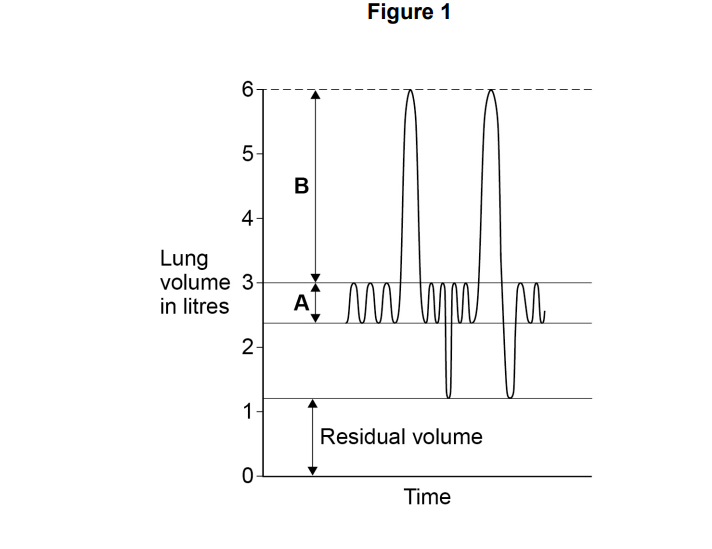
Identify lung volumes A and B in Figure 1.
In Figure 1, what would happen to lung volume A during exercise?
Justify your answer to Question 7.2
Define inhalation and describe how it takes place at rest.
Refer to the intercostal muscles, rib cage and diaphragm in your answer.
Was this exam question helpful?
What is the role of the valves in the veins?
Identify two features of the structure of arteries. Explain how each feature helps the arteries to perform their function.
Was this exam question helpful?
Which one of these describes stroke volume?
The volume of blood in the veins
The volume of blood pumped by the heart in one minute
The volume of blood pumped by the heart in one contraction
The volume of blood within the heart
Was this exam question helpful?
What happens to the diaphragm during inhalation?
It contracts
It extends
It expands
It remains the same
Was this exam question helpful?
Which one of these will air pass through immediately before entering the alveoli?
Bronchi
Bronchioles
Mouth
Trachea
Was this exam question helpful?
Which one of these is the maximum heart rate for a 14-year-old girl?
204
206
208
210
Was this exam question helpful?
Figure 2 shows a diagram of the heart.
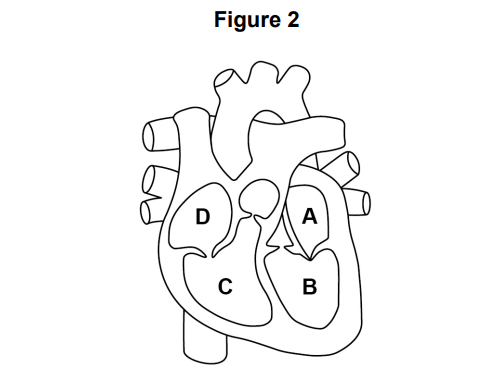
Name the four chambers labelled A, B, C and D in Figure 2.
Was this exam question helpful?
A marathon runner has a resting heart rate of 48 beats per minute and a stroke volume of 80 ml.
Complete the formula for cardiac output.
Cardiac output = _________________ x _________________
Calculate the runner's cardiac output at rest. Show your working
Identify the term used to describe the increase in the runner's heart rate in the moments just before the race begins.
Was this exam question helpful?
Mia is a swimmer. Before her race begins she notices her heart is already beating faster than normal.
State the term used to describe this increase in heart rate before exercise has begun.
Name the hormone responsible for causing this response.
Was this exam question helpful?
Jake is a 100m sprinter. He is preparing for a race and his coach is explaining the mechanics of breathing.
State the action of the external intercostal muscles during inhalation at rest
Identify the movement of the rib cage as a result of this muscle contraction.
Explain how these movements cause air to rush into the lungs.
Was this exam question helpful?
Identify two features of the structure of arteries.
State one structural difference between a vein and an artery
Name the blood vessel where gaseous exchange takes place between the blood and the body tissues.
Was this exam question helpful?
Sarah is a 400m freestyle swimmer. As she pushes off the blocks and begins to swim, deoxygenated blood is rapidly returning to her heart to be sent to her lungs.
Name the blood vessel that returns deoxygenated blood from Sarah's body back to her heart.
Identify the chamber of the heart that this deoxygenated blood enters first.
Explain the role of the valves as blood moves through Sarah's heart during her 400m race.
Was this exam question helpful?
Breathing enables gaseous exchange to occur at the alveoli.
Outline how two features of the alveoli assist in gaseous exchange
Was this exam question helpful?
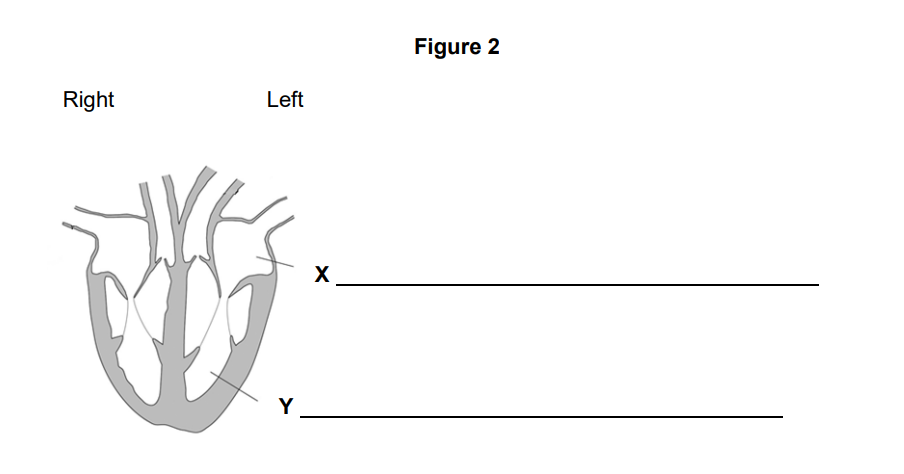
Figure 2 shows a diagram of the heart.
Using Figure 2, identify the names of the chambers of the heart labelled X and Y.
Was this exam question helpful?
Chris is an experienced 25-year-old 800m runner.
Table 1 shows Chris’s heart rate in beats per minute (bpm) at the start and during an 800m race.
Distance (m) | Heart rate (bpm) |
0 | 80 |
200 | 130 |
400 | 140 |
600 | 160 |
800 | 200 |
Chris’s breathing rate will change during the race.
Define tidal volume.
Explain the changes that occur to Chris’s tidal volume during the 800m race.
Was this exam question helpful?
Describe the pathway of blood from when it enters the heart on the right side box to where it leaves the heart on the left side.
Was this exam question helpful?
Explain how the function of arteries box and veins in the cardiovascular system allows an athlete to complete a marathon.
Was this exam question helpful?
A netball player sprints to intercept a pass. As exercise intensity increases, her body redirects blood away from certain organs towards the working muscles.
State the term used to describe this redirection of blood flow during exercise.
Explain how the blood vessels redirect blood flow towards the working muscles during high intensity exercise
Identify one organ system that receives a reduced blood supply during the sprint, and justify why this redirection of blood is necessary for the netball player.
Was this exam question helpful?
Table 1 shows the heart rate of a 1500m runner in the build-up to a race and during the first two laps.
Time | Heart Rate (bpm) |
|---|---|
15 minutes before the start | 65 |
1 minute before the start | 115 |
During Lap 1 | 160 |
During Lap 2 | 160 |
Using the data in Table 1, name and explain the physiological response occurring between 15 minutes and 1 minute before the start of the race.
Identify the type of exercise intensity the runner is working at during Laps 1 and 2, where their heart rate remains constant at 160 bpm.
During the race, the runner's vascular shunt mechanism is active.
Explain how vasodilation and vasoconstriction work together to direct blood flow for the runner.
Was this exam question helpful?
Figure 3 shows a spirometer trace for an athlete at rest and then during exercise.
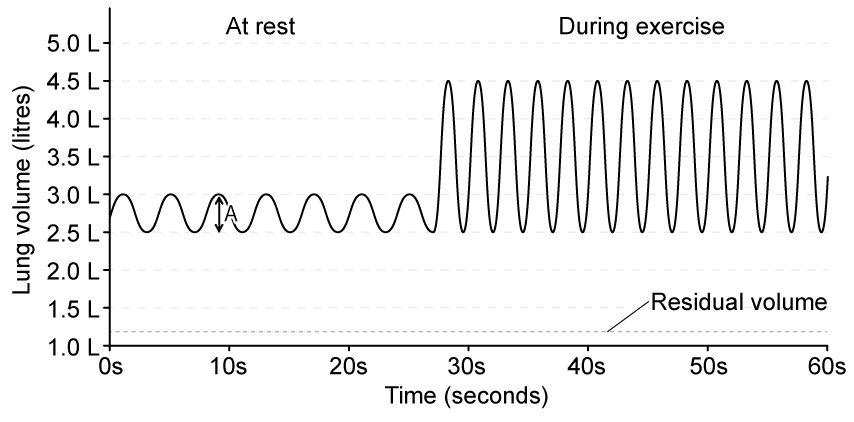
Identify the lung volume labelled A in Figure 3.
Using Figure 3, describe two changes to the breathing pattern during exercise compared to rest.
Justify why both of these changes occur during exercise
Was this exam question helpful?
Liam is a 400m freestyle swimmer. As he approaches the final 50m of his race, his heart rate is at its maximum. His working muscles require a continuous, rapid supply of oxygenated blood, meaning his cardiac cycle must be highly efficient.
State the specific term used to describe the relaxation and filling phase of Liam's cardiac cycle.
Oxygenated blood returns from Liam's lungs to his heart. Outline the exact pathway this blood takes through the specific vessels and chambers of the heart before it is transported to his working muscles.
During the ejection phase, the valves in Liam's heart play a crucial role. Explain the mechanics of these valves and justify why their function is essential for Liam to maintain his pace in the final 50m.
Was this exam question helpful?
A marathon runner relies on efficient gaseous exchange at the alveoli to perform effectively.
Identify two features of the alveoli. Explain how each feature assists the runner in gaseous exchange.
Was this exam question helpful?
A trained cyclist and an untrained person of the same age both have a resting cardiac output of 5600 ml/minute. The trained cyclist has a resting heart rate of 50 bpm, whereas the untrained person has a resting heart rate of 70 bpm.
Calculate the resting stroke volume for both the trained cyclist and the untrained person. Show your working.
Explain why the trained cyclist has a lower resting heart rate than the untrained person despite having the same cardiac output.
The untrained person is diagnosed with a condition where the valves in their heart do not close properly.
Explain the normal role of these valves, and explain how this condition will negatively affect their cardiac output and ability to exercise.
Was this exam question helpful?
During a 10km road race a runner's cardiorespiratory system must respond continuously to the demands of sustained exercise.
Analyse how the heart, the blood vessels and the alveoli work together as a system to ensure the working muscles receive a continuous oxygen supply and waste products are removed efficiently throughout the race.
Was this exam question helpful?
David is a long-distance runner preparing for a major race.
David’s heart rate begins to increase while he is standing on the starting line before the race has even begun.
Identify the specific term used to describe this, and name the hormone responsible.
During the race, blood is transported back to David's heart.
Name the type of blood vessel that transports this blood back to the heart, and explain the role of the valves inside it.
Once the race begins, David's cardiorespiratory system must adapt to the physical demands.
Analyse how David's mechanics of breathing will change to increase his oxygen intake, and evaluate how the cardiovascular system will use vasodilation and vasoconstriction to ensure this oxygen reaches his working muscles.
Was this exam question helpful?
Deoxygenated blood returns to the heart of a gymnast via the vena cava.
Analyse the pathway this blood takes through the heart and lungs to become oxygenated, and evaluate how the structure of the arteries and veins allows for the effective transport of blood during their routine
Was this exam question helpful?