The Need for Transport (Edexcel GCSE Combined Science: Biology): Revision Note
Exam code: 1SC0

The Need for Transport
In order for any organism to function properly, it needs to exchange substances between itself and the environment such as:
Oxygen
Carbon dioxide
Water
Dissolved food molecules
Mineral ions
Urea
This exchange of substances occurs across the cell membrane
There are three transport processes that living organisms use for exchange: diffusion, osmosis and active transport
Unicellular (single-celled) organisms like amoeba have very large surface areas (SA) in comparison to their volumes
This means that the distance between the surface of the organism to its centre is very small
As a result, unicellular organisms do not need to have specialist exchange surfaces or transport systems; as diffusion, osmosis and active transport through the cell membrane occur at a sufficient rate to meet the needs of the organism

Unicellular organisms such as amoeba do not require transport systems due to their large surface area to volume ratio
Multicellular organisms
For larger, multicellular organisms the distance between the surface of the organism to its centre is relatively long
This is why larger organisms usually have exchange surfaces and transport systems; as diffusion, osmosis and active transport cannot happen sufficiently to meet a larger organism’s needs otherwise
Transport systems in animals include:
The blood and circulatory system - carries the necessary substances around the body
Transport systems in plants include:
The xylem - moves water and mineral ions from roots to shoots
The phloem - moves sugars and amino acids to where they are needed in the plant
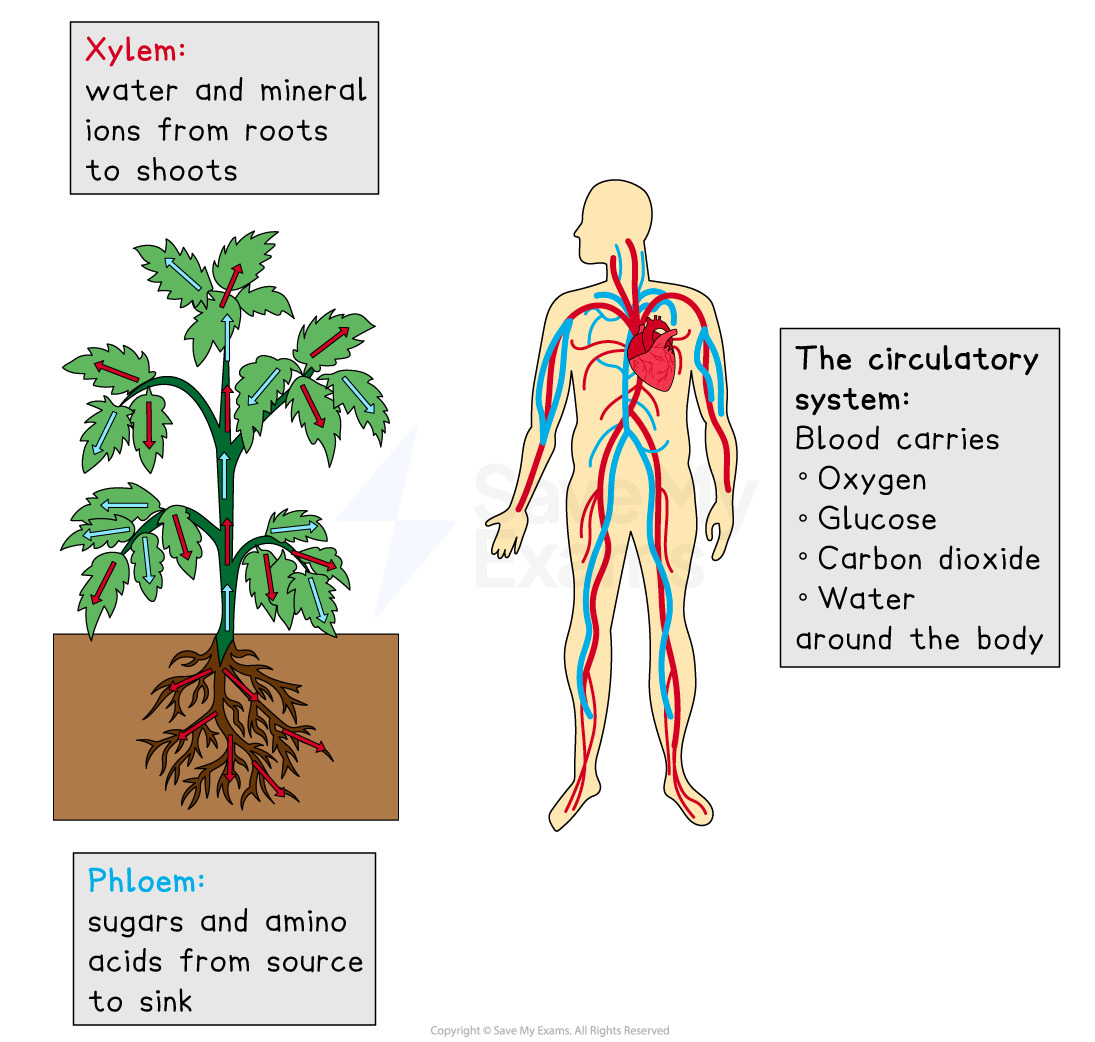
Some examples of transport systems in plants and animals
The Need for Exchange Surfaces
Large, multicellular organisms like humans have relatively small surface areas (SA) in comparison to their volumes
This is why larger organisms need exchange surfaces within their transport systems to carry out diffusion, osmosis and active transport at a sufficient rate
Exchange surfaces in animals include:
The lungs and alveoli for gas exchange
The small intestines and villi for absorption of digested food
Exchange surfaces in plants include:
Roots and root hairs where mineral ions and water are absorbed
The leaves for gas exchange

Some examples of exchange surfaces in plants and animals
Properties of exchange surfaces
Multicellular organisms have surfaces and organ systems that maximise the exchange of materials by increasing the efficiency of exchange in a number of ways:
Having a large surface area to increase the rate of transport
A barrier that is as thin as possible to separate two regions, to provide as short a diffusion path as possible for substances to move across
In addition, animals have:
A large network of blood vessels throughout the body:
To reduce the distance of exchange of materials between cells and the bloodstream
To move substances towards or away from exchange surfaces to maintain concentration gradients
Gas exchange surfaces that are well ventilated to maintain concentration gradients
You should be able to calculate and compare surface area to volume ratios
You can model the effect of how increasing size affects surface area to volume ratio using simple cubes:

Calculating the surface area to volume ratio

Unlock more, it's free!
Join the 100,000+ Students that ❤️ Save My Exams
the (exam) results speak for themselves:

Was this revision note helpful?
Build on this topic