Predicting Genetic Inheritance (Edexcel GCSE Combined Science: Biology): Revision Note
Exam code: 1SC0

Monohybrid Inheritance
Monohybrid inheritance is the inheritance of characteristics controlled by a single gene
It can be investigated using a genetic diagram known as a Punnett square
A Punnett square diagram shows the possible combinations of alleles that could be produced in the offspring
From this, the ratio of these combinations can be worked out
Remember the dominant allele is shown using a capital letter and the recessive allele is shown using the same letter but lower case
Pea plants
Pea plants were used by the scientist Mendel to investigate monohybrid inheritance
The height of pea plants is controlled by a single gene that has two alleles: tall and short
The tall allele is dominant and is shown as T
The small allele is recessive and is shown as t
A pure breeding short plant is bred with a pure breeding tall plant
The term ‘pure breeding’ indicates that the individual is homozygous for that characteristic

A pure-breeding genetic cross in pea plants. It shows that all offspring will have the tall phenotype.
Crossing the offspring from the first cross

A genetic cross diagram (F2 generation). It shows a ratio of 3 tall : 1 short for any offspring.
All of the offspring of the first cross have the same genotype, Tt (heterozygous), so the possible combinations of offspring bred from these are: TT (tall), Tt (tall), tt (short)
There is more variation in the second cross, with a 3:1 ratio of tall : short
The F2 generation is produced when the offspring of the F1 generation (pure-breeding parents) are allowed to interbreed
Crossing a heterozygous plant with a short plant
The heterozygous plant will be tall with the genotype Tt
The short plant is showing the recessive phenotype and so must be homozygous recessive – tt
The results of this cross are as follows:

A cross between a heterozygous plant with a short plant
How to construct Punnett squares
Determine the parental genotypes
Select a letter that has a clearly different lower case, for example, Aa, Bb, Dd
Split the alleles for each parent and add them to the Punnett square around the outside
Fill in the middle four squares of the Punnett square to work out the possible genetic combinations in the offspring
You may be asked to comment on the ratio of different allele combinations in the offspring, calculate percentage chances of offspring showing a specific characteristic or to determine the phenotypes of the offspring
Completing a Punnett square allows you to predict the probability of different outcomes from monohybrid crosses
Calculating probabilities from Punnett squares
A Punnett square diagram shows the possible combinations of alleles that could be produced in the offspring
From this, the ratio of these combinations can be worked out
However, you can also make predictions of the offsprings’ characteristics by calculating the probabilities of the different phenotypes that could occur
For example, in the second genetic cross (F2 generation) that was given earlier (see above), two plants with the genotype Tt (heterozygous) were bred together
The possible combinations of offspring bred from these two parent plants are: TT (tall), Tt (tall), tt (short
The offspring phenotypes showed a 3:1 ratio of tall : short
Using this ratio, we can calculate the probabilities of the offspring phenotypes
The probability of an offspring being tall is 75%
The probability of an offspring being short is 25%
Examiner Tips and Tricks
If you are asked to use your own letters to represent the alleles in a Punnett square, try to choose a letter that is obviously different as a capital than the lower case so the examiner is not left in any doubt as to which is dominant and which is recessive.
Family Pedigrees
Family pedigree diagrams are usually used to trace the pattern of inheritance of a specific characteristic (usually a disease) through generations of a family
This can be used to work out the probability that someone in the family will inherit the genetic disorder
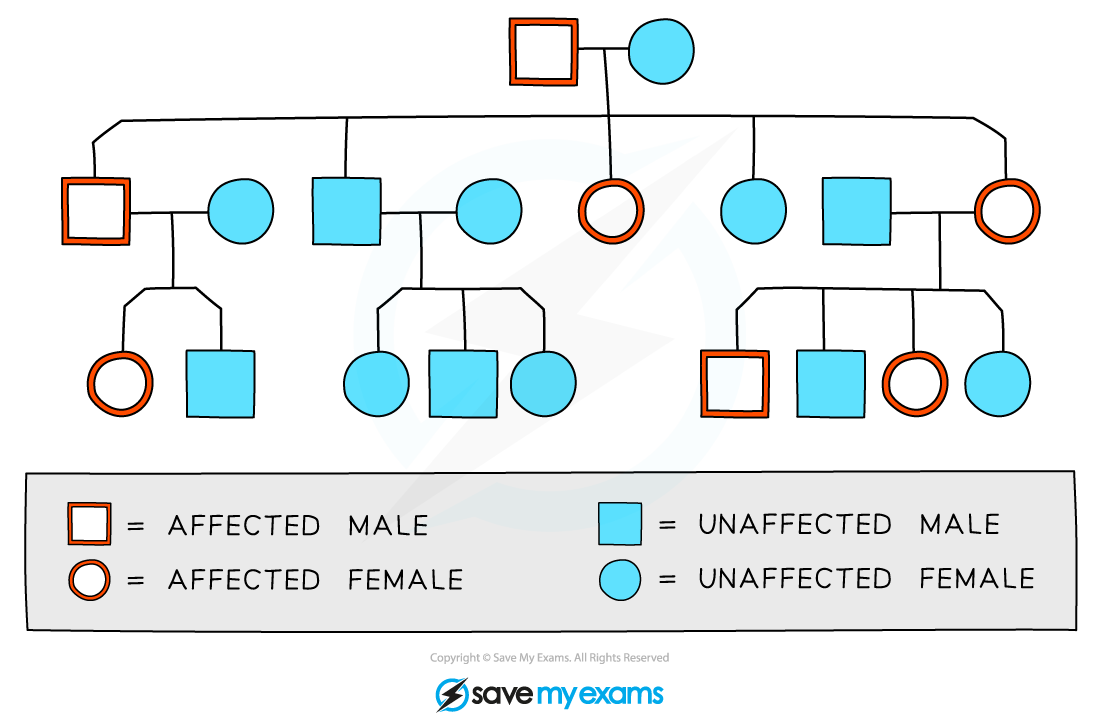
A family pedigree chart
Males are indicated by the square shape and females are represented by circles
Affected individuals are red and unaffected are blue
Horizontal lines between males and females show that they have produced children (which are shown underneath each couple)
The family pedigree above shows:
Both males and females are affected
Every generation has affected individuals
That there is one family group that has no affected parents or children
The other two families have one affected parent and affected children as well

Unlock more, it's free!
Join the 100,000+ Students that ❤️ Save My Exams
the (exam) results speak for themselves:

Was this revision note helpful?
Build on this topic