GPE & KE (Edexcel GCSE Combined Science: Physics): Revision Note
Exam code: 1SC0

Gravitational Potential Energy
Energy in the gravitational store of an object is defined as:
The energy an object has due to its height in a gravitational field
This means:
If an object is lifted up, energy is transferred to its gravitational potential store
If an object falls, energy will be transferred away from its gravitational potential store

Energy is transferred to the gravitational potential store of the mass as it is lifted through a gravitational field
The change in the gravitational potential energy, ΔGPE of an object can be calculated using the equation:
Where:
ΔGPE = change in gravitational potential energy, in joules (J)
m = mass, in kilograms (kg)
g = gravitational field strength in newtons per kilogram (N/kg)
Δh = change in vertical height in metres (m)
In Physics, Δ is the capital Greek letter 'delta' which stands for 'change in'
The two graphs below show how GPE changes with height for a ball being thrown up in the air and when falling down
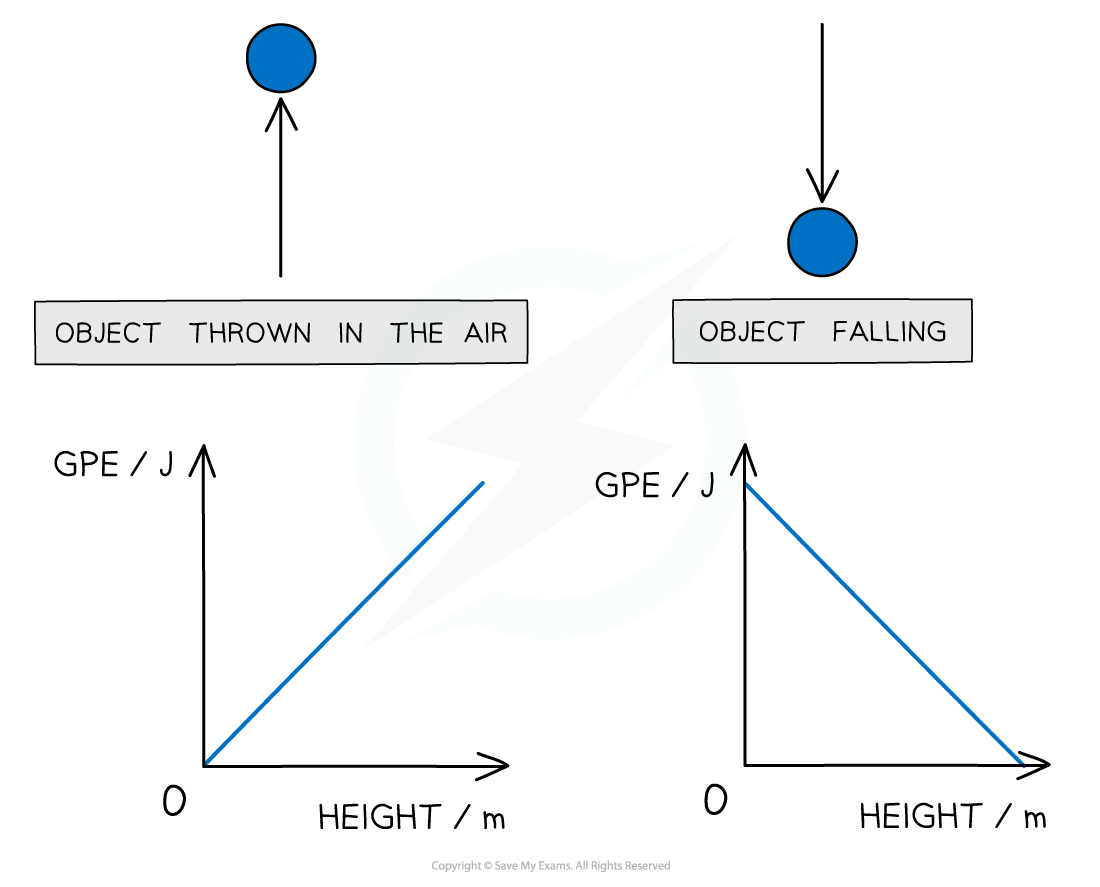
Graphs showing the linear relationship between GPE and height
Kinetic Energy
Energy in an object's kinetic store is defined as:
The amount of energy an object has as a result of its mass and speed
This means that any object in motion has energy in its kinetic energy store

Kinetic energy can be calculated using the equation:
Where:
KE = kinetic energy in joules (J)
m = mass of the object in kilograms (kg)
v = speed of the object in metres per second (m/s)
Energy Equivalency
In a perfect energy transfer, there is no wasted energy
Energy transfers can be assumed to be perfect if the wasted energy transfer is negligible
Some exam questions will state to ignore air resistance for example
In reality, there is no such thing as a perfect energy transfer
Ignoring wasted energy transfers is helpful in calculations because it allows energy values to be equated
Pendulums are often used as examples of perfect energy transfers
All of the energy in the kinetic store of the pendulum is transferred mechanically into its gravitational potential store
And then all of the energy in the gravitational potential store of the pendulum is transferred mechanically into its kinetic store
Energy is transferred back and forth between these two stores as the pendulum swings
Therefore, it can be said that:
Worked Example
The diagram shows a rollercoaster going down a track.
The rollercoaster takes the path A → B → C → D.

The rollercoaster begins at a height of 15 m above the ground and ends at ground level.
Breaking to stop the ride begins after it passes position D.
The mass of the rollercoaster is 100 kg.
Calculate the maximum speed of the rollercoaster at position D. Ignore any frictional effects before passing point D.
Answer:
Step 1: List the known quantities
Height, h = 15 m
Mass, m = 100 kg
Gravitational field strength, g = 10 N/kg
Step 2: Write out the equation for gravitational potential energy
Step 3: Calculate the gravitational potential energy
Step 4: Use energy equivalency to equate the gravitational potential and kinetic energy
Frictional effects are to be ignored therefore a perfect energy transfer can be assumed
Step 5: Write out the equation for kinetic energy
Step 6: Rearrange to make speed the subject:
Step 7: Calculate the maximum possible speed of the rollercoaster at position D
At position D the rollercoaster is at ground level
Therefore all the energy has been transferred from the gravitational potential to the kinetic store
The maximum possible speed is using the assumption of a perfect energy transfer
Examiner Tips and Tricks
When the question tells you to ignore the effects of resistance (ie wasted energy transfers) this is a clue that may need to use energy equivalency to find the missing quantity needed for your calculation.

Unlock more, it's free!
Join the 100,000+ Students that ❤️ Save My Exams
the (exam) results speak for themselves:

Was this revision note helpful?
Build on this topic