Problem Solving using Vectors (Cambridge (CIE) IGCSE Additional Maths): Revision Note
Exam code: 0606

Problem-solving using vectors
What problems may I be asked to solve involving vectors?
Showing that two lines or vectors are parallel
Two vectors are parallel if they are scalar multiples of each other
i.e. where is a constant
See Vector Addition
Finding the midpoint of two (position) vectors
Showing that three points are collinear
Collinear describes points that lie on the same straight line
e.g. The points and all lie on the line with equation
Vectors can be used to show this, and similar, results
Results concerned with geometric shapes
Shapes with parallel lines are often involved
e.g. parallelogram, rhombus
These often include lines or vectors being split into ratios
e.g. The point lies on the line such that
How do I find the midpoint of two vectors?
If the point has position vector and the point has position vector
the position vector of the midpoint of is
This can be derived by considering
using the result from Vector Addition
If is the midpoint of then
Therefore, the position vector of the midpoint, is
How do I show three points are collinear?
Three points are collinear if they all lie on the same straight line
There are two ways to show this for three points, and say
Method 1 Show that where is a constant i.e. show that and are scalar multiples of each other
As the vectors are scalar multiples they will have the same direction (and so be parallel)
So as both vectors start at point , they must be collinear
Method 2 Show that AND that point lies on both the vectors and
Which method you should use will depend on the information given and how you happen to see the question
How do I solve problems involving geometric shapes?
Problems involving geometric shapes involve finding paths around the shape using known vectors
there will be many other vectors in the shape that are equal and/or parallel to the known vectors
The following grid is made up entirely of parallelograms, with the vectors and defined as marked in the diagram:
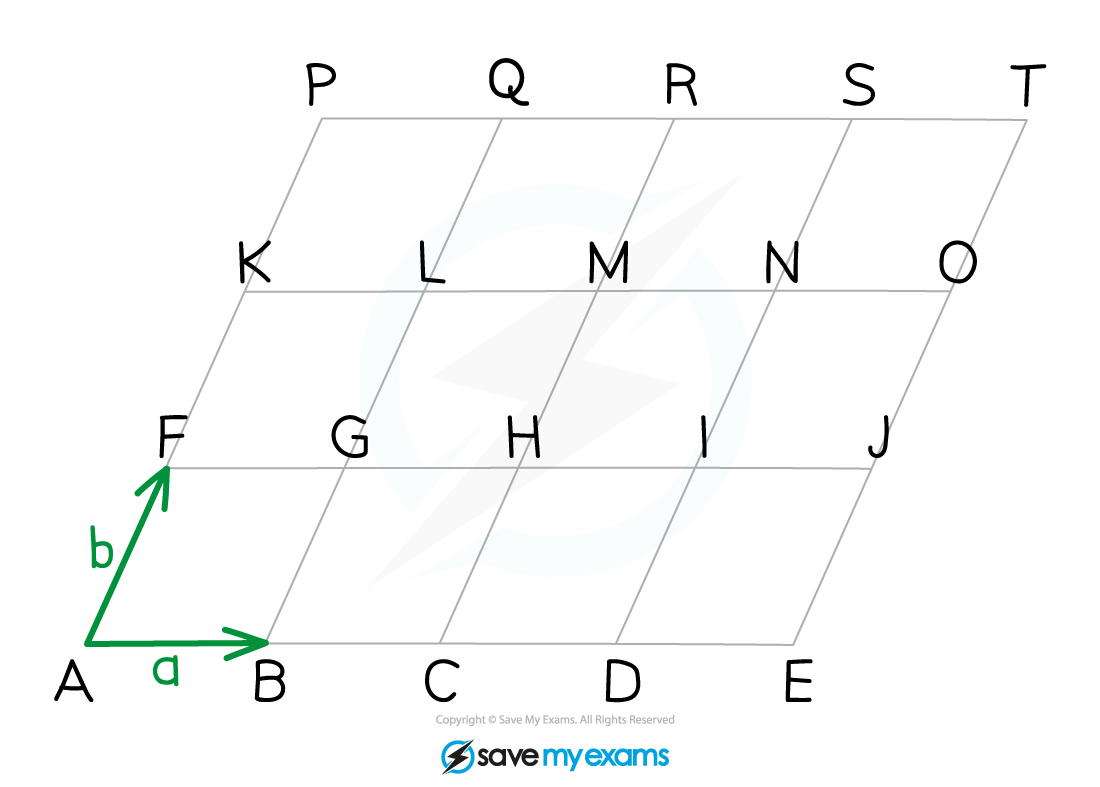
Note the difference between "specific" and "general" vectors
The vector in the diagram is specific and refers only to the vector starting at and ending at
However, the vector is a general vector
any vector the same length as and parallel to it is equal to
e.g.
Vector is also a general vector
e.g.
There will also be vectors in the diagram that are the same magnitude but have the opposite direction to or
e.g.
There are also many instances of the vector addition result
e.g.
There are many scalar multiples of the vectors or
e.g.
Using a combination of these it is possible to describe a vector between any two points in terms of and
Examiner Tips and Tricks
Diagrams are helpful in vector questions
If a diagram has been given, label it and add to it as you progress through a question
If a diagram has not been given, draw one, it does not need to be accurate!
Worked Example
The following diagram consists of a grid of identical parallelograms.
Vectors and are defined by and .
Write the following vectors in terms of and .
a)
To get from A to E follow vector four times (to the right).
b)
There are many ways to get from G to T. One option is to go from G to Q ( twice), and then from Q to T ( three times).
c) Point is such that it is midpoint of .
Find the vector .
There are many ways to get from P to Z.
One option is to go from P to R ( twice), and then from R to Z ( one-and-a-half times).

Unlock more, it's free!
Join the 100,000+ Students that ❤️ Save My Exams
the (exam) results speak for themselves:

Was this revision note helpful?
Build on this topic