Applications of Differentiation (Cambridge (CIE) IGCSE Additional Maths): Revision Note
Exam code: 0606

Finding gradients
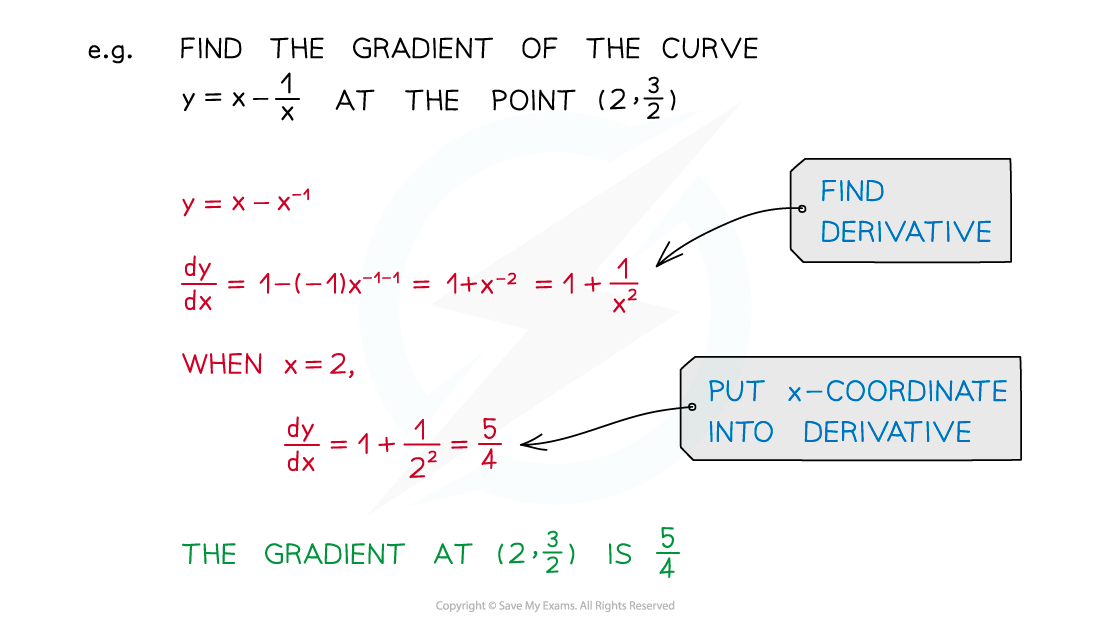
How do I use the derivative to find the gradient of a curve?
The gradient of a curve at a point is the gradient of the tangent to the curve at that point
To find the gradient of a curve, at any point on the curve
differentiate to find (unless is already known)
substitute the x‑coordinate of the point into the derivative and evaluate
How do I find the approximate change in y as x increases?
so, for small changes you can write
For example, if the gradient of at is
what is the approximate change in as increases from to , where is small?
Examiner Tips and Tricks
Read the question carefully; sometimes you are given and so don't need to differentiate initially - don't just automatically differentiate the first thing you see!
The following mean the same thing:
"Find the gradient of the curve at "
"Find the gradient of the tangent at "
the tangent gradient = curve gradient at that point
"Find the rate of change of y with respect to x at "
Worked Example
A curve has the equation .
(a) Find the gradient of the curve when .
is already in a form that can be differentiated
Substitute into
The gradient of the curve at is 19
(b) Work out the possible values of for which the rate of change of with respect to is 4.
"Rate of change" is another way of describing the derivative
Solve this equation to find
Note that it is quadratic equation so it could have up to two solutions
The question refers to 'values' implying there is (or could be) more than one value for
The possible values of , that give a rate of change of 4, are and
Increasing & decreasing functions
What are increasing and decreasing functions?
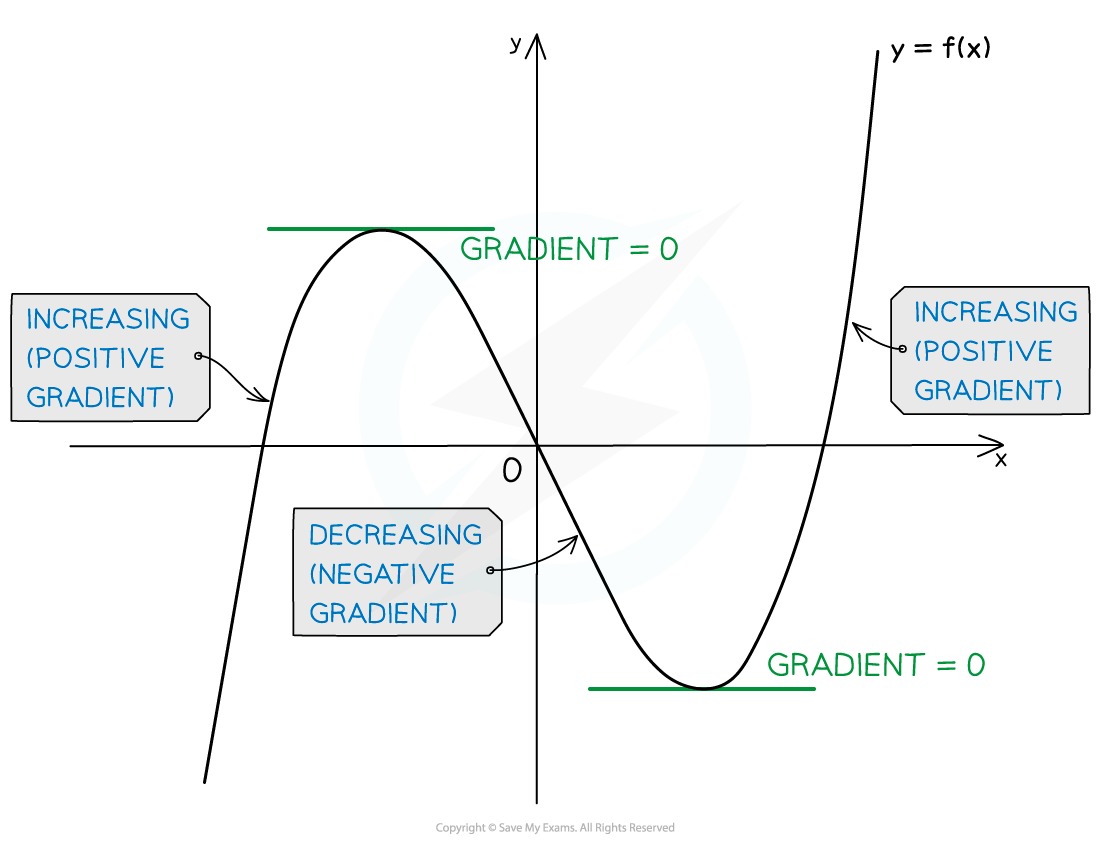
A function is increasing when (the gradient is positive)
This means graph of a function goes up as increases
A function is decreasing when (the gradient is negative)
This means graph of a function goes down as increases
How do I find where functions are increasing or decreasing?
To identify the intervals on which a function is increasing or decreasing
STEP 1
Find the derivative f'(x)
STEP 2
Solve the inequalities
(for increasing intervals) and/or
(for decreasing intervals)
Most functions are a combination of increasing, decreasing and stationary
a range of values of (interval) is given where a function satisfies each condition
e.g. The function has derivative so
is decreasing for
is stationary at
is increasing for
To identify the intervals (the range of values) for which a curve is increasing or decreasing you need to:
Find the derivative
Solve the inequalities (for increasing intervals) or (for decreasing intervals)
Examiner Tips and Tricks
In an exam, if you need to show a function is increasing or decreasing you can use either strict (<, >) or non-strict (≤, ≥) inequalities
You will get the marks either way in this course
Worked Example
For what values of is a decreasing function?
The function is decreasing when its gradient is less than 0.
Find the derivative of the function by differentiating.
Solve the inequality to find the set of values where the gradient is negative.
Factorise.
The solutions to are and . Find the correct way around for the inequalities by considering the graph of . The graph is a positive quadratic, so the function is negative between the values of 0 and 1 (where it is below the -axis).
Considering a sketch of the graph of the gradient function may help you see this.
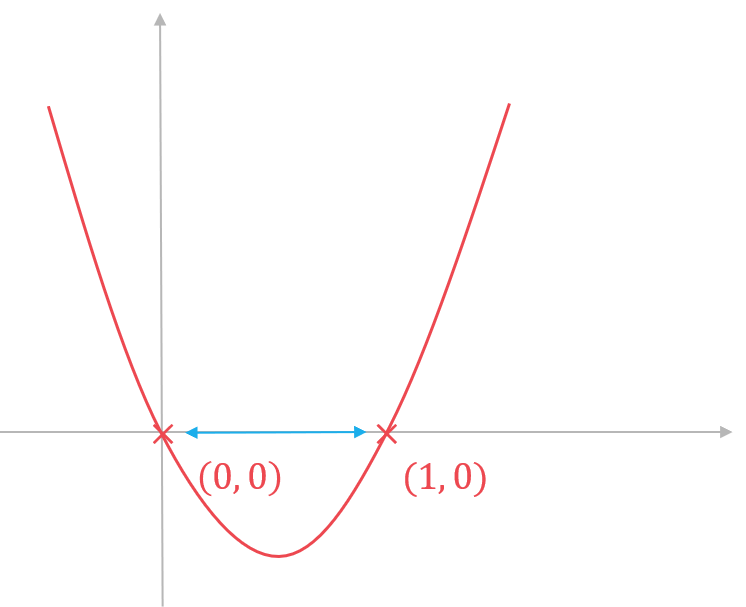
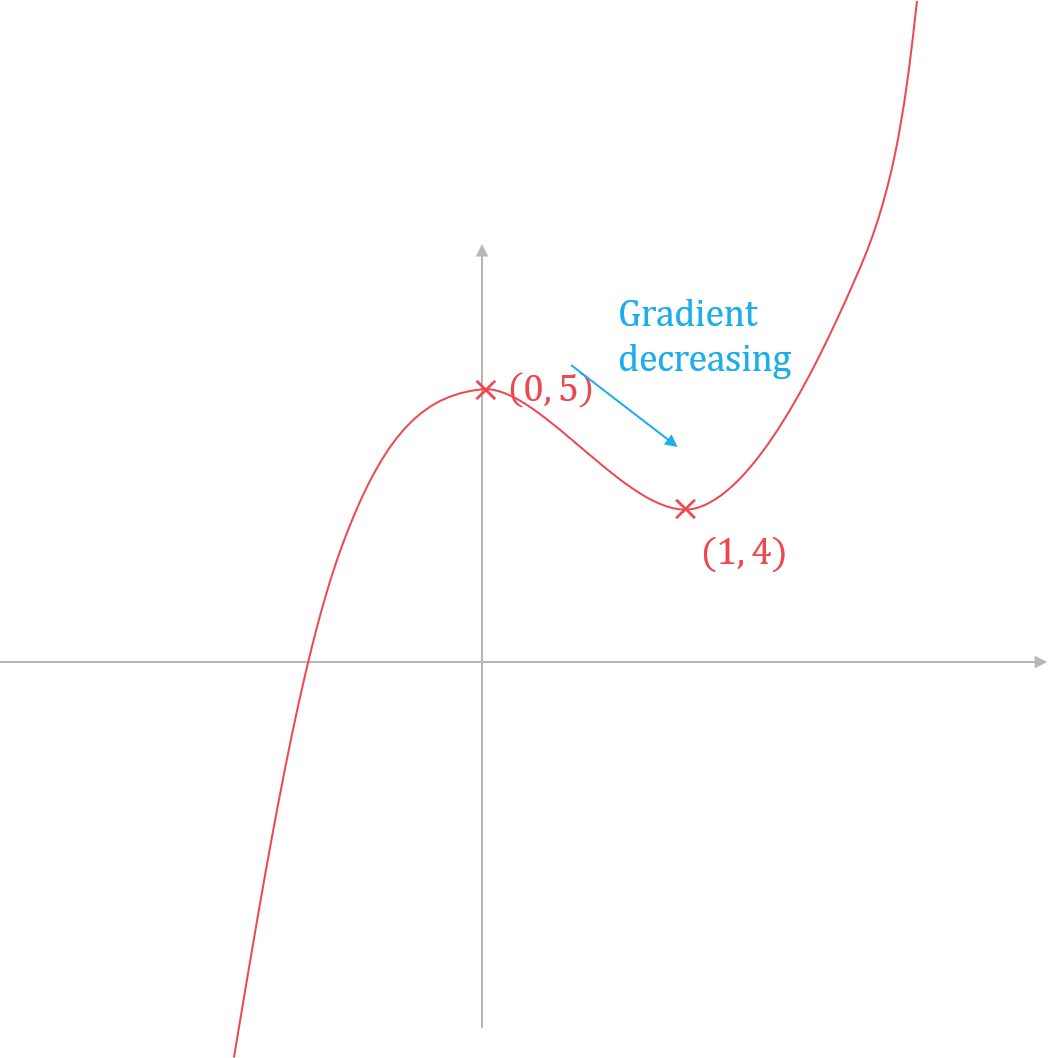
You can check your answers by considering a sketch of the original function, it should be decreasing at the point where
Tangents & normals
What is a tangent?
At any point on the graph of a (non-linear) function, the tangent is the straight line that touches the graph at a point without crossing through it
Its gradient is given by the derivative function
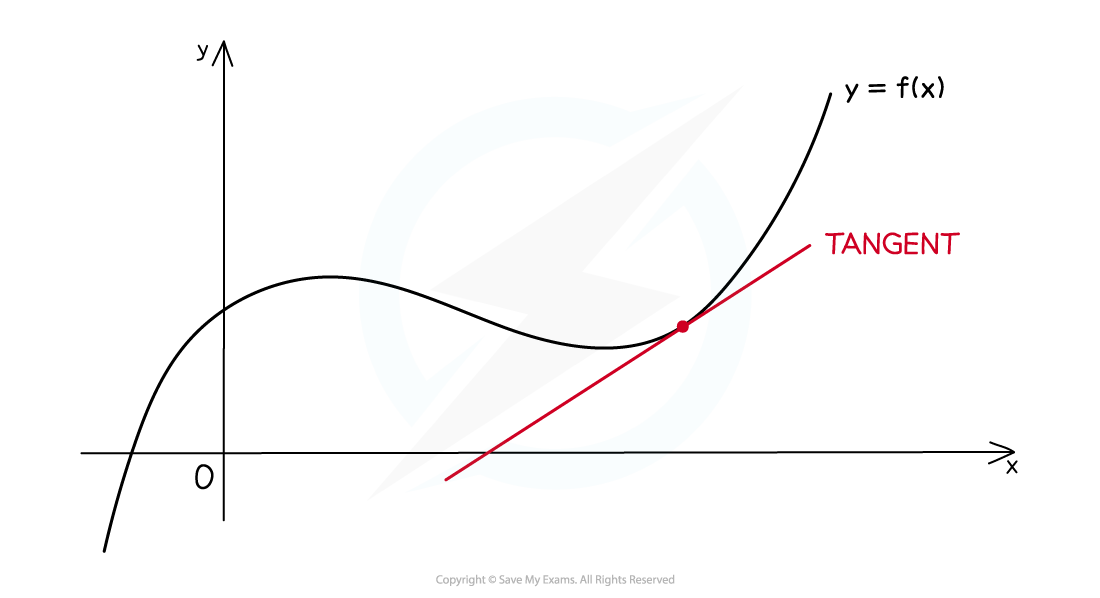
How do I find the equation of a tangent?
To find the equation of a straight line, a point and the gradient are needed
The gradient, , of the tangent to the function at is
You can find this by differentiating the function, and then substituting the -coordinate of the point into the derivative
Therefore find the equation of the tangent to the function at the point by substituting the gradient, , and point into , giving:
(You could also substitute into )
What is a normal?
At any point on the graph of a (non-linear) function, the normal is the straight line that passes through that point and is perpendicular to the tangent
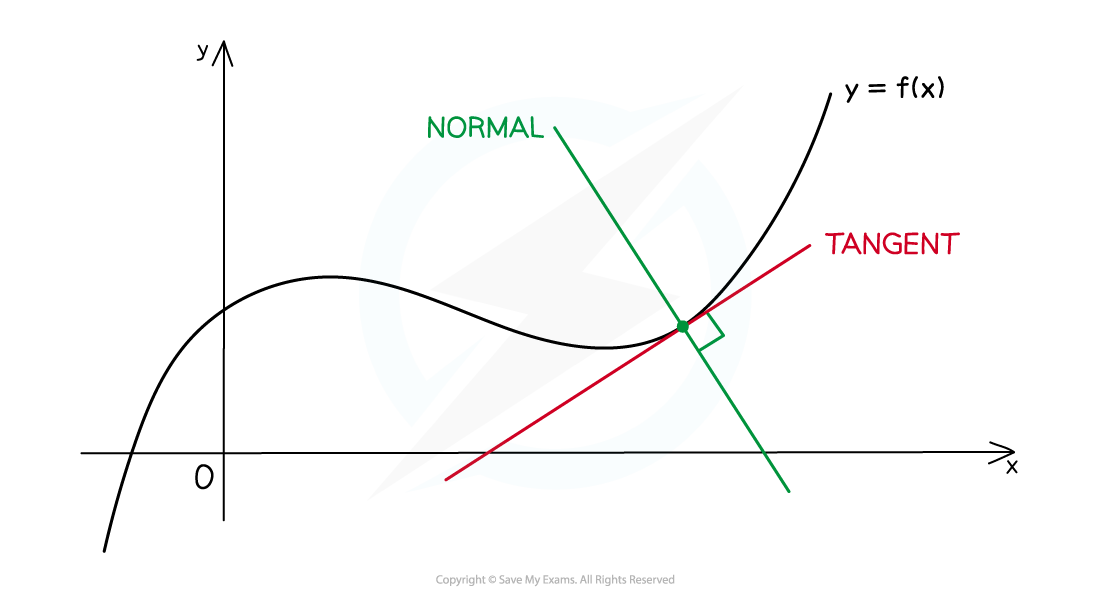
How do I find the equation of a normal?
The gradients of two perpendicular lines are negative reciprocals
This means that if is the gradient of the first line and is the gradient of a line perpendicular to the first line, then
Rearranging the formula above, is a useful way to test whether two lines are perpendicular
Therefore gradient of the normal to the function at is
Find the equation of the normal to the function at the point by using
(or )
Examiner Tips and Tricks
To be successful in this topic, first make sure you are confident with finding the equation of a straight line!
Worked Example
The function is defined by
a) Find an equation for the tangent to the curve at the point where , giving your answer in the form .
First find the derivative by differentiating
Start by rewriting as powers of x
Now differentiate
Now substitute into to find the gradient of the tangent
We also need the y-coordinate, so substitute into also
Now we can substitute the point (1, 5) and the gradient, 2, into
Note that we are asked for the final answer in the form , so rearrange to this form
b) Find an equation for the normal at the point where , giving your answer in the form , where , and are integers.
We already have the gradient of the tangent; the gradient of the normal is where is the gradient of the tangent
gradient of normal =
Substitute the point (1, 5) from part (a) and the gradient of the normal into
And rearrange into the form required
Note that , and must be integers so multiply by 2 to clear the fractions

Unlock more, it's free!
Join the 100,000+ Students that ❤️ Save My Exams
the (exam) results speak for themselves:

Was this revision note helpful?
Build on this topic
