Composite Functions (Cambridge (CIE) IGCSE Additional Maths): Revision Note
Exam code: 0606

Composite functions
What is a composite function?
A composite function is where one function is applied after another function

The ‘output’ of one function will be the ‘input’ of the next one
Sometimes called function-of-a-function
A composite function can be denoted
All of these mean “ of ”

How do I work with composite functions?

Recognise the notation
means “f of g of x”
The order matters
First apply to to get
Then apply to to get
Always start with the function closest to the variable
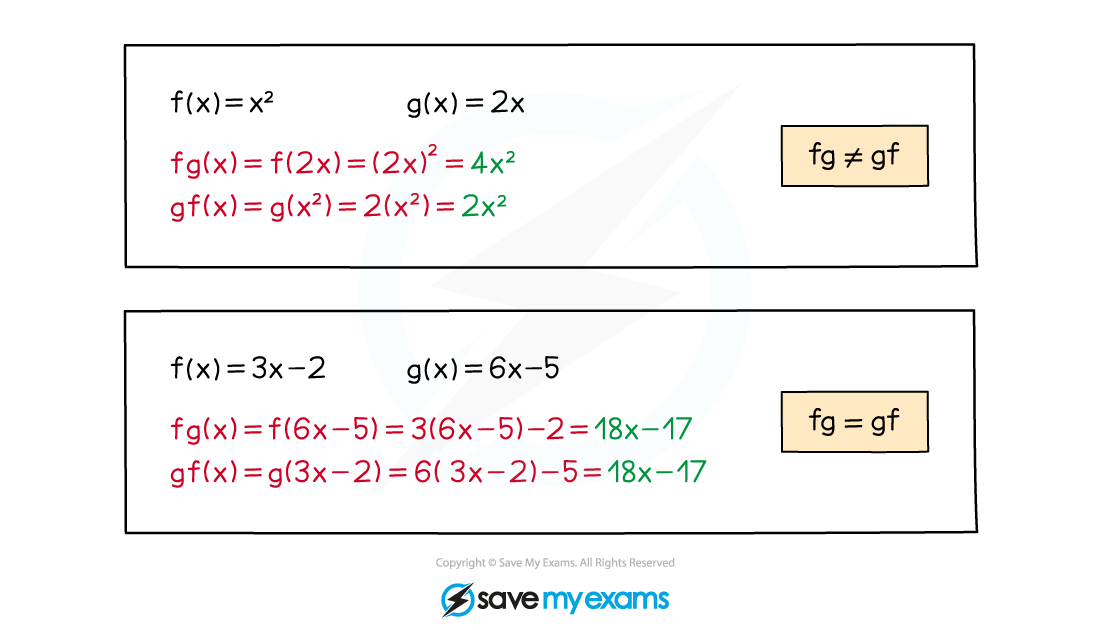
is not usually equal to
Special cases
and are generally different but can sometimes be the same
is written as
Note that trig functions are exceptions to this rule
e.g. means not
For inverse functions,
Worked Example
Two functions, and are
a) Find and .
b) Find, in terms of , .
is the first function to be applied ...
Domain & range of composite functions
How do I find the domain and range of composite functions?
Use logic to determine the domain and range of a composite function
For the first function to be applied will be
So, at best, the domain of will be the same as the domain of
However, for this to be the case, the range of must be contained within the domain of
If this is not the case, then restrictions on the domain of will be required
Similarly, at best, the range of will be the same as the range of
But if the domain of has been affected, the range of will also be affected
Examiner Tips and Tricks
Domain and range are important in composite funcitons like
the ‘output’ (range) of g must be in the domain of f(x), so could exist, but may not (or not for some values of )
Worked Example
Two functions, and are defined as follows
a) Write down the range of and the range of .
As the domain of is , will always be greater than 1,
The range of is
The square of any value will be positive or zero, but here, is not included in the domain for .
The range of is
b) Use your answers to (a) to help explain why does not exist.
is the first function to be applied The range of would need to be contained within the domain of But the range of is which is outside the domain of which is does not exist
c) Find the range of ,
is the first function. The range of is . This is the same as the domain of .
The range of is

Unlock more, it's free!
Join the 100,000+ Students that ❤️ Save My Exams
the (exam) results speak for themselves:

Was this revision note helpful?
Build on this topic
