Discriminants (Cambridge (CIE) IGCSE Additional Maths): Revision Note
Exam code: 0606

Discriminants
What is a discriminant?
The discriminant is the part of the quadratic formula that is under the square root sign
It is
The quadratic formula, in full, is
where the quadratic equation is written in the form
It is sometimes denoted by the Greek letter (capital delta)
Worked Example
Find, in terms of the constant , the discriminant of the quadratic equation .
First write the quadratic equation in the form .
It can be easier/clearer to pick out and first, before finding the discriminant.
The discriminant is .
Applications of discriminant
How does the value of the discriminant affect roots?
There are three options for the outcome of the discriminant:
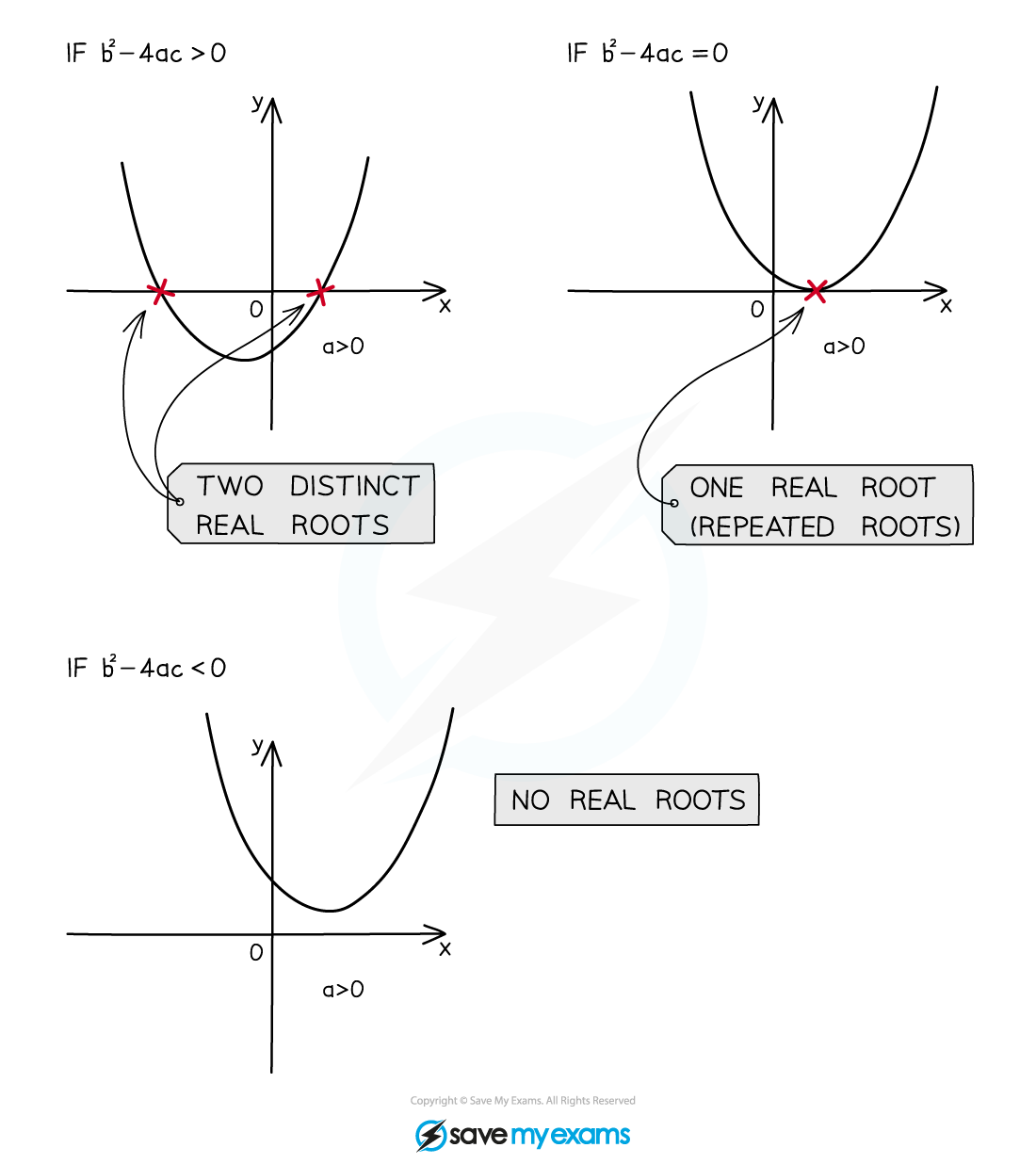
If the square root part of the quadratic formula can be calculated leading to two solutions (values of )
i.e. two different real roots
If the square root part of the quadratic formula will be zero leading to one solution
i.e. one repeated root or two equal roots
If the square root part of the quadratic formula cannot be calculated leading to no solutions
i.e. no (real) roots
How do I sketch quadratic graphs using the discriminant?
If the quadratic equation has two different real roots
The graph of the quadratic will intersect the -axis twice (at the roots)
If the quadratic equation has two equal roots (one root)
The graph of the quadratic will intersect (touch) the -axis once (at the root)
If the quadratic equation has no (real) roots
The graph of the quadratic will not intercept the -axis
How do I use the discriminant to find the number of intersections between a line and a curve?
For the graphs of two functions, and where
is quadratic
is linear
the number of intersections between the graphs can be found using the discriminant.
STEP 1
Set
STEP 2
Rearrange into the form such that is in the quadratic form
STEP 3
Find the discriminant and thus determine the number of intersections between the graphs of and
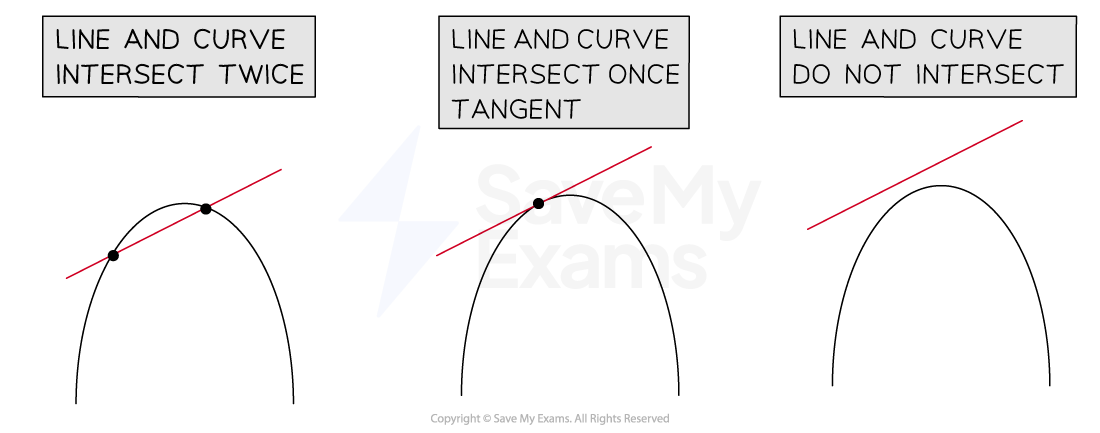
if (two real roots) the graphs intersect twice
if (equal roots) the graphs intersect once
this means the line () is a tangent to the curve ()
if (no real roots) the graphs do not intersect
Worked Example
Show that the line with equation is tangent to the curve with equation .
STEP 1 - set the equations of the line and curve equal to each other.
STEP 2 - rearrange to quadratic form.
STEP 3 - find the discriminant and interpret its value.
Since the discriminant is zero, the line and the curve intersect at one point only. Therefore the line is a tangent to the curve.

Unlock more, it's free!
Join the 100,000+ Students that ❤️ Save My Exams
the (exam) results speak for themselves:

Was this revision note helpful?
Build on this topic
