Integrating Powers of x (Cambridge (CIE) IGCSE Additional Maths): Revision Note
Exam code: 0606

Integrating powers of x
How do I integrate powers of x?
Powers of are integrated according to the following formulae:
If then where and is the constant of integration
For each term …
… increase the power (of x) by 1
… divide by the new power
This does not apply when the original power is -1
the new power would be 0 and division by 0 is undefined

If the power of is multiplied by a constant then the integral is also multiplied by that constant
If then where and is a constant and is the constant of integration
Remember the special case:
e.g.
This allows constant terms to be integrated
How do I integrate expressions containing powers of x?
The formulae for integrating powers of apply to all rational numbers so it is possible to integrate any expression that is a sum or difference of powers of
e.g. If then
Functions involving roots will need to be rewritten as fractional powers of first
eg. If then rewrite as and integrate
Functions involving fractions with denominators in terms of will need to be rewritten as negative powers of first
e.g. If then rewrite as and integrate
Products and quotients cannot be integrated this way so would need expanding/simplifying first
e.g. If then
Examiner Tips and Tricks
You can speed up the process of integration in the exam by committing the pattern of basic integration to memory
In general you can think of it as 'raising the power by one and dividing by the new power'
Practice this lots before your exam so that it comes quickly and naturally when doing more complicated integration questions
Worked Example
Given that
find an expression for in terms of.
Rewrite all terms as powers of x using the laws of indices for fractional and negative powers on the last term.
Find y by integrating each term.
Rewrite using the same format given in the question.
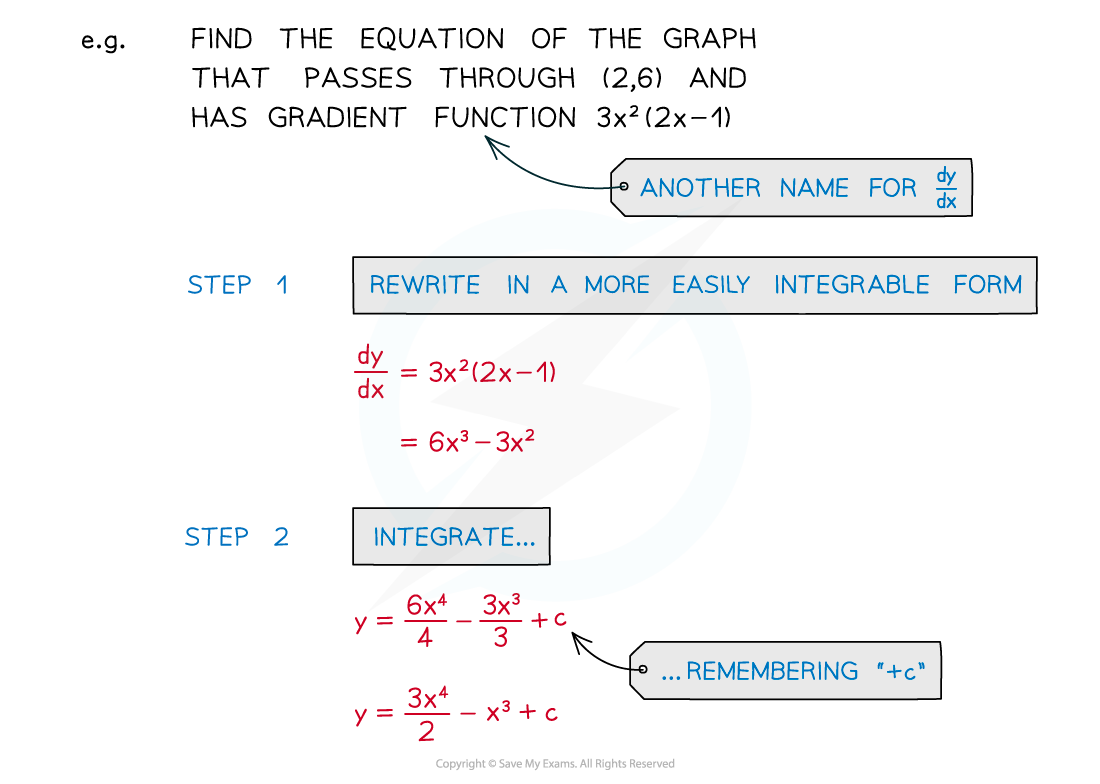
Finding the constant of integration
How do I find the constant of integration?
STEP 1
Rewrite the function into a more easily integrable form
Each term needs to be a power of x (or a constant)
STEP 2
Integrate each term and remember “+c”
Increase power by 1 and divide by new power
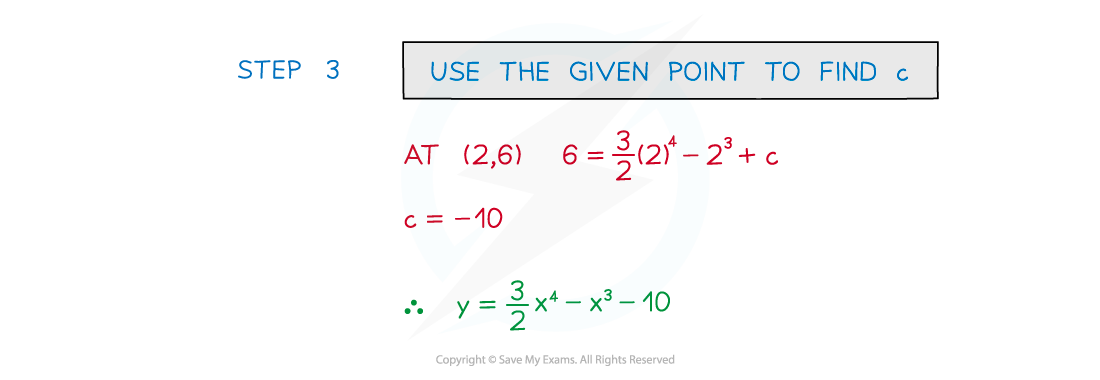
STEP 3
Substitute the coordinates of a given point in to form an equation in c
Solve the equation to find c
Examiner Tips and Tricks
If a constant of integration can be found then the question will need to give you some extra information
If this is given then make sure you use it to find the value of c
Worked Example
Given and , find .
Rewrite in a form the can be integrated more easily.
Integrate each term, remember to include a constant of integration.
Simplify.
Use f(1) =25 to find the value of c.

Unlock more, it's free!
Join the 100,000+ Students that ❤️ Save My Exams
the (exam) results speak for themselves:

Was this revision note helpful?
Build on this topic
