Logarithmic Functions (Cambridge (CIE) IGCSE Additional Maths): Revision Note
Exam code: 0606

Logarithmic functions
What are logarithmic functions?
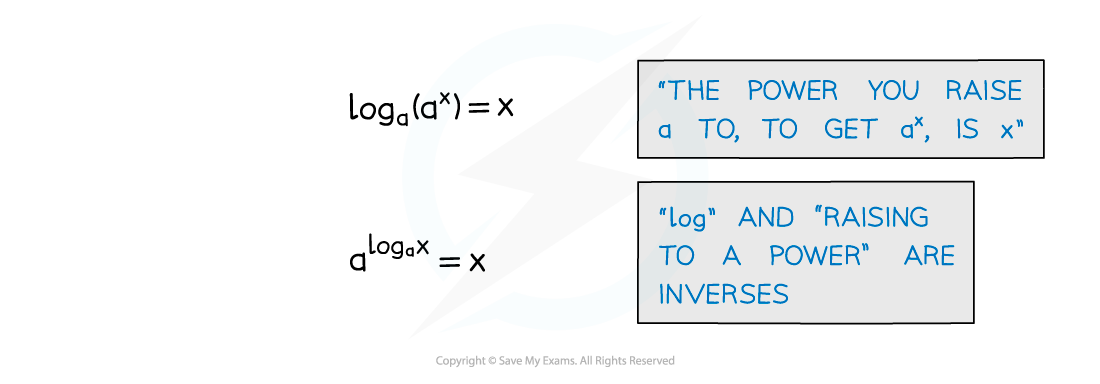
A logarithm is the inverse of raising to a power
If then
is called the base of the logarithm
Try to get used to ‘reading’ logarithm statements to yourself
would be read as “the power that you raise ... to, to get ..., is ”
So would be read as “the power that you raise 5 to, to get 125, is 3”
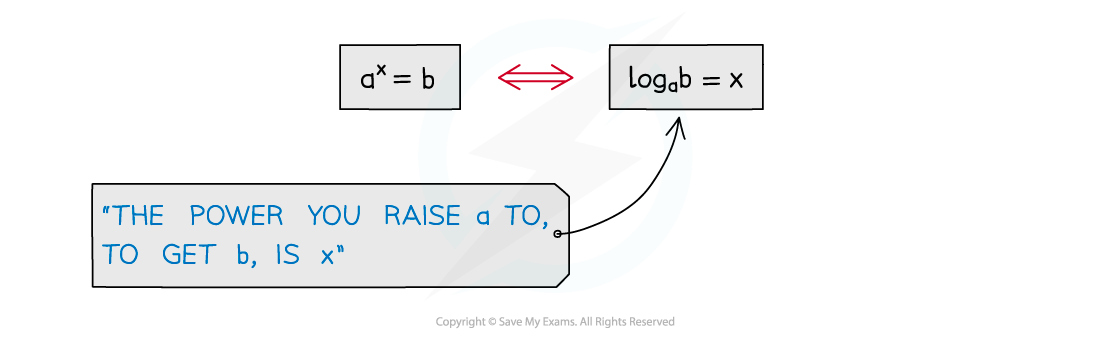
A logarithm is the inverse of raising to a power so we can use rules to simplify logarithmic functions
Why use logarithms?
Logarithms allow us to solve equations where the exponent is the unknown value
We can solve some of these by inspection
For example, for the equation 2x = 8 we know that x must be 3
Logarithms allow use to solve more complicated problems
For example, the equation 2x = 10 does not have a clear answer
Instead, we can use our calculator to find the value of
How do I use logarithms?
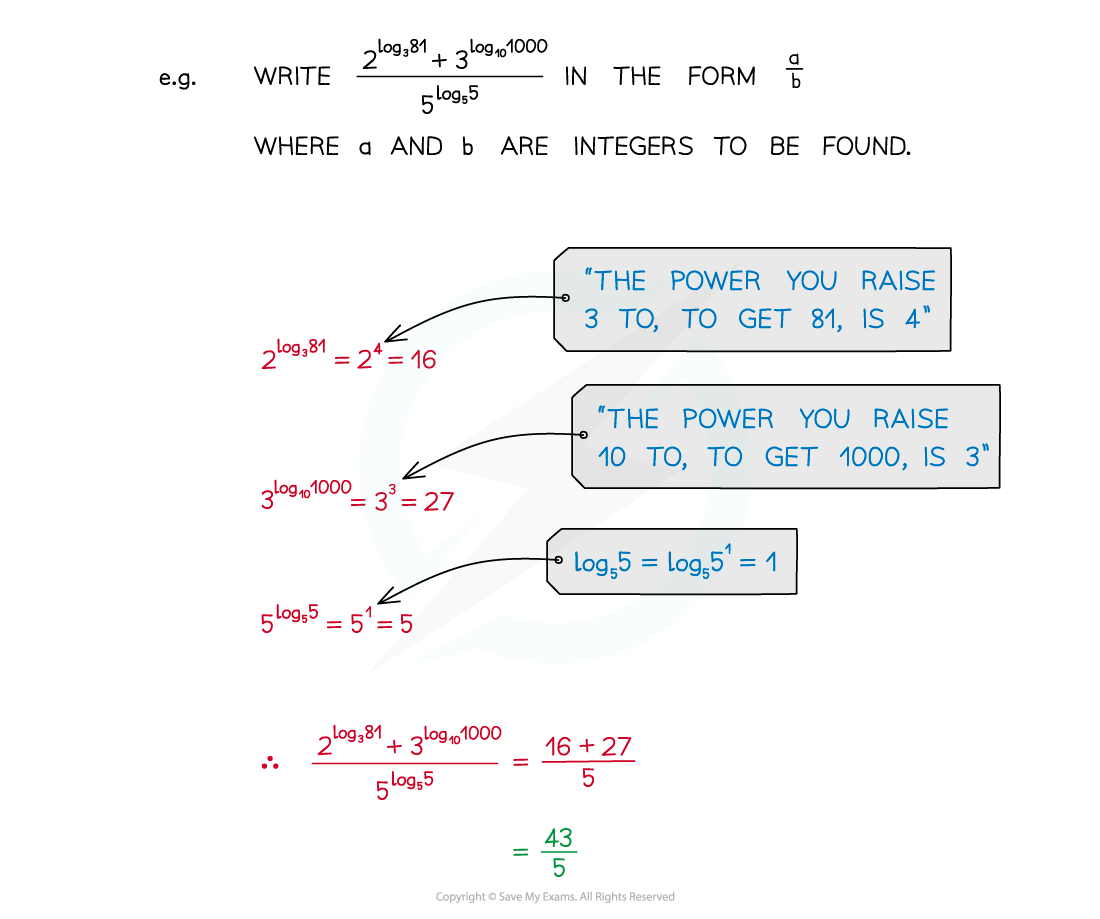
Recognising the rules of logarithms allows expressions to be simplified
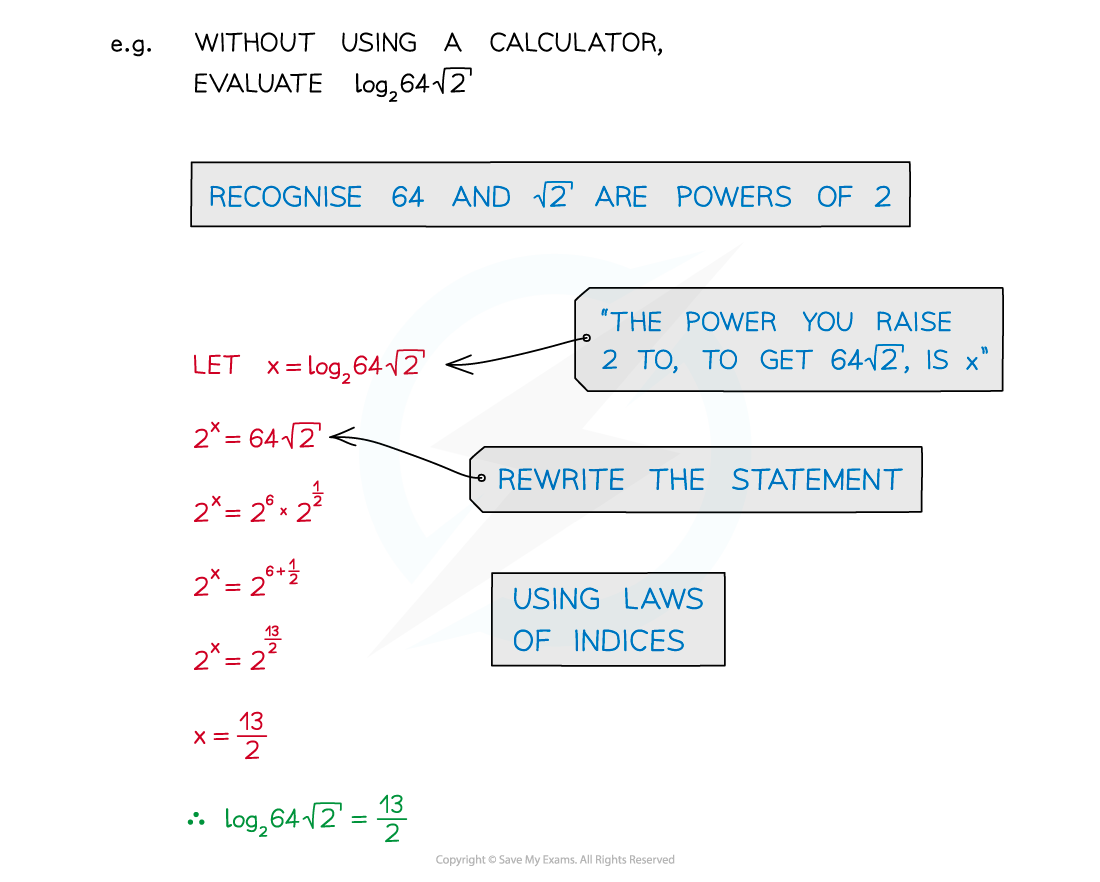
Recognition of common powers helps in simple cases
Powers of 2: 20 = 1, 21 = 2, 22 = 4, 23 = 8, 24 =16, …
Powers of 3: 30 = 1, 31 = 3, 32 = 9, 33 = 27, 34 = 81, …
The first few powers of 4, 5 and 10 should also be familiar
For more awkward cases a calculator is needed

Calculators can have, possibly, three different logarithm buttons

This button allows you to type in any number for the base

Natural logarithms (see “e”)

Shortcut for base 10 although SHIFT button needed
Before calculators, logarithmic values had to be looked up in printed tables
What notation might I see with logarithms?
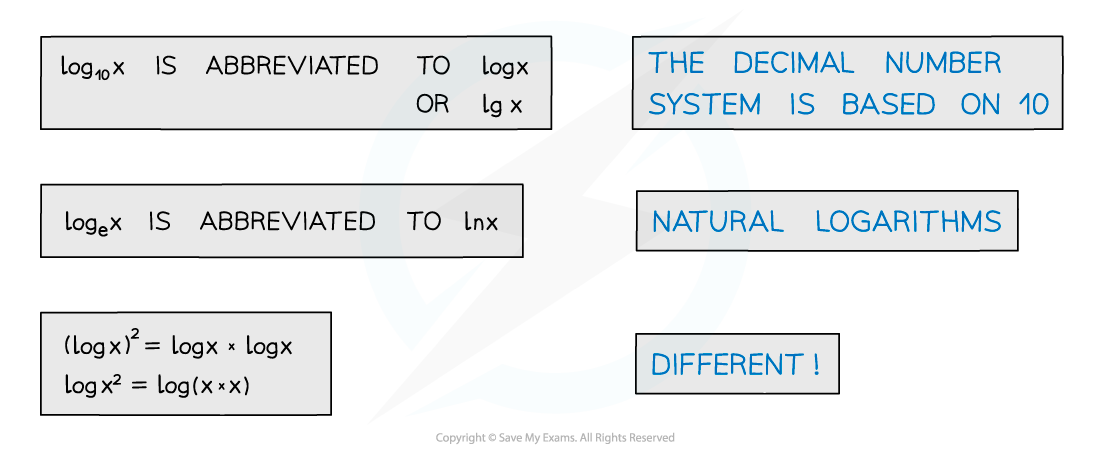
10 is a common base
log10 x is abbreviated to log x or lg x
The value e is another common base
loge x is abbreviated to ln x
(log x)2 ≠ log x2
Examiner Tips and Tricks
Before going into the exam, make sure you are completely familiar with your calculator and know how to use its logarithm functions
ln x
What is ln?
ln is a function that stands for natural logarithm
It is a logarithm where the base is the constant "e"
It is important to remember that ln is a function and not a number
The natural logarithm () and the exponential function () are inverses of each other
It is defined for all positive numbers ()
cannot be defined for negative numbers or
What are the properties of ln?
Using the definition of a logarithm you can see
is only defined for positive x
How can I solve equations involving e & ln?
The functions and are inverses of each other
If then
If then
If then
If then
If your equation involves "e" then try to get all the "e" terms on one side
If "e" terms are multiplied, you can add the powers
You can then apply ln to both sides of the equation
If "e" terms are added, try transforming the equation with a substitution
For example: If then
You can then solve the resulting equation (usually a quadratic)
Once you solve for y then solve for x using the substitution formula
If your equation involves "ln", try to combine all "ln" terms together
Use the laws of logarithms to combine terms into a single term
If you have then solve
If you have then solve
Examiner Tips and Tricks
If you're working on the non-calculator exam paper you may need to leave answers as exact values so using lnx is a good idea
This can be solved with ex which can then be left as an exact value
Worked Example
Solve the equation , leaving your answer as an exact value.
Take the natural logarithm of both sides.
Use the property that .
Divide both sides by 2.
Do not use your calculator to evaluate this as the question asks for the answer given as an exact value.

Unlock more, it's free!
Join the 100,000+ Students that ❤️ Save My Exams
the (exam) results speak for themselves:

Was this revision note helpful?
Build on this topic